Expressionism
Evening (Emil Nolde)
Emil Nolde (1867–1956) maakte Evening. Het behoort tot de Expressionism-stroming.

 Voorvertoning

 Met de hand geschilderd olieverfwerk
 Verstuur
 Delen
 Informatieblad


 Download
 Vergelijkbare items
 Röntgenonderzoek
 Diavoorstelling
 Vraag & antwoord

 Statistieken
Evening, in het kort
- Titel
- Evening
- Kunstenaar
- Emil Nolde (1867–1956)
- Geboren in [jaar]
- Nolde, Denemarken
- Beweging
- Expressionism
- Onderwerp
- landscape painting, cloudscape artwork, water reflection, dreamlike scene, abstract nature, evening glow”
Wat stelt Evening voor?
A Symphony of Color: Experiencing Emil Nolde’s “Evening”
Emil Nolde's "Evening" is a captivating exploration of light and atmosphere, characteristic of his expressive landscape work. This piece doesn’t depict a literal evening scene, but rather an *emotional* response to one – a distillation of the feeling of twilight rendered in bold color and simplified forms. A dominant, luminous yellow cloud commands attention in the upper left quadrant, acting as a focal point that draws the eye down into the composition. Below, a gradient of blues transitions from deep indigo to lighter turquoise and verdant greens along the horizon line, suggesting water reflecting the celestial drama above.
Expressionism & The Power of Color
- Stylistic Roots: Nolde was a key figure in early 20th-century Expressionism, a movement that prioritized subjective experience and emotional impact over realistic representation. “Evening” exemplifies this approach through its non-naturalistic color palette and abstracted forms.
- Technique & Materials: The artwork appears to be executed in watercolor or gouache, evidenced by the fluidity of the washes and blending of colors. Nolde masterfully employs these techniques to create a sense of atmospheric depth despite the flattened perspective. Visible brushstrokes add texture and energy.
- Influences: While forging his own path, Nolde was influenced by artists like Vincent van Gogh and Paul Gauguin, particularly their use of intense color to convey emotion. He also drew inspiration from traditional folk art and primitive masks, evident in the bold outlines and simplified shapes.
Symbolism & Emotional Resonance
The symbolism within “Evening” is subtle yet potent. The large yellow cloud can be interpreted as a source of radiant energy or enlightenment – a beacon amidst the darkening sky. The winding body of water, reflecting the colors above, suggests a connection between the earthly and celestial realms. More broadly, Nolde’s landscapes often represent an attempt to connect with nature on a spiritual level.
The overall emotional impact is one of tranquility mixed with a hint of mystery. The stylized representation invites contemplation and allows viewers to project their own feelings onto the scene. Nolde's work frequently evokes a sense of longing or melancholy, reflecting his own complex relationship with the world around him.
Nolde’s Life & Legacy
Born in 1867 in Nordel, Germany, Emil Nolde dedicated himself to art after years working as a wood carver. Despite facing opposition from his family and later persecution under the Nazi regime (his work was deemed “degenerate”), he remained committed to his artistic vision. Nolde’s landscapes, seascapes, and portraits are celebrated for their raw emotional power and innovative use of color. His ability to capture the essence of a place or feeling – rather than simply its appearance – continues to resonate with audiences today.
Hoogwaardige afbeeldingen van Evening
Publiek domein: de kunstenaar is overleden in 1956.
Emil Nolde, Evening. Publiek domein
De kleuren zijn door een digitale expert afgestemd op het origineel en het bestand is zorgvuldig geretoucheerd, trouw aan de penseelstreken van de kunstenaar.
Koop het bestand in hoge resolutieVragen over Evening, beantwoord
Wat stelt "Evening" voor?
De onderwerpen van "Evening" zijn landscape painting, cloudscape artwork, water reflection, dreamlike scene, abstract nature, evening glow”, “stylized landscape”.
Is "Evening" vrij van auteursrecht?
Wat betreft het auteursrecht valt "Evening" onder bevindt zich in het publiek domein - de auteursrechten zijn verlopen.
Wie is de kunstenaar achter "Evening"?
De kunstenaar achter "Evening" is Emil Nolde. Het werk is gecatalogiseerd onder de naam van Emil Nolde.
Bij welke kunststroming behoort "Evening" door Emil Nolde?
"Evening" is een werk uit de Expressionism. De stroming geeft de artistieke traditie aan waartoe het werk behoort.
In welke periode van de carrière van Emil Nolde valt "Evening"?
"Evening" behoort tot de Mature Period in de carrière van Emil Nolde. Deze classificatie plaatst het werk in de context van de ontwikkeling van de kunstenaar.
Wat is de reden voor de auteursrechtelijke status van "Evening" door Emil Nolde?
"Evening" door Emil Nolde is bevindt zich in het publiek domein - de auteursrechten zijn verlopen. De auteursrechtelijke bescherming loopt vanaf het overlijden van de kunstenaar, dat plaatsvond in 1956.
Hoe verhoudt "Evening" zich tot het oeuvre van Emil Nolde?
"Evening" deelt met andere werken van Emil Nolde de Expressionism-stijl en de terugkerende thema's: german romanticism influence, nature's ethereal beauty", "symbolic, spiritual themes", expressionist color theory, reflects coastal landscapes, nolde's personal visions.
Is "Evening" typerend voor het werk van Emil Nolde?
De terugkerende thema's van Emil Nolde omvatten german romanticism influence, nature's ethereal beauty", "symbolic, spiritual themes", expressionist color theory, reflects coastal landscapes, nolde's personal visions; "Evening" richt zich op landscape painting, cloudscape artwork, water reflection, dreamlike scene, abstract nature, evening glow”, “stylized landscape”.
Over de kunstenaar, Emil Nolde
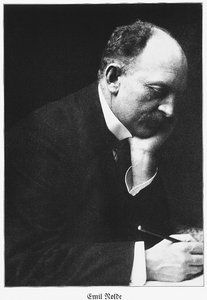
1867–1956, Denemarken
Emil Nolde
Het Leven en de Identiteit van Emil Nolde Geboren als Hans Emil Hansen op 7 augustus 1867, groeide de man die later de wereld zou veroveren als Emil Nolde op in de nabijheid van het dorpje Nolde in het hertogdom Sleeswijk. Zijn vroege jaren werden gevormd door het rurale, agrarische leven van zijn familie, een wereld van hard werken en traditie. Uiteindelijk koos hij voor een ander pad en wendde hij zich tot het vakmanschap als houtsnijder en meubeldecorateur. Dit tactiele, fysieke werk vormde de basis voor zijn latere verschuiving naar de schilderkunst en de grafiek.
Ook van Emil Nolde
 Sunset
 Sea with Red Sky
 Couple on the beach1903
 Masks1911
Essays over Evening
 Masterpieces of Emotion: The Top 25 Vincent van Gogh ArtworksImmerse yourself in the vibrant world of Vincent van Gogh. Explore 25 iconic Post-Impressionist masterpieces, from Starry Night to Sunflowe…
 Chasing Shadows: The Enchanting Beauty of Dim Light in Impressionist MasterpiecesDiscover the ethereal magic of Impressionist nightscapes. Explore how masters like Monet and Whistler captured the alchemy of moonlight, sh…
 Unveiling Inner Worlds: Exploring Psychological Depth in 20th & 21st Century ArtExplore the profound psychological themes within 20th & 21st-century art. Discover Expressionism, Surrealism & more – and learn how to coll…