

 Voorvertoning
 Verstuur
 Delen
Delen
 Details bekijken
 Gids
Gids

 Download
 Vergelijkbare items
 Röntgenonderzoek
 Diavoorstelling
 Statistieken
Constanze Mozart


 Lees meer
Handgemaakte olieverfreproductie
Met de hand geschilderd in olieverf op canvas in uw gewenste maat en lijst, op bestelling gemaakt door onze kunstenaars. ( Schakel over naar print Schakel over naar digitale afbeeldingen)




P118B €10

P118H €10

P118W €10

P438Z €10

P508JH €12

P508YH €12

P805H €10

P805Z €10

P919BZ €10

P919G €10

P919XJ €10

P959ZH €10

P968JZ €12

W106C €8

W218G €10

W218JH €8

W218Y €10

W307PJ €10

W316G €10

W316PJ €8

W316Y €10

W398PJ €8

W4111J €10

W500HY €15

W500JH €15

W692G €12

W849H €8

W940BG €15

W953PJ €8




Kies uit onze vooraf ingestelde maten die overeenkomen met de originele verhoudingen van het kunstwerk.

Voer de breedte en hoogte in die u nodig heeft, passend bij uw lijst of uw muur. Omdat dit handgeschilderd is, kan de kunstenaar bij een afmeting met een andere beeldverhouding iets meer rondom het schilderij schilderen of juist iets meer weglaten — u kiest zelf. Wij sturen u een digitaal mockup ter goedkeuring voordat het schilderwerk begint. De afbeelding die op deze pagina wordt getoond, is niet het uiteindelijke resultaat — alleen de mockup geeft dit weer.
Na de bestelling zal het team van OriginalUniqueArt.com per e-mail contact opnemen met de klant voor instructies en een mockup-voorbeeld sturen.
Wereldwijde levering () binnen 3 tot 4 weken in plaats van de standaard 5 weken. (25 oktober). Zonder concessies aan de kwaliteit.

Gratis wereldwijde expressverzending

Hoogwaardig linnen canvas

Volledige verzendverzekering

Garantie op terugbetaling van invoerrechten

Garantie op exacte kleurweergave

Retourbeleid van 100 dagen (alleen bij defecten)

100% Geld-terug-garantie

Korting bij meerdere afnames
 De optie voor glas is alleen beschikbaar bij een formaat kleiner dan 110 cm.

Constanze Mozart
Druktechniek
Afmetingen reproductie
-


Eindtotaal
€ 263
The Enigmatic Figure: An Exploration of Emil Nolde’s “Constanze Mozart”
Emil Nolde's "Constanze Mozart," painted in 1902, isn’t merely a portrait; it’s a carefully constructed distillation of memory, emotion, and the lingering echoes of a bygone era. Nolde, a pivotal figure within the Die Brücke movement, eschewed photographic realism in favor of an intensely subjective approach to representation – a strategy that profoundly shaped his distinctive visual language. This particular work, housed within the Mozart-Museums of Salzburg, immediately draws the viewer into a world steeped in quiet contemplation and a subtle undercurrent of sadness. The subject herself, Constanze Mozart, is rendered with a remarkable degree of intimacy, her gaze direct yet veiled, suggesting both vulnerability and an inner strength.
Nolde’s technique here is immediately arresting. He employs a bold, almost aggressively applied palette dominated by deep blues and browns – colors that evoke the twilight hours, the shadows of memory, and perhaps even the melancholy associated with Mozart's own life. The brushstrokes are thick and impastoed, creating a tactile surface that invites close inspection. Notice how he utilizes broken color—small, distinct patches of hue rather than smooth transitions—to build up form and texture. This technique isn’t about replicating reality; it’s about conveying feeling – the weight of experience, the fragility of beauty, and the enduring power of a single, poignant image.
Echoes of Salzburg: Historical Context and Artistic Influences
To fully appreciate “Constanze Mozart,” one must consider the artistic climate in which it was created. Nolde’s early career was deeply influenced by the radical Expressionist group Die Brücke, a collective dedicated to rejecting academic conventions and exploring the raw emotions of modern life. This movement sought to capture not just what *was* seen, but what *felt* – a philosophy perfectly embodied in Nolde's work. His use of intense color and distorted forms can be traced back to his encounters with artists like Vincent van Gogh and Paul Gauguin, both of whom championed the expressive potential of color as a vehicle for conveying emotion. Furthermore, Nolde’s fascination with primitive art – particularly masks and carvings from various cultures – is evident in the painting's simplified forms and symbolic weight.
The portrait itself is rooted in a specific historical context: Salzburg during the late 19th century, a city inextricably linked to the legacy of Mozart. Constanze’s presence within this setting adds another layer of complexity to the work. She represents not only a real woman but also an idealized image of feminine grace and resilience – qualities that resonated deeply with Nolde's artistic sensibilities.
Symbolism and Emotional Resonance: A Portrait Beyond Representation
Beyond its formal elements, “Constanze Mozart” is rich in symbolic meaning. The book she holds isn’t simply a prop; it represents knowledge, contemplation, and perhaps even a yearning for understanding. Her direct gaze invites the viewer to engage with her inner world – to share in her thoughts and emotions. The muted lighting and somber color palette contribute to a sense of melancholy, suggesting that this portrait is not merely a likeness but an exploration of memory and loss. It’s a quiet meditation on beauty, fragility, and the enduring power of the past.
Nolde masterfully avoids sentimentality, instead offering a nuanced portrayal of a woman caught between worlds – between the idealized image of Mozart's wife and the complexities of her own life. “Constanze Mozart” is a testament to Nolde’s ability to transform a simple portrait into a profound statement about human experience, leaving the viewer with a lingering sense of both beauty and sadness.
Veelgestelde vragen
Hoe kan ik een digitale afbeelding van "Constanze Mozart" door Emil Nolde verkrijgen?
Om een digitale afbeelding van "Constanze Mozart" door Emil Nolde te verkrijgen, kunt u een digitale afbeelding in hoge resolutie om te downloaden bestellen op de Digitale afbeelding pagina.
In welke periode van de carrière van Emil Nolde valt "Constanze Mozart"?
Binnen de carrière van Emil Nolde valt "Constanze Mozart" in de Late Period. Deze fase helpt om het werk te vergelijken met andere werken van de kunstenaar.
Is er een factsheet over "Constanze Mozart" door Emil Nolde voor studenten?
Er is een Informatieblad pagina beschikbaar voor "Constanze Mozart" door Emil Nolde: een printbaar informatieblad over het kunstwerk, ontworpen voor studenten en gebruik in de klas.
Biografie kunstenaar
Early Life and Artistic Beginnings
Emil Nolde, een bekende Duitse en Deense schilder, werd geboren als Hans Emil Hansen op 7 augustus 1867 in Nolde, Schleswig-Holstein, Duitsland. Hij kwam uit een familie met sterke banden met het platteland en religieuze overtuigingen – factoren die zijn artistieke visie diepgaand zouden beïnvloeden. Ondanks de weerstand van zijn ouders, die hem graag een meer conventionele carrière wilden zien, achtervolgde Nolde onverzettelijk zijn passie voor kunst. In eerste instantie werkte hij als houtbewerker en meubelmaker voordat hij zich in de late twintiger jaren volledig aan het schilderen wijdde. Zijn jeugdige fascinatie voor kleur en vorm werd al vroeg aangewakkerd door de landelijke omgeving en de religieuze tradities van zijn familie, wat later terug zou komen in zijn werk.Artistic Development and Influences
Nolde’s artistieke reis was gekenmerkt door zelfstudie en verkenning. Hij reisde veelvuldig, waarbij hij zich liet inspireren door verschillende culturen en kunstvormen. Vroege invloeden omvatten Vincent van Gogh, Paul Gauguin en traditioneel volkskunst – met name de expressieve kracht van primitieve maskers en houtsnijwerken. Deze ontmoetingen wekten zijn interesse in felle kleuren, gestileerde vormen en emotioneel geladen thema’s op. In eerste instantie experimenteerde hij met Realisme en Impressionisme, maar verplaatste zich snel naar een meer subjectieve en expressieve stijl. Hij was gefascineerd door de werken van primitieve kunstenaars, die hij zag als een bron van onvervalste emotie en kleur. Deze invloeden zouden cruciaal zijn voor het ontwikkelen van zijn unieke visuele taal.Die Brücke and Expressionist Breakthrough
In 1905 richtte Nolde samen met andere kunstenaars de groep Die Brücke (De Brug) op, een cruciale verzamelingsplaats van Duitse expressionisten. Deze collectieve beweging streefde ernaar om zich los te maken van academische tradities en innerlijke emoties uit te drukken door radicaal artistiek experimenteren. Nolde’s bijdrage aan Die Brücke was significant; zijn intense gebruik van kleur en vervormde vormen dwong de grenzen van representatie opnieuw af. Tegelijkertijd behield hij een enigszins onafhankelijke positie binnen de groep, waarbij hij vaak afweek in onderwerpkeuze en stijlaanpak. De expressieve aard van Die Brücke was voor Nolde een manier om zijn innerlijke wereld te uiten, maar ook een uitdaging om zich te onderscheiden van de andere leden.Key Themes and Artistic Style
Nolde’s oeuvre wordt gekenmerkt door verschillende terugkerende thema's: religieuze scènes, landschappen, zeegezichten en portretten. Hij was bijzonder gefascineerd door de kracht van maskers – zowel als fysieke objecten als symbolische representaties van primitieve emoties. Zijn stijl werd gekenmerkt door:- Felle, levendige kleuren die gebruikt werden om intensiteit over te brengen
- Vervormde vormen die expressie boven realisme zetten
- Impasto-techniek – dik aanbrengen van verf waardoor textuur ontstaat
- Een focus op het vastleggen van innerlijke psychologische toestanden
Notable Works and Achievements
Gedurende zijn carrière creëerde Nolde een enorme hoeveelheid werk. Enkele van zijn meest bekende schilderijen omvatten:- Masks (1906-1907) – toonde zijn fascinatie voor primitieve kunst
- The Mocking of Christ (1909) – een krachtig en emotioneel geladen religieus schilderij
- Autumn Sea (1908) - demonstreerde zijn expressieve landschapsschilderkunst.
- Flower Garden (Girl and Washing) (1907)
- Dance around the Golden Calf (1909)
Historical Significance and Legacy
Emil Nolde’s innovatieve gebruik van kleur en expressieve penseelstreken heeft generaties kunstenaars beïnvloed. Zijn werk overbrugde de kloof tussen traditionele representatiekunst en de volgende abstracte bewegingen. Hij blijft een centrale figuur in de geschiedenis van Duitse expressionisme, geëerd om zijn intense emotie, experimentele stijl en blijvende artistieke visie. Zijn nalatenschap inspireert nog steeds kunstenaars en kunstliefhebbers wereldwijd.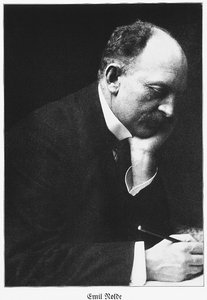
Emil Nolde
1867 - 1956 , Duitsland
Belangrijkste feiten
- Artistic Movement Or Style: Expressionisme / Die Brücke
- Artists Or Movements Influenced By This Artist: ['Brücke']
- Artists Who Influenced This Artist:
- Van Gogh
- Gauguin
- Date Of Birth: 7 aug 1867
- Date Of Death: 15 apr 1956
- Full Name: Emil Nolde / Hans Emil Hansen
- Nationality: Duits-Denemarks
- Notable Artworks:
- Maskers
- Bekentenis van Christus
- Zee in de herfst
- Place Of Birth: Nolde, Duitsland
Gerelateerde artikelen

Ephemeral Visions: Exploring the Artistic Legacy & Nuances of Watercolor Painting
Explore the captivating world of watercolor painting! Discover its rich history, essential techniques, influential artists & collecting tips from art experts. A comprehensive guide for enthusiasts.

Ephemeral Visions: Exploring the History & Emotional Resonance of Watercolor Painting
Explore the captivating history of watercolor painting, from ancient techniques to modern masters like Kandinsky & Blake. Discover essential artists, collecting tips & the emotional power of this luminous medium. Expert insights for art enthusiasts.

Ephemeral Visions: Exploring the Artistic Legacy & Contemporary Practice of Watercolor Painting
Explore the captivating world of watercolor painting! Discover its rich history, essential techniques, influential artists & collecting tips. A comprehensive guide for art enthusiasts from OriginalUniqueArt.

Top 10 Legendarische Aquarellen die de Kunst voor Altijd Veranderden | OriginalUniqueArt
Ontdek de 10 legendarische aquarellen die kunstgeschiedenis schreven! Van Turner tot Monet, leer over techniek, emotie & impact. Vind museumkwaliteit reproducties en interieurinspiratie op OriginalUniqueArt.com.

De Blijvende Aantrekkingskracht van Aquarel: Geschiedenis, Technieken en Hedendaagse Praktijk
Ontdek de fascinerende wereld van aquarel! Leer over de geschiedenis, technieken en materialen van deze prachtige kunstvorm. Laat je inspireren door meesters en moderne trends.

