Post-Impressionism
After Work (Edward William Stott)
Edward William Stott (1859–1918) maakte After Work. Het behoort tot de Post-Impressionism-stroming. Het is gemaakt van Oil On Canvas.
- Oil On Canvas

 Voorvertoning

 Met de hand geschilderd olieverfwerk
 Verstuur
 Delen
 Informatieblad


 Download
 Vergelijkbare items
 Röntgenonderzoek
 Diavoorstelling
 Vraag & antwoord

 Statistieken
After Work, in het kort
- Titel
- After Work
- Kunstenaar
- Edward William Stott (1859–1918)
- Geboren in [jaar]
- Rochdale, Verenigd Koninkrijk
- Medium
- Oil On Canvas
- Beweging
- Post-Impressionism
- Periode
- 19th Century
- Onderwerp
- landscape, solitude, travel, rural, dusk, horseback
Wat stelt After Work voor?
Identification of After Work by Edward William Stott
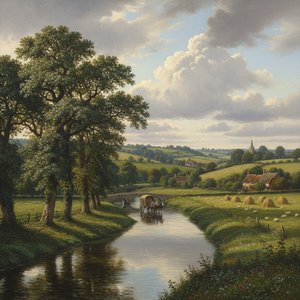
In this work, titled After Work, we encounter a quiet moment of transition captured by the English painter Edward William Stott. Born in 1859, Stott developed a sensibility deeply rooted in the nuances of the natural world, a focus that remains central to this piece. The painting presents a solitary figure on horseback navigating a desolate landscape, a scene that reflects the artist's lifelong interest in the rhythms of rural life and the changing qualities of light.
Edward William Stott, who lived until 1918, possessed a specific ability to render the atmosphere of the English countryside. In After Work, this is expressed through a somber, melancholic mood, established by an overcast sky and a palette of earthy browns and muted yellows. The composition relies on strong horizontal lines—the rider's back, the terrain, and the distant horizon—to create a sense of vastness and isolation within the frame.
The subject matter centers on a lone traveler in a rugged environment, suggesting themes of solitude and resilience. There is a palpable sense of the weight of the day's labor, as the figure moves through a landscape where the background recedes into a hazy darkness. It is a study of a quiet, singular moment caught between the physical reality of the terrain and the emotional stillness of the evening.
The Composition and Visual Elements
The composition is defined by a series of heavy horizontal lines. The horse’s back, the uneven ground, and the distant horizon all pull the eye across the canvas, emphasizing a sense of vastness and isolation. This structural choice anchors the solitary figure on horseback as they traverse a desolate landscape. The subject is a lone traveler moving through a rugged environment, a figure that seems small against the weight of the terrain.
The color palette is restrained, relying primarily on earthy browns and muted yellows. These tones contribute to a somber mood, mirroring the quietude of the scene. Lighting is diffused and flat, lacking any strong highlights that might disrupt the stillness. Instead, the light settles softly over the landscape, allowing the forms to emerge through subtle shifts in tone rather than sharp contrast. In the distance, the background recedes into a hazy darkness, creating a sense of depth that feels both immense and impenetrable.
Technique and Artistic Style
The work is executed in oil on canvas, a choice that allows for the heavy, moisture-laden texture characteristic of the artist's approach to the landscape. There is a palpable sense of weight in the application of the paint. Thick brushstrokes define the terrain and the figure, suggesting a painterly technique that prioritizes the physical presence of the medium. This tactile quality gives the organic shapes of the horse and rider a tangible, grounded reality.
The style leans toward realism, yet it is handled with an expressive brushstroke technique that avoids clinical precision. Lines are loose and expressive, defining the forms of the traveler and the rugged environment without relying on sharp or rigid edges. This softness allows the subject to merge subtly with the atmosphere of the desolate landscape. The shapes remain largely organic, rendered with a visible texture that emphasizes the raw, unpolished nature of the scene.
Hoogwaardige afbeeldingen van After Work
Publiek domein: de kunstenaar is overleden in 1918.
Edward William Stott, After Work. Publiek domein
Veelgestelde vragen over After Work
Met welk medium is "After Work" door Edward William Stott uitgevoerd?
"After Work" is uitgevoerd in Oil On Canvas.
Wat wordt er afgebeeld in "After Work" door Edward William Stott?
De thema's die aanwezig zijn in "After Work" door Edward William Stott omvatten landscape, solitude, travel, rural, dusk, horseback, melancholy, vastness. Samen vatten zij de onderwerpen van het kunstwerk samen.
Behoort "After Work" door Edward William Stott tot het publiek domein?
"After Work" door Edward William Stott valt onder bevindt zich in het publiek domein - de auteursrechten zijn verlopen. Deze status bepaalt hoe de afbeelding van het werk mag worden gereproduceerd.
Aan welke kunstenaar wordt "After Work" toegeschreven?
De kunstenaar achter "After Work" is Edward William Stott. Het werk is gecatalogiseerd onder de naam van Edward William Stott.
Tot welke stijl behoort "After Work"?
"After Work" is een werk uit de Post-Impressionism. De stroming geeft de artistieke traditie aan waartoe het werk behoort.
Uit welke fase van de carrière van Edward William Stott is "After Work"?
Binnen de carrière van Edward William Stott valt "After Work" in de Late Victorian. Deze fase helpt om het werk te vergelijken met andere werken van de kunstenaar.
Waarom heeft het kunstwerk "After Work" deze auteursrechtelijke status?
"After Work" door Edward William Stott is bevindt zich in het publiek domein - de auteursrechten zijn verlopen. De auteursrechtelijke bescherming loopt vanaf het overlijden van de kunstenaar, dat plaatsvond in 1918.
Hoe verhoudt "After Work" zich tot het oeuvre van Edward William Stott?
Binnen het oeuvre van Edward William Stott past "After Work" binnen de Post-Impressionism-stijl, samen met de thema's van sussex colony's artistic hub, domestic scenes, fading light focus, bastien-lepage, impressionism, linnell, palmer – english tradition.
Is "After Work" typerend voor het werk van Edward William Stott?
Binnen de bekende thema's van Edward William Stott - sussex colony's artistic hub, domestic scenes, fading light focus, bastien-lepage, impressionism, linnell, palmer – english tradition - legt "After Work" een eigen focus op landscape, solitude, travel, rural, dusk, horseback, melancholy, vastness.
Over de kunstenaar, Edward William Stott

1859–1918, Verenigd Koninkrijk
Edward William Stott
De Atmosferische Ziel van het Engelse Landschap Edward William Stott blijft een fascinerende figuur in het weefsel van de Britse kunst, een schilder wiens werk ademt met de stille, melancholische schoonheid van het late Victoriaanse tijdperk. Geboren in 1855 te midden van de industriële rauwheid van Rochdale, Lancashire, stonden Stotts artistieke gevoeligheden ver af van het roet en ijzer van zijn geboorteplaats. In plaats daarvan zocht hij een diepe verbinding met de natuurlijke wereld, waarbij hij uiteindelijk zijn spirituele en creatieve thuis vond in de glooiende, serene landschappen van het landelijke Sussex. Zijn reis was er een van voortdurende verfijning, bewegend van de gestructureerde academische omgevingen van Manchester en Parijs naar de spontane, lichtdoorzwolken velden van het Engelse platteland.
Over Edward William Stott Bekende werken van Edward William Stott
Ook van Edward William Stott
 Black And White Cat
 The Labourer's Cottage
 Hagar And Ishmael Beside A Well In The Desert
 Ploughing
Essays over After Work
 Top 10 Meesterwerken uit de 19e Eeuw: Kunstgeschiedenis voor uw InterieurOntdek de 10 meest iconische kunstwerken uit de 19e eeuw! Van romantiek tot impressionisme, leer het verhaal achter meesterwerken van Monet…
 John Constable: Nature, Light & the Romantic Vision of Rural EnglandExplore the life & art of John Constable, the Romantic painter who revolutionized landscape with emotive scenes of rural England. Discover …
 American artworks of the 1850s1850s American landscapes by Asher Brown Durand and John Frederick Kensett showcase the era's beauty. View the full collection at OriginalU…