Olieverfversie
 Alles over Evening







































 Voor kunstwerken of reproducties die aan één zijde groter zijn dan 105 cm (ongeveer 41 inch), wordt de lijst als een losse set verzonden. Deze methode garandeert een veilige levering en voorkomt schade tijdens het transport.


Edvard Munch's "Evening": A Study in Melancholy and Solitude
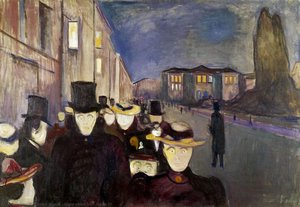
Edvard Munch’s “Evening,” painted in 1888, is an early work that foreshadows the artist’s later explorations of psychological depth and emotional intensity. This piece, housed within the Museo Nacional Thyssen-Bornemisza, offers a poignant glimpse into Munch's developing style as he transitioned from Impressionism towards Expressionism. The painting depicts a solitary figure, believed to be his sister Laura, seated in profile against a backdrop of a Norwegian fjord at dusk.
Style and Technique
“Evening” showcases a blend of Impressionistic techniques with emerging Symbolist tendencies. While the brushstrokes are looser than those found in purely academic works, they still retain a degree of naturalism in depicting the landscape. However, Munch’s use of color is far from objective; he employs dark, muted tones—primarily blues, greens, and browns—to evoke a sense of melancholy and introspection. The composition itself contributes to this mood: Laura's placement on the left side of the canvas, partially obscured and truncated, emphasizes her isolation. The original painting included two additional figures which Munch later removed, further amplifying the feeling of solitude.
Historical Context and Influences
Created during a period of significant artistic change in the late 19th century, “Evening” reflects a broader shift away from traditional representational art. Artists were increasingly interested in exploring subjective experiences and expressing inner emotions rather than simply depicting external reality. Munch was influenced by Symbolism and early Expressionist ideas, which sought to convey psychological states through symbolic imagery and distorted forms. The painting’s somber atmosphere aligns with the growing sense of alienation and anxiety that characterized modern life during this era.
Symbolism and Emotional Impact
The symbolism within “Evening” is subtle yet powerful. Laura's gaze directed towards the distant fjord suggests a longing or contemplation, while her detached posture conveys a profound sense of solitude. The darkening sky and tranquil waters contribute to an overall atmosphere of quiet melancholy. Munch’s choice to eliminate other figures from the scene underscores this feeling of isolation, drawing the viewer’s attention solely to Laura's introspective state. The painting resonates with viewers because it taps into universal human experiences of loneliness, reflection, and the passage of time.
A Precursor to Munch's Masterpieces
“Evening” serves as a crucial stepping stone in Munch’s artistic development, foreshadowing many of the themes and stylistic elements that would define his later masterpieces, including “The Scream.” It demonstrates his early mastery of conveying complex emotions through color, composition, and subtle symbolism. Owning a reproduction of this work allows one to appreciate not only its inherent beauty but also its significance within the broader context of modern art history.
Veelgestelde vragen
Is Evening handgeschilderd of een print?
Met de hand geschilderd: een professioneel kunstenaar kopieert Evening in olieverf op linnen canvas.
Welke maat moet ik kiezen voor Evening?
De afmetingen variëren van 27.2 x 36.7 cm (€178) tot 181.4 x 244.4 cm (€1460); in de tabel op deze pagina vindt u de verschillende opties en de bijbehorende prijzen.
Hoe lang duurt de bezorging?
De levertijd bedraagt 4 tot 5 weken, inclusief gratis wereldwijde expressverzending; op deze pagina wordt een optie voor spoedproductie aangeboden. U kunt het binnen 100 dagen zonder voorwaarden retourneren voor een volledige terugbetaling.
Waar is het origineel van Evening?
Het origineel maakt deel uit van de collectie van het Thyssen-Bornemisza Museum, Madrid.
Welk medium heeft Edvard Munch gebruikt voor Evening?
Oil On Canvas
 Voorvertoning

 Verstuur
 Delen
 Details bekijken
 Informatieblad


 Download
 Vergelijkbare items
 Röntgenonderzoek
 Diavoorstelling
 Vraag & antwoord

 Statistieken