Schakel over naar print
 Lees meer







































 Voor kunstwerken of reproducties die aan één zijde groter zijn dan 105 cm (ongeveer 41 inch), wordt de lijst als een losse set verzonden. Deze methode garandeert een veilige levering en voorkomt schade tijdens het transport.


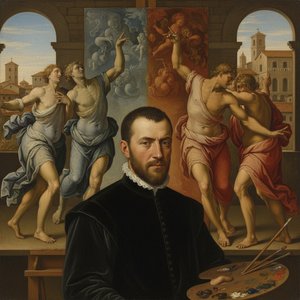
A Vision of Divine Announcement: Domenico Beccafumi's "Annunciation"
This captivating artwork presents a scene steeped in Christian theology – the Annunciation. It depicts the pivotal moment when the Archangel Gabriel announces to the Virgin Mary that she will conceive and bear Jesus, the Son of God. Painted by Domenico di Pace Beccafumi, one of the last significant figures of the Sienese school, this piece offers a unique perspective on a universally recognized biblical narrative.
Style & Technique: A Provincial Mannerism
Beccafumi’s style is characterized as provincial Mannerism. Unlike the more refined and classical approaches prevalent in Florence at the time, Beccafumi's work retains a distinct medieval sensibility. The painting employs oil on canvas or wood panel – traditional materials for the period – allowing for rich pigment application and subtle blending. Notice the dramatic use of light and shadow, a hallmark of Baroque influence even within this Mannerist context. Strong highlights illuminate Mary’s face and garments, creating a focal point while darker tones define the richly decorated architectural setting. The perspective is intentionally flattened, contributing to a sense of depth through receding elements and atmospheric haze. The brushwork reveals texture and volume, adding dynamism to the scene.
Symbolism & Composition: A Pyramid of Grace
Beyond its narrative function, the artwork is rich in symbolic detail. The flowers presented by the angel are traditional symbols of purity and humility, qualities associated with Mary. The angel himself embodies divine grace and serves as a messenger of God’s will. The composition itself is carefully structured around a pyramidal form, with Mary at the base and the angel positioned above her, guiding the viewer's eye upwards towards the heavens. This arrangement reinforces the hierarchical relationship between humanity and the divine. Observe how lines are used to define not only the architecture – arches, columns, drapery – but also to suggest movement in the flowing robes of both figures and the angel’s wings.
Historical Context & Beccafumi's Legacy
Domenico di Pace Beccafumi (1486-1551) was a key figure within the Sienese artistic tradition, which had historically rivaled Florence. His work represents a fascinating bridge between the Renaissance and Mannerism, retaining elements of medieval eccentricity while incorporating some Baroque dramatic flair. He stands out for his unique style that deviates from the dominant trends in Florentine art, showcasing a provincial quality marked by emotional intensity and a non-linear approach to perspective. Beccafumi’s “Annunciation,” like much of his oeuvre, offers a glimpse into a distinct artistic vision – one that celebrates both religious devotion and individual expression within the context of 16th-century Italy.
Veelgestelde vragen
Is "Annunciation" typerend voor het werk van Domenico Di Pace Beccafumi?
"Annunciation" verbeeldt religious, annunciation, angel, virgin mary, baroque, flowers, divine, interior, terwijl de bekende thema's van Domenico Di Pace Beccafumi sienese school traditions, renaissance mannerism elements, byzantine artistic heritage, representative of his mature style, last undiluted sienese painter, demonstrates provincial artistry, christian theology & annunciation, divine grace and purity themes zijn. Een vergelijking tussen beide laat zien hoe het werk zich verhoudt tot de gebruikelijke onderwerpen van de kunstenaar.
Welke kleuren overheersen in "Annunciation" door Domenico Di Pace Beccafumi?
De kleuridentiteit van "Annunciation" door Domenico Di Pace Beccafumi: een Earthy palet, gedomineerd door Black (#080d0c).
Hoe harmonieus zijn de kleuren van "Annunciation" door Domenico Di Pace Beccafumi?
"Annunciation" door Domenico Di Pace Beccafumi vertoont een Balanced Harmony kleurharmonie.
 Voorvertoning
 Verstuur
 Delen
Delen
 Details bekijken
 Gids
Gids

 Download
 Vergelijkbare items
 Röntgenonderzoek
 Diavoorstelling
 Q&A
Q&A Statistieken