

 Bekijk op ware grootte
 Verstuur
 Delen
Delen
 Details bekijken
 Gids voor studentenkunstwerken

 Download
 Vergelijkbare items
 Röntgenonderzoek
 Diavoorstelling
 Statistieken
Roman Ruins
 Oil
Oil- WallArt
- Dutch Golden Age
 1620
1620- Early Modern
 23.0 x 31.0 cm
 Lees meer
Handgemaakte olieverfreproductie
Met de hand geschilderd in olieverf op canvas in uw gewenste maat en lijst, op bestelling gemaakt door onze kunstenaars. ( Schakel over naar print Schakel over naar digitale afbeeldingen)




P118B €10

P118H €10

P118W €10

P438Z €10

P508JH €12

P508YH €12

P805H €10

P805Z €10

P919BZ €10

P919G €10

P919XJ €10

P959ZH €10

P968JZ €12

W106C €8

W218G €10

W218JH €8

W218Y €10

W307PJ €10

W316G €10

W316PJ €8

W316Y €10

W398PJ €8

W4111J €10

W500HY €15

W500JH €15

W692G €12

W849H €8

W940BG €15

W953PJ €8




Kies uit onze vooraf ingestelde maten die overeenkomen met de originele verhoudingen van het kunstwerk.

Voer de breedte en de hoogte in die u nodig heeft, passend bij uw lijst of uw muur. Dit is handgeschilderd, dus bij een afmeting met een andere vormverhouding kan de kunstenaar iets meer rondom het schilderij schilderen of juist iets meer weglaten — u kiest zelf. Wij sturen u een digitaal mockup ter goedkeuring voordat het schilderwerk begint. De afbeelding die op deze pagina wordt getoond, is niet het uiteindelijke resultaat — alleen de mockup geeft dit weer.
Na de bestelling zal het team van OriginalUniqueArt.com per e-mail contact opnemen met de klant voor instructies en een mockup-voorbeeld sturen.
Wereldwijde levering () binnen 3 tot 4 weken in plaats van de standaard 5 weken. (24 oktober). Zonder concessies aan de kwaliteit.

Gratis wereldwijde expressverzending

Hoogwaardig linnen canvas

Volledige verzendverzekering

Garantie op terugbetaling van invoerrechten

Garantie op exacte kleurweergave

Retourbeleid van 100 dagen (alleen bij defecten)

100% Geld-terug-garantie

Korting bij meerdere afnames
 De optie voor glas is alleen beschikbaar bij een formaat kleiner dan 110 cm.

Roman Ruins
Reproductiemethode
Formaat reproductie
-


Totaalprijs
€ 263
A Window into Antiquity: The Timeless Allure of Roman Ruins
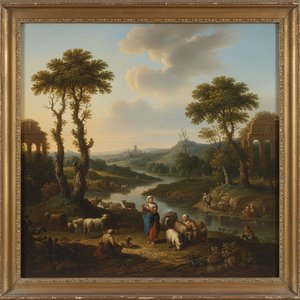
In the delicate, circular embrace of this exquisite tondo, Cornelis van Poelenburgh invites us to step through a portal into a bygone era. Painted around 1620, Roman Ruins is far more than a mere depiction of architectural decay; it is a profound meditation on the passage of time and the enduring relationship between humanity and the remnants of greatness. The composition, framed by its characteristic round format, focuses our gaze upon a landscape where the grandeur of the Roman Empire has softened into a pastoral sanctuary. Within this intimate space, the heavy stone arches and crumbling pillars serve as silent witnesses to history, now providing a backdrop for the quiet, rhythmic pulse of rural life.
The scene unfolds with a masterful use of light and shadow, reminiscent of the Dutch Golden Age's obsession with atmospheric truth. As we gaze upon the foreground, we encounter a world in gentle motion: a shepherd tending his flock, a laborer with his oxen, and figures caught in quiet contemplation. These small-scale inhabitants of the landscape bring a sense of warmth and vitality to the otherwise somber ruins. The artist employs a subtle, earthy palette—rich ochres, muted greens, and soft umbers—to weave a tapestry of textures that feels both tactile and ethereal. The hazy, overcast sky suggests the fleeting light of dawn or dusk, casting a melancholic yet peaceful glow over the entire vista, evoking a sense of nostalgia for a lost civilization.
The Mastery of the Italianate Style
Cornelis van Poelenburgh was a pivotal figure in the first generation of Dutch landscape painters who found profound inspiration in Italy. His travels to Rome allowed him to infuse his Northern training with the classical elegance of the Mediterranean. In Roman Ruins, we see this synthesis perfected. The technique is characterized by an incredible attention to detail; every crack in the ancient masonry and every distant bird in flight is rendered with a precision that draws the viewer deeper into the frame. This meticulousness does not feel clinical, however, but rather serves to enhance the three-dimensional depth of the scene, making the archway feel like a real threshold through which one might walk.
For the discerning collector or interior designer, this piece offers a unique emotional resonance. It possesses a "Caravaggesque" drama tempered by a serene, pastoral tranquility. The symbolism of the ruins—representing the inevitable cycle of rise and fall—is balanced by the resilience of the natural world and the simplicity of the human spirit. Such a work is an ideal centerpiece for a sophisticated interior, providing a conversational focal point that inspires reflection. Whether placed in a sunlit study or a grand gallery, this reproduction captures a moment of eternal stillness, offering any space it inhabits a touch of historical majesty and poetic grace.
Vragen & Antwoorden
Wie heeft "Roman Ruins" gemaakt en in welk jaar?
"Roman Ruins" werd in 1620 gecreëerd door Cornelis Van Poelenburgh.
Wat stelt "Roman Ruins" door Cornelis Van Poelenburgh voor?
De thema's die aanwezig zijn in "Roman Ruins" door Cornelis Van Poelenburgh omvatten figures, sheep, cow, archway, ruins, trees, birds, earth tones. Samen vatten zij de onderwerpen van het kunstwerk samen.
Hoe intens zijn de kleuren van "Roman Ruins"?
De kleuren van "Roman Ruins" door Cornelis Van Poelenburgh vertonen een Muted verzadiging met een Balanced intensiteit.
Biografie van de kunstenaar
vroege jaren en opleiding
Cornelis van Poelenburgh, een vooraanstaande Nederlandse landschapsschilder, werd in 1594 geboren in Utrecht, Nederland. Zijn artistieke reis begon onder de meesterlijke begeleiding van Abraham Bloemaert, een kunstenaar van grote reputatie in die tijd. Deze fundamentele opleiding vormde de onmisbare basis voor het latere succes en de verfijnde techniek van Van Poelenburgh.artistieke carrière en invloeden
De reizen van Van Poelenburgh naar Rome in de vroege 17e eeuw lieten een diepe indruk achter op zijn oeuvre, waardoor hij uitgroeide tot een leidende vertegenrende van de eerste generatie Nederlandse landschapsschilders die actief waren in Italië. Zijn fijnmazige, kleinschalige schilderijen, waarin vaak geïtalieniseerde landschappen versmelten met kleine figuren die bijbelse of mythologische scènes tot leven brengen, getuigen van een volstrekt unieke stijl. Opmerkelijke werken:- Satyrs spying on nymphs (na 1627), een karakteristiek voorbeeld van het werk van Van Poelenburgh, waarin archaïsche landschappen worden gecombineerd met figuren die baden. (Bekijk op OriginalUniqueArt)
- Council of the gods (ca. 1630), een schilderij dat de geïdealiseerde heuvelachtige landschappen en Romeins-geïnspireerde godinnen van Van Poelenburgh toont, tegenwoordig ondergebracht in het Mauritshuis (Den Haag, Nederland). (Bekijk op OriginalUniqueArt)
erfenis en latere leven
Het werk van Van Poelenburgh werd met groot respect bekeken door zijn tijdgenoten, waaronder de groothertog van Toscane en de Nederlandse stadhouder. Uiteindelijk keerde hij terug naar Utrecht, waar hij in 1667 overleed, slechts enkele jaren na zijn voormalige leermeester Abraham Bloemaert. Kernpunten:- Geboren in Utrecht, Nederland in 1594
- Opleiding onder Abraham Bloemaert
- Sterk beïnvloed door zijn verblijf in Rome
- Bekend om kleinschalige Italiaanse landschappen met figuren
- Overleden in Utrecht in 1667 Bekijk de kunstwerken van Cornelis van Poelenburgh op OriginalUniqueArt Lees meer over Cornelis van Poelenburgh op Wikipedia

Cornelis Van Poelenburgh
1594 - 1667 , Nederland
Snelle feiten
- Artistic Movement Or Style: Nederlands landschap, Romanate
- Artists Or Movements Influenced By This Artist: ['Claude Lorraine']
- Artists Who Influenced This Artist: ['Abraham Bloemaert']
- Date Of Birth: 1594, Utrecht, Nederland
- Date Of Death: 1667, Utrecht, Nederland
- Full Name: Cornelis van Poelenburgh
- Nationality: Nederlands
- Notable Artworks:
- Satyrs die nimfen bespioneren
- Raad van de goden
- Place Of Birth: Utrecht, Nederland
Gerelateerde artikelen

Golden Light & Dutch Skies: The Timeless Magic of Dutch Golden Age Landscapes
Discover the breathtaking beauty of Dutch Golden Age landscapes. Explore the mastery of light, chiaroscuro, and 17th-century realism through an expert art history lens, celebrating the enduring legacy of the Dutch Masters for discerning collectors and art lovers.

Golden Age Reflections: Dutch Baroque Painting & Cultural Innovation
Explore the Dutch Golden Age of painting! Discover key artists like Vermeer & ter Borch, their innovative techniques, and the rich cultural context behind these Baroque masterpieces. Learn about collecting & appreciating this iconic art period.

Mastering Light & Shadow: A Journey Through the Dutch Golden Age's Luminous Legacy
Embark on a cultural journey through the Dutch Golden Age. Explore the masterful interplay of light and shadow in 17th-century masterpieces, from Rembrandt to Vermeer, and discover how this era of profound realism continues to inspire fine art collectors today.

Top 10 Meesterwerken van de Gouden Eeuw: Kunst voor uw interieur | OriginalUniqueArt.nl
Ontdek de 10 meesterwerken van de Gouden Eeuw! Leer over Rembrandt, Vermeer & andere Hollandse schilders. Prachtige kunst reproducties voor uw interieur. Museumkwaliteit prints op OriginalUniqueArt.com.
Nicolaes Berchem: Dutch Golden Age Pastoralism & the Evolution of Landscape Painting
Explore the captivating world of Nicolaes Berchem, a leading Dutch Golden Age painter. Discover his idyllic landscapes, masterful technique & lasting influence on art history. Learn more at OriginalUniqueArt.