
 Voorvertoning
 Verstuur
 Delen
Delen
 Details bekijken
 Gids
Gids

 Download
 Vergelijkbare items
 Röntgenonderzoek
 Diavoorstelling
 Q&A
Q&A Statistieken
Putto Picking Grapes

- 49.0 x 64.0 cm


 Lees meer
Giclée / Kunstafdrukken
Giclée- of canvasafdruk van museumkwaliteit met een snelle productie en flexibele afwerkingsmogelijkheden. ( Bestel handgeschilderde reproductie Schakel over naar digitale afbeeldingen)




P118B €10

P118H €10

P118W €10

P438Z €10

P508JH €12

P508YH €12

P805H €10

P805Z €10

P919BZ €10

P919G €10

P919XJ €10

P959ZH €10

P968JZ €12

W106C €8

W218G €10

W218JH €8

W218Y €10

W307PJ €10

W316G €10

W316PJ €8

W316Y €10

W398PJ €8

W4111J €10

W500HY €15

W500JH €15

W692G €12

W849H €8

W940BG €15

W953PJ €8




Kies uit onze vooraf ingestelde maten die overeenkomen met de originele verhoudingen van het kunstwerk.

Voer de gewenste breedte en hoogte in, passend bij uw lijst of muur. Een afdruk kan alleen worden ingekort en nooit groter worden gemaakt dan het origineel; een formaat met andere verhoudingen zal daarom een deel van de afbeelding verliezen. Wij sturen u een digitaal mockup ter goedkeuring voordat we tot drukwerk overgaan. De afbeelding op deze pagina toont niet de werkelijke uitsnede — dit is alleen te zien op het mockup.
Wereldwijde levering () binnen 2 weken in plaats van de standaard 4/5 weken. (2 november)

Gratis wereldwijde expressverzending

Hoogwaardig linnen canvas

Volledige verzendverzekering

Garantie op terugbetaling van invoerrechten

Garantie op exacte kleurweergave

Retourbeleid van 100 dagen (alleen bij defecten)

100% Geld-terug-garantie

Korting bij meerdere afnames
 De optie voor glas is alleen beschikbaar bij een formaat kleiner dan 110 cm.

Putto Picking Grapes
Giclée / Kunstafdrukken
Afmetingen reproductie
-


Eindtotaal
€ 72
Bernardino Luini’s “Putto Picking Grapes”: A Symphony of Grace and Renaissance Reverie
Bernardino Luini's "Putto Picking Grapes," painted around 1523, isn’t merely a depiction of a young boy gathering fruit; it’s a profound meditation on childhood innocence, the bounty of nature, and the enduring legacy of Leonardo da Vinci. This exquisite panel painting, now housed within the Pinacoteca di Brera in Milan, offers a glimpse into the heart of the High Renaissance, revealing Luini's unique artistic vision and his deep connection to the master who profoundly shaped his style.
Luini’s distinctive “Luinesque” aesthetic—characterized by elongated figures, gentle expressions, and an almost dreamlike quality—is immediately apparent. The central figure, a young boy with a serene countenance, is bathed in soft light that seems to emanate from within the painting itself. His posture is relaxed yet attentive, his gaze fixed on the grapes he delicately gathers from a vine. The artist masterfully employs sfumato – Leonardo’s signature technique of blurring lines and softening edges – creating an atmosphere of hazy beauty and imbuing the scene with a sense of ethereal tranquility. Notice how the details are rendered with remarkable precision, yet never feel overly realistic; Luini prioritizes capturing the *essence* of the moment over photographic accuracy.
A Dialogue with Leonardo: Influences and Techniques
Luini’s artistic journey is inextricably linked to that of Leonardo da Vinci. While the precise nature of their collaboration remains debated, it's widely accepted that Luini spent several formative years working directly under the master in Milan. This apprenticeship instilled within him a deep appreciation for Leonardo’s innovative techniques and his profound understanding of human anatomy and perspective. “Putto Picking Grapes” is a testament to this influence; observe how Luini subtly echoes Leonardo’s use of light and shadow, creating a sense of depth and volume that draws the viewer into the scene. The composition itself—a carefully balanced arrangement of figures and elements—demonstrates a clear debt to Leonardo's meticulous approach to design.
Furthermore, Luini’s work reflects the broader artistic trends of the era. The painting embodies the Renaissance ideal of *natura mortua* – the beauty of decay and the cyclical nature of life. The grapes themselves represent abundance, fertility, and the passage of time. The setting, a rustic vineyard bathed in golden light, evokes a sense of pastoral harmony—a refuge from the complexities and anxieties of urban life.
Symbolism and Emotional Resonance
Beyond its technical brilliance, “Putto Picking Grapes” is rich in symbolic meaning. The young boy embodies innocence, purity, and the promise of future growth. His simple act of gathering grapes becomes a metaphor for the acquisition of knowledge and wisdom—a fundamental theme of Renaissance humanism. The vine itself symbolizes life, connection, and the interconnectedness of all things. The overall mood is one of quiet contemplation and gentle joy, inviting the viewer to pause and appreciate the beauty of the natural world.
Interestingly, Luini’s work often features a subtle undercurrent of melancholy—a recognition that even in moments of idyllic beauty, time inevitably marches on. This poignant awareness adds another layer of depth to the painting's emotional resonance. It’s not simply a celebration of youth and abundance; it’s also a meditation on mortality and the fleeting nature of earthly pleasures.
A Timeless Masterpiece: Reproduction and Display
Reproductions of “Putto Picking Grapes” capture only a fraction of the painting's original allure. The delicate sfumato, the subtle nuances of color, and the profound sense of atmosphere are difficult to replicate fully. However, high-quality reproductions offer an accessible way to experience Luini’s genius and bring this timeless masterpiece into your home or office.
When selecting a reproduction, consider the materials used—a fine art print on archival paper will ensure that the colors remain vibrant for generations to come. Furthermore, think about the framing – a simple, elegant frame will allow the painting’s beauty to shine through without distracting from its inherent charm. “Putto Picking Grapes” is more than just a decorative image; it's a window into the soul of the Renaissance—a testament to the enduring power of art to inspire and uplift.
Veelgestelde vragen
Zijn de kleuren van "Putto Picking Grapes" door Bernardino Luini levendig of gedempt?
"Putto Picking Grapes" door Bernardino Luini is vastgelegd met een Clear Color Presence verzadiging en een Vivid intensiteit.
In welk jaar en binnen welke stroming werd "Putto Picking Grapes" gemaakt?
"Putto Picking Grapes" werd gemaakt in 1523, binnen de Northern Renaissance-stroming.
Kan ik augmented reality gebruiken om "Putto Picking Grapes" door Bernardino Luini in mijn eigen ruimte te bekijken?
"Putto Picking Grapes" door Bernardino Luini kan via de AR-weergave-pagina van het kunstwerk op uw eigen muur worden geproefd met behulp van augmented reality op een compatibel apparaat.
Biografie kunstenaar
A Lombard Luminary: The Life and Art of Bernardino Luini
Bernardino Luini, a name that whispers through the halls of Italian Renaissance painting, emerged from the serene landscapes surrounding Lake Maggiore around 1480. Born in Runo, a small hamlet nestled near Dumenza, his early life remains shrouded in a gentle mist of mystery – details scarce and often debated amongst scholars. Yet, it’s clear that fate orchestrated a journey for him, leading him to Milan, the vibrant heart of artistic innovation in northern Italy. By the year 1500, he had settled within its bustling walls, poised to absorb the creative energy radiating from Leonardo da Vinci's workshop and become one of his most devoted disciples. This apprenticeship wasn’t merely a technical education; it was an immersion into a world of subtle observation, innovative composition, and the elusive quality known as *sfumato*, which Luini would masterfully integrate into his own distinctive style – a style forever marked by its profound humanity.The Shadow of Leonardo and the Forging of a Unique Style
Luini’s artistic development wasn't defined by direct imitation of Leonardo’s rigorous intellect or anatomical precision, but rather by a sensitive assimilation of the master’s techniques filtered through his own deeply rooted Lombard sensibility. He didn’t strive to replicate Da Vinci’s intellectual complexity or meticulous detail; instead, he embraced the softer, more lyrical aspects of Leonardo's approach – the hazy outlines, the subtle gradations of light and shadow that created an atmosphere of profound emotion. This is particularly evident in his depictions of women—graceful figures with elongated eyes, often described by Vladimir Nabokov as “Luinesque” – possessing a captivating melancholy, an inwardness that invites contemplation and a quiet reverence. Early works like the *Adoration of the Magi* (c. 1505) in San Pietro, Luino, already hint at this emerging style, showcasing a delicate handling of light and shadow and a growing mastery of composition. The frescoes he created for the Oratory of Santa Maria Nuova in Pilastrello further solidified his unique approach, demonstrating an ability to balance technical skill with profound emotional depth.The Flourishing Years: Commissions and Artistic Evolution
The period between 1509 and 1514 witnessed a remarkable surge in Luini’s artistic activity – a time of intense creativity fueled by numerous commissions from wealthy patrons and influential figures. He wasn't confined to the realm of religious subjects; his talents were sought after for secular projects as well, reflecting the breadth of his artistic vision. The frescoes he created for Villa Pelucca in Sesto San Giovanni stand as particularly compelling examples of this versatility, depicting mythological scenes with a refined elegance that graced the walls of this aristocratic residence. These works, now housed in Milan’s Pinacoteca di Brera, reveal a painter equally adept at capturing the dynamism of classical narratives and the intimate beauty of human form. He continued to receive prestigious commissions throughout Lombardy – adorning churches and palaces with his distinctive style, solidifying his position as one of the most sought-after artists of the era. The influence of Bernardino Zenale’s *Cantù Polyptych* is also visible in works like *St. Anthony of Padua* (1510s), demonstrating Luini's ability to synthesize diverse influences into a cohesive artistic vision.Key Works and Lasting Influence
Bernardino Luini left behind a remarkable body of work, each piece imbued with his unique sensibility. The *Madonna del Roseto* (c. 1510) in Milan’s Pinacoteca di Brera is perhaps one of his most celebrated works, capturing the serene beauty of the Virgin Mary and Child with an unparalleled sense of intimacy. The *Holy Family with Saints Anne and John the Baptist*, a masterpiece currently residing in the Pinacoteca di Brera, exemplifies his masterful use of light, color, and composition to evoke a profound sense of peace and spirituality. His frescoes for the Certosa di Pavia, including scenes depicting the life of Christ, demonstrate his ability to convey complex narratives with remarkable clarity and emotional resonance. Even his smaller works – such as *Salome with the Head of John the Baptist* – possess an arresting power and technical brilliance. Luini’s legacy extends far beyond these individual masterpieces; he profoundly influenced subsequent generations of Lombard painters, shaping the artistic landscape of the region for decades to come.A Legacy of Grace and Intimacy
Bernardino Luini passed away in Milan in June 1532, leaving behind a body of work that continues to captivate and inspire. His son, Aurelio, followed in his footsteps, continuing the family’s artistic tradition. However, it is Bernardino who remains the more celebrated figure – remembered for his graceful figures, delicate *sfumato*, and the uniquely captivating quality of his “Luinesque” women. His paintings serve as a poignant reminder of the beauty that can be found in simplicity and intimacy—a testament to the enduring power of art to touch our hearts and souls. His works are now treasured within museums across Italy, offering a glimpse into the artistic sensibilities of a bygone era – a legacy secured through his profound understanding of human emotion and his masterful command of the painter’s craft.
Bernardino Luini
1480 - 1532 , Italië
Belangrijkste feiten
- Artistic Movement Or Style: Renaissance, Mannerisme
- Artists Or Movements Influenced By This Artist: ['Luinesque stijl']
- Artists Who Influenced This Artist: ['Leonardo da Vinci']
- Date Of Birth: c. 1480/82
- Date Of Death: 1532
- Full Name: Bernardino Luini
- Nationality: Italiaans
- Notable Artworks:
- Adoratie Magi
- St. Anthony Padua
- Frescoes Villa Pelucca
- Place Of Birth: Reno, Italië
Gerelateerde artikelen

The Enduring Legacy of Fresco: Technique, History & Artistic Expression
Explore the rich history & enduring artistry of fresco painting. Discover techniques from Giotto to Michelangelo, conservation efforts, & modern applications. Learn how OriginalUniqueArt brings this timeless art form to your home.

The Enduring Legacy of Fresco: Technique, History & Artistic Expression Across Cultures
Explore the rich history & enduring legacy of fresco painting! Discover ancient techniques, Giotto's masterpieces, and modern applications. Expert insights for art lovers & professionals.

Leonardo da Vinci's Top 25 Meesterwerken: Kunst voor uw Interieur | OriginalUniqueArt
Ontdek de 25 meest iconische meesterwerken van Leonardo da Vinci! Van de Mona Lisa tot De Laatste Avondmaal, leer over zijn techniek & geschiedenis. Museumkwaliteit kunstprints voor uw interieur op OriginalUniqueArt.com

De Fresco als Familielegatie: Schilder Je Erfgoed op de Muren
Ontdek de fascinerende wereld van fresco schilderkunst! Leer over technieken, geschiedenis en restauratie. Expertise & hoogwaardige reproducties bij .
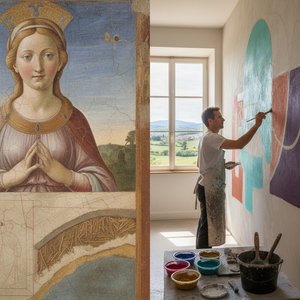
The Enduring Legacy of Fresco Painting: Techniques, History & Contemporary Relevance
Explore the rich history & enduring artistry of fresco painting – from Giotto to Michelangelo! Discover techniques, conservation efforts, & modern applications. Learn how OriginalUniqueArt brings this timeless art form to your home.

