
 Verstuur
 Delen
Delen
 Details bekijken
 Gids
Gids

 Download
 Vergelijkbare items
 Diavoorstelling
 Statistieken
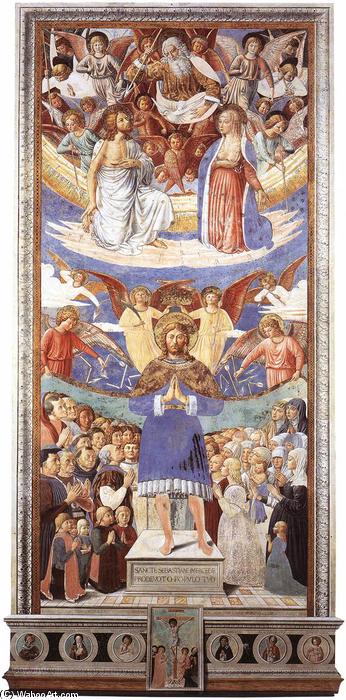
St Sebastian Intercessor
 Fresco
- Early Renaissance
 1464
1464- Renaissance
 527.0 x 248.0 cm
 Nave of Sant'Agostino
 Lees meer
Koop een digitale afbeelding in hoge resolutie met verbeterde kwaliteit, die veel superieur is aan de online voorvertoning.
Elk bestand wordt met uiterste precisie voorbereid door onze interne specialisten, met behulp van geavanceerde tools en deskundige handmatige retouche. Wij garanderen dat elke afbeelding een uitzonderlijke helderheid, nauwkeurige kleurweergave en verfijnde details bezit.
Het uiteindelijke bestand wordt binnen 72 uur per e-mail geleverd, geoptimaliseerd voor direct gebruik in professionele, redactionele en printomgevingen. Dit is dezelfde kwaliteit waarop vooraanstaande designstudio's, uitgevers en galerieën vertrouwen.
Digitale afbeeldingen
Download een bestand met hoge resolutie voor persoonlijke weergave, afdrukken en creatieve projecten. ( Schakel over naar print Bestel handgeschilderde reproductie)
Inbegrepen bij elke bestelling van een digitale afbeelding
Professionele digitale levering, gegarandeerd
Wanneer u kiest voor OriginalUniqueArt.com, ontvangt u niet alleen een afbeelding – u krijgt een professioneel verbeterd digitaal kunstwerk, met precisie vervaardigd en voorzien van een tevredenheidsgarantie. Dit is alles wat automatisch bij uw bestelling is inbegrepen:

Snelle levering per e-mail
Uw hoogwaardige digitale afbeeldingsbestand wordt binnen 72 uur na bestelling naar u gemaild – klaar voor direct gebruik.

AI-verbeterd digitaal bestand
Uw kunstwerk wordt professioneel geoptimaliseerd met behulp van geavanceerde AI-tools en handmatige bewerkingen, waardoor maximale details, helderheid en kleurnauwkeurigheid worden gegarandeerd.

Gratis levenslange herlevering van digitale bestanden
Je bestand per ongeluk verwijderd of kwijtgeraakt? Geen zorgen – we sturen het u op elk gewenst moment gratis opnieuw toe.

Geen invoerkosten – nooit
Geniet direct van uw kunstwerk zonder invoerrechten, belastingen of verzendkosten – digitale downloads zijn altijd belastingvrij.

Garantie op kleurgetrouwheid
Met behulp van professionele hulpmiddelen en kleurbeheer zorgen wij ervoor dat uw digitale afbeelding de originele kleuren zo nauwkeurig mogelijk weergeeft.

100 dagen tevredenheidsgarantie
Mocht u niet tevreden zijn met uw digitale afbeelding, dan passen wij deze aan of storten wij 100% terug binnen 100 dagen – zonder vragen te stellen.

100% Geld-terug-garantie
Niet tevreden? Ontvang een volledige terugbetaling binnen 100 dagen na ontvangst van uw digitale bestand – zonder vragen te stellen.

Korting bij grote bestellingen
Koop 3 afbeeldingen, bespaar 10% - Koop 5, bespaar 15% - Koop 10+, bespaar 20%. Ideaal voor creatieve projecten, galerieën en bureaus.
St Sebastian Intercessor: A Renaissance Masterpiece by Benozzo Gozzoli
- Title: St Sebastian Intercessor
- Artist: Benozzo Gozzoli
- Date: 1464
- Size: 527 x 248 cm
- Location: Nave of Sant'Agostino (San Gimignano, Italy)
Artistic Style and Technique
“St Sebastian Intercessor” is a remarkable fresco created by the renowned Italian artist Benozzo Gozzoli in 1464. This large-scale work showcases his mastery of the fresco technique, a method involving painting directly onto wet plaster. The vibrant colors and intricate details characteristic of Gozzoli’s style are evident throughout the scene. His approach blends realism with an International Gothic influence, resulting in figures that possess both detailed rendering and a sense of stylized elegance.
The composition depicts a gathering of people, including angels, Roman soldiers, and numerous onlookers, all centered around the martyrdom of St Sebastian. The use of perspective guides the viewer's eye upwards towards Christ, creating a hierarchical structure that emphasizes the spiritual significance of the event. Gozzoli’s skillful application of fresco allows for rich color saturation and textural depth, bringing the narrative to life.
Historical Context and Symbolism
Painted during a period of plague in 1464, “St Sebastian Intercessor” served as a votive offering – a prayer for divine intervention. The depiction of St Sebastian, fully clothed and shielding people from arrows, deviates from the traditional portrayal of him riddled with wounds. This symbolizes his role not just as a martyr but also as an intercessor, protecting humanity from suffering.
The scene is rich in symbolism: God the Father surrounded by angels prepares to hurl arrows representing divine wrath, while Mary and Christ kneel as intercessors, appealing for mercy. Christ’s display of his wounds and Mary's baring of her breast are poignant reminders of sacrifice and redemption. The crowd at St Sebastian’s feet represents humanity seeking solace and protection.
Emotional Impact and Legacy
“St Sebastian Intercessor” evokes a powerful sense of awe, reverence, and spiritual significance. The vibrant colors, detailed figures, and dramatic lighting create an emotionally charged atmosphere that draws the viewer into the scene. The painting’s enduring appeal lies in its ability to convey both the suffering of humanity and the promise of divine grace.
Benozzo Gozzoli's work remains a testament to the artistic achievements of the Early Renaissance, celebrated for its beauty, technical skill, and profound spiritual message. The fresco’s location within the Nave of Sant'Agostino continues to inspire visitors and art enthusiasts alike.
Veelgestelde vragen
Zijn de kleuren van "St Sebastian Intercessor" krachtig of juist zacht?
De kleurintensiteit van "St Sebastian Intercessor" is Balanced. Intensiteit geeft aan hoe krachtig de kleuren overkomen.
Hoe verhoudt "St Sebastian Intercessor" zich tot de terugkerende thema's van Benozzo Gozzoli?
Binnen de bekende thema's van Benozzo Gozzoli - international gothic style, fra angelico training, early work showcasing developing skill, demonstrates fresco mastery., religious devotion, plague intercession, divine mercy - legt "St Sebastian Intercessor" een eigen focus op martyrdom, saint sebastian, fresco, religious, intercessor, angels, gozzoli, san gimignano.
Hoe wordt de stemming van "St Sebastian Intercessor" door Benozzo Gozzoli beschreven?
De algehele stemming van "St Sebastian Intercessor" door Benozzo Gozzoli is Classic. De stemming beschrijft de algemene atmosfeer van het werk.
Kunstenaarsbiografie
Early Life and Training
Benozzo Gozzoli, born circa 1420 in Florence, Italy, descended from a family of prosperous farmers—a lineage that instilled in him an appreciation for meticulous craftsmanship and detailed observation. His father was a doublet maker, providing him with invaluable experience in manipulating fabrics and achieving textural harmony – skills that would later translate into his distinctive artistic style. While precise details about his formative years remain elusive, Gozzoli’s early training centered around the tutelage of Fra Angelico, arguably Florence's most celebrated painter of the Early Renaissance. This influential mentorship profoundly shaped his artistic sensibilities, exposing him to Angelico’s refined aesthetic and fostering a dedication to capturing spiritual beauty with unparalleled precision. Notably, Gozzoli’s initial works mirrored Angelico’s designs, demonstrating an unwavering commitment to stylistic continuity and establishing a foundational connection between their artistic visions.Notable Works and Collaborations
Benozzo Gozzoli's prolific output spanned across Tuscany and Umbria, cementing his reputation as one of the Renaissance's foremost muralists. Among his most iconic achievements is “The Journey of the Magi” (1459-1461), executed in the Magi Chapel of Palazzo Medici Riccardi—a fresco cycle that exemplifies Gozzoli’s mastery of International Gothic style. The chapel’s vibrant colors, intricate draperies, and meticulously rendered figures convey a palpable sense of grandeur and evoke the atmosphere of a medieval pilgrimage. Furthermore, he collaborated seamlessly with Lorenzo Ghiberti on the third bronze door of the Baptistery in Florence (1444-1447), contributing to this monumental artistic endeavor—a testament to his collaborative spirit and technical prowess. Gozzoli’s involvement extended beyond individual projects; he served as a crucial assistant to Fra Angelico during the decoration of San Marco Monastery, furthering his stylistic dialogue with Angelico's oeuvre. His contribution to Pope Nicholas V’s chapel in Rome (1447) showcased his ability to adapt to diverse artistic contexts and maintain a consistently high level of artistic excellence.Artistic Style and Legacy
Gozzoli’s distinctive style—characterized by its meticulous attention to detail, harmonious color palettes, and subtle incorporation of International Gothic influences—stands apart from many of his contemporaries. Unlike Michelangelo or Leonardo da Vinci, who favored dramatic compositions and expressive gestures, Gozzoli prioritized elegance and refinement, achieving a remarkable balance between decorative splendor and psychological depth. His frescoes frequently depict processions with figures dressed in sumptuous robes and adorned with elaborate jewelry—a stylistic choice that reflects the opulent patronage of Florentine elites during his lifetime. However, Gozzoli’s artistic legacy transcends mere stylistic imitation; he championed a humanist vision of art rooted in observation and naturalism—a departure from medieval conventions that anticipated developments in later Renaissance painting. His unwavering dedication to capturing the beauty of the human form and landscape—as evidenced by “The Procession of the Magi”—established him as a pivotal figure in shaping the aesthetic sensibilities of his era.Key Dates
* Born: Circa 1420, Florence, Italy * Active: Florence, Umbria, Rome (1444-1497) * Died: Oct. 4, 1497, Pistoia
Benozzo Gozzoli
1420 - 1497 , Italy
Belangrijkste feiten
- Artistic Movement Or Style: International Gothic
- Artists Or Movements Influenced By This Artist: ['Renaissance']
- Artists Who Influenced This Artist:
- Fra Angelico
- Lorenzo Ghiberti
- Date Of Birth: ca. 1420
- Date Of Death: 1497
- Full Name: Benozzo di Lese
- Nationality: Florentine
- Notable Artworks:
- Journey of the Magi
- Scenes from St Francis
- Place Of Birth: Florence, Italy