

 Verstuur
 Delen
Delen
 Details bekijken
 Gids voor studentenkunstwerken

 Download
 Vergelijkbare items
 Diavoorstelling
 Statistieken
Figuur (Archaeus)


 Lees meer
De kunstwerken die op deze pagina worden weergegeven, zijn beschermd door de auteursrechtwetgeving, wat betekent dat het ons wettelijk niet is toegestaan om identieke reproducties te maken of te verkopen. Deze bescherming wordt gehandhaafd onder internationale overeenkomsten zoals de Conventie van Bern en door nationale wetgeving, waaronder de bepalingen van de Amerikaanse auteurswet - Titel 17. Alle rechten voorbehouden. Reproduceren of distribueren van afbeeldingen is niet toegestaan zonder uitdrukkelijke schriftelijke toestemming van WahooArt.com en de rechthebbenden.
Deze methode voldoet volledig aan de auteursrechtwetgeving, omdat het niet gaat om het kopiëren of dupliceren van het beschermde kunstwerk. In plaats daarvan is er sprake van een creatieve herinterpretatie — een nieuw schilderij dat door het origineel wordt geïnspireerd, maar er niet identiek aan is.
Giclée / Kunstafdrukken
Giclée- of canvasafdruk van museumkwaliteit met een snelle productie en flexibele afwerkingsmogelijkheden. ( Koop handgeschilderd kunstwerk Schakel over naar digitale afbeeldingen)




































Kies uit onze vooraf ingestelde maten die overeenkomen met de originele verhoudingen van het kunstwerk.

Voer de breedte en de hoogte in die u nodig heeft, passend bij uw lijst of uw muur. Een afdruk kan alleen worden ingekort, nooit groter worden gemaakt dan het origineel, waardoor een formaat met een andere verhouding een deel van de afbeelding verliest. Wij sturen u een digitaal mockup ter goedkeuring voordat we iets drukken. De afbeelding op deze pagina toont niet de werkelijke uitsnede — dit is alleen te zien op het mockup.
Wereldwijde levering () binnen 2 weken in plaats van de standaard 4/5 weken. (22 oktober)

Gratis wereldwijde expressverzending

Hoogwaardig linnen canvas

Volledige verzendverzekering

Garantie op terugbetaling van invoerrechten

Garantie op exacte kleurweergave

Retourbeleid van 100 dagen (alleen bij defecten)

100% Geld-terug-garantie

Korting bij meerdere afnames
 De optie voor glas is alleen beschikbaar bij een formaat kleiner dan 110 cm.

Figuur (Archaeus)
Giclée / Kunstafdrukken
Formaat reproductie
-


Totaalprijs
€ 71
Een Sculptuur van Barbara Hepworth: Een Symbool van Archaïsche Energie
Barbara Hepworth (1903 – 1975), geboren in Wakefield, Yorkshire, staat bekend als een pionier binnen de moderne kunst en sculptuur. Haar opleiding aan het Leeds School of Art en haar daaropvolgende studie aan het Royal College of Art legden de basis voor een artistieke carrière die internationaal werd erkend en gekenmerkt door een unieke stijl en een voortdurende zoektocht naar nieuwe vormen van expressie. Hepworth behoorde tot de eerste groep vrouwen die wereldwijde aandacht verwierf binnen de kunstwereld, wat haar positie als een belangrijke figuur in het Britse kunstenaarschap bevestigde.De Filosofie Achter "Figure (Archaean)"
Het werkstuk “Figure (Archaean)” uit 1959 is een prachtige illustratie van Hepworth’s filosofie over sculptuur en haar fascinatie voor geometrische vormen. De sculptuur, gemaakt van lichtgewicht steen, staat op een eenvoudige pedestal en wordt gekenmerkt door een centraal gat dat een gevoel van ruimte en beweging oproept. Hepworth beschouwde het gat niet alleen als een technische noodzaak, maar ook als een manier om de essentie van het beeldmateriaal te vatten – een verwijzing naar de vroegste vormen van leven op Aarde, een archetypische afbeelding die Hepworth wilde weergeven. Deze keuze voor een primitieve vorm onderstreepte haar geloof in de kracht van eenvoud en haar interesse voor natuurlijke principes.Techniek en Uitvoering
De sculptuur werd uitgevoerd met behulp van een combinatie van technieken, waaronder het gebruik van een diamantboor om het gat te creëren en vervolgens het steen voorzichtig vorm te geven met behulp van hamerslagen en beitels. Hepworth’s aandacht voor detail en haar beheersing van de materiaalkunde waren kenmerken die haar werk definiëerden. Het materiaal zelf – lichtgewicht steen – werd zorgvuldig gekozen om een gevoel van stabiliteit en beweging te combineren, een balans die essentieel is voor het succes van elke sculptuur. De oppervlaktebehandeling was minimaal, waardoor de natuurlijke textuur van het gesteente kon worden weergegeven en het beeldmateriaal optimaal kon worden gepresenteerd.Historische Context en Inspiratie
“Figure (Archaean)” ontstond tijdens een periode waarin Hepworth actief betrokken was bij de ontwikkeling van de abstracte kunstbeweging, met name de Unit One kunstbeweging die zij samen met andere kunstenaars oprichtte in 1933. Deze beweging wilde surrealisme en abstractie verenigen en werd sterk beïnvloed door Europese kunststromingen zoals het Surrealisme en het Bauhaus. Hepworth’s werk wordt vaak gezien als een voorteken van de ontwikkeling van moderne sculptuur en een belangrijke bijdrage aan het Britse kunstenaarschap van de jaren ’50 en ’60. Haar inspiratie kwam voort uit zowel natuurlijke vormen als geometrische principes, waardoor haar sculpturen een unieke combinatie van eenvoud en kracht verkregen.Een Adembenemende Energie
Het kunstwerk “Figure (Archaean)” straalt een gevoel van energie en beweging uit dat het publiek aanspreekt. De combinatie van lichtgewicht steen en het centrale gat creëert een visueel interessante ervaring die de aandacht vasthoudt en een gevoel van verwondering oproept. Hepworth’s sculptuur is meer dan alleen een kunstobject; het is een symbool van archeïsche energie en een prachtige illustratie van haar artistieke visie. Een hoogwaardige reproductie biedt een kans om deze energie en schoonheid binnen voor jouw huis te brengen, waardoor je kunt genieten van een stuk kunstgeschiedenis en een inspirerende bron van creativiteit.Vragen & Antwoorden
Zijn de kleuren van "Figuur (Archaeus)" door Barbara Hepworth verzadigd of gedempt?
Het kleurenpalet van "Figuur (Archaeus)" heeft een verzadiging van Gedempt.
Wie heeft "Figuur (Archaeus)" gemaakt en in welke stijl is het uitgevoerd?
Barbara Hepworth creëerde "Figuur (Archaeus)" binnen de Abstraction-Création-stroming.
Hoe wordt het kleurenpalet van "Figuur (Archaeus)" door Barbara Hepworth beschreven?
Het kleurenpalet van "Figuur (Archaeus)" door Barbara Hepworth wordt beschreven als Aardse tinten. Het is een beknopte beschrijving van de kleuren in het werk.
Biografie van de kunstenaar
Early Life and Education
Barbara Hepworth (née Jocelyn Barbara Hepworth) was born on January 10, 1903, in Wakefield, Yorkshire, the eldest child of Herbert and Gertrude Johnson Hepworth. Her father, a civil engineer for the West Riding County Council, instilled in her a fascination with landscapes and structures—a passion that would profoundly shape her artistic vision. Growing up in rural Yorkshire provided Hepworth with formative experiences that contrasted sharply with the urban environment of London where she later pursued her studies. From an early age, Hepworth demonstrated musical talent, earning music prizes at Wakefield Girls’ High School, a testament to her innate creativity and dedication. This scholarship enabled her to attend Leeds School of Art in 1920, where she encountered Henry Moore—a fellow student who would become a lifelong friend and collaborator. Their shared artistic sensibilities fostered a dynamic creative partnership that spanned decades. Hepworth's formative years instilled within her an appreciation for both natural beauty and formal experimentation, laying the groundwork for her groundbreaking contributions to modern sculpture.Academic Career
Hepworth’s pursuit of artistic excellence continued at the Royal College of Art in London from 1921 until she graduated in 1924 with a diploma. The RCA's emphasis on abstraction and exploration of new materials proved instrumental in shaping her artistic trajectory. Notably, Hepworth secured a prestigious West Riding Travel Scholarship, allowing her to immerse herself in the Italian Renaissance—a pivotal experience that exposed her to monumental sculpture and influenced her aesthetic sensibilities. Her studies at the RCA coincided with the burgeoning modernist movement, where she honed her skills alongside influential figures like Moore and Nicholson, fostering an environment of intellectual exchange and artistic innovation. Hepworth’s dedication to mastering sculptural techniques cemented her position as one of Britain's foremost artists during this period.Early Career and Influences
Following her graduation, Hepworth embarked on a collaborative project with John Skeaping, whom she married in 1925. Together they established a studio in Hampstead, London—a hub for avant-garde artistic activity—where they championed “direct carving”—a technique that prioritized working directly into raw materials like wood and stone rather than modeling sculptures from clay. This approach reflected Hepworth’s belief in honoring the inherent qualities of the material itself, aligning her practice with the principles of Cubism and Surrealism. Skeaping's influence on Hepworth extended beyond their partnership; he encouraged her to embrace experimentation and challenge conventional artistic conventions. Hepworth’s early work was characterized by simplified forms inspired by Egyptian sculpture—a fascination that would endure throughout her career.Mid-Career Achievements
Hepworth’s artistic breakthrough arrived during the Second World War when she relocated to St Ives, Cornwall, alongside Ben Nicholson—a fellow artist and collaborator who had become her romantic partner. The Cornish landscape profoundly impacted Hepworth's creative output, informing her sculptures with references to geological formations and organic shapes. Her distinctive style—characterized by a sensual blend of abstraction and naturalism—became synonymous with the St Ives School of Art movement, attracting artists from across Europe. Hepworth’s monumental sculpture *Winged Figure* (1961–3), commissioned for John Lewis department store in Oxford Street, London, stands as a testament to her artistic ambition and technical prowess. It exemplifies her masterful manipulation of bronze—a material she embraced wholeheartedly throughout her later years.Legacy and Recognition
Barbara Hepworth’s enduring legacy rests on her pioneering contributions to modern sculpture and her unwavering commitment to exploring the relationship between form and space. Her sculptures—including *Two Forms*, *Totem*, and numerous smaller pieces—are housed in museums worldwide, demonstrating their universal appeal and artistic significance. Hepworth was awarded the Dame Commander of the Order of the British Empire (DCE) in 1958—a recognition of her distinguished artistic achievements—and she received the rank of Dame in 1965—honoring her lifetime dedication to art and creativity. Hepworth’s influence continues to inspire artists today, cementing her place as one of Britain's most celebrated sculptors and a pivotal figure in the history of modern art.
Barbara Hepworth
1903 - 1975 , Verenigd Koninkrijk
Snelle feiten
- Artistic Movement Or Style: Modernisme
- Artists Or Movements Influenced By This Artist: ['Unit One']
- Artists Who Influenced This Artist: ['Henry Moore']
- Date Of Birth: 10 januari 1903
- Full Name: Jocelyn Barbara Hepworth
- Nationality: Engels
- Notable Artworks:
- Oval Form
- Two Forms
- Totem
- Place Of Birth: Wakefield, Yorkshire
Gerelateerde artikelen

The Enduring Form: Exploring Themes & Techniques in Sculpture Across Historical Periods
Explore the rich history of sculpture from ancient masterpieces to contemporary innovations. Discover key techniques, influential artists & investment potential for discerning art collectors.
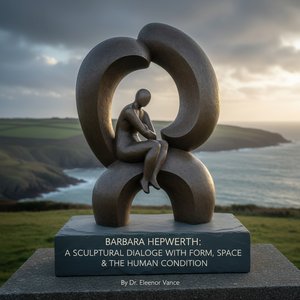
Barbara Hepworth: A Sculptural Dialogue with Form, Space & the Human Condition
Explore the profound world of Barbara Hepworth's sculpture. Discover her artistic evolution, iconic forms, and lasting influence on modern art. A guide for collectors & enthusiasts.

The Enduring Form: Sculpture Across History, Technique & Emotional Resonance
Explore the rich history of sculpture with OriginalUniqueArt. Discover key techniques, influential artists & investment potential for discerning collectors. Expert insights into valuing and collecting timeless masterpieces.

Top 10 Legendarische Bronzen Meesterwerken die de Kunst Veranderden | OriginalUniqueArt
Ontdek de 10 meest legendarische bronzen meesterwerken die de kunstgeschiedenis veranderden! Van Rodin tot Michelangelo, leer over techniek & betekenis. Museumkwaliteit reproducties voor uw interieur op OriginalUniqueArt.com. Exploreer de collectie online!

Top 10 Bronzen Beeldhouwwerken die de Kunst Voorgoed Veranderden | OriginalUniqueArt
Ontdek de 10 meest legendarische bronzen beeldhouwwerken die kunstgeschiedenis schreven! Van Rodin tot Michelangelo, leer over hun meesterwerken & technieken. Vind museumkwaliteit reproducties en inspiratie voor uw interieur op OriginalUniqueArt.com.


