

 Bekijk op ware grootte
 Verstuur
 Delen
Delen
 Details bekijken
 Gids voor studentenkunstwerken

 Download
 Vergelijkbare items
 Röntgenonderzoek
 Diavoorstelling
 Statistieken
Fruit, Flowers, and Shells
 Oil On Canvas
- WallArt
- Baroque Still Life
 1629
1629- Renaissance
 55.0 x 89.0 cm
 Toledo Museum of Art
 Lees meer
Handgemaakte olieverfreproductie
Met de hand geschilderd in olieverf op canvas in uw gewenste maat en lijst, op bestelling gemaakt door onze kunstenaars. ( Schakel over naar print Schakel over naar digitale afbeeldingen)




P118B €10

P118H €10

P118W €10

P438Z €10

P508JH €12

P508YH €12

P805H €10

P805Z €10

P919BZ €10

P919G €10

P919XJ €10

P959ZH €10

P968JZ €12

W106C €8

W218G €10

W218JH €8

W218Y €10

W307PJ €10

W316G €10

W316PJ €8

W316Y €10

W398PJ €8

W4111J €10

W500HY €15

W500JH €15

W692G €12

W849H €8

W940BG €15

W953PJ €8




Kies uit onze vooraf ingestelde maten die overeenkomen met de originele verhoudingen van het kunstwerk.

Voer de breedte en de hoogte in die u nodig heeft, passend bij uw lijst of uw muur. Dit is handgeschilderd, dus bij een afmeting met een andere vormverhouding kan de kunstenaar iets meer rondom het schilderij schilderen of juist iets meer weglaten — u kiest zelf. Wij sturen u een digitaal mockup ter goedkeuring voordat het schilderwerk begint. De afbeelding die op deze pagina wordt getoond, is niet het uiteindelijke resultaat — alleen de mockup geeft dit weer.
Na de bestelling zal het team van OriginalUniqueArt.com per e-mail contact opnemen met de klant voor instructies en een mockup-voorbeeld sturen.
Wereldwijde levering () binnen 3 tot 4 weken in plaats van de standaard 5 weken. (23 oktober). Zonder concessies aan de kwaliteit.

Gratis wereldwijde expressverzending

Hoogwaardig linnen canvas

Volledige verzendverzekering

Garantie op terugbetaling van invoerrechten

Garantie op exacte kleurweergave

Retourbeleid van 100 dagen (alleen bij defecten)

100% Geld-terug-garantie

Korting bij meerdere afnames
 De optie voor glas is alleen beschikbaar bij een formaat kleiner dan 110 cm.

Fruit, Flowers, and Shells
Reproductiemethode
Formaat reproductie
-


Totaalprijs
€ 263
A Symphony of Natural Wonders: Balthasar van der Ast’s *Fruit, Flowers, and Shells*
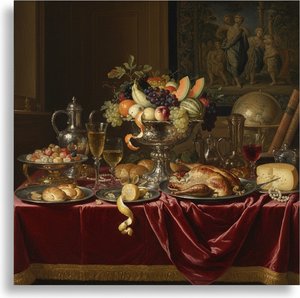
Balthasar van der Ast's 1629 masterpiece, *Fruit, Flowers, and Shells*, is more than a still life; it’s a meticulously crafted window into the burgeoning world of Dutch Golden Age artistry and intellectual curiosity. This painting, measuring 55 x 89 cm, immediately captivates with its astonishing detail – a profusion of exquisitely rendered fruit, flowers, and shells that seem poised to leap from the canvas. Van der Ast’s skill isn't merely in depicting these objects; it lies in his ability to imbue them with a sense of scientific observation and humanist contemplation, reflecting the profound shifts occurring across Europe during the 16th and 17th centuries.
The Art of Shell Painting and Scientific Observation
Van der Ast’s reputation rests largely on his pioneering work in shell painting, a technique demanding an almost obsessive attention to detail. He elevates the humble shell – sourced from exotic locales like the South Pacific and Indian Ocean – into objects of profound beauty and scientific interest. The inclusion of these shells, alongside rare tulips (introduced to Europe from Turkey around 1550), parrots, lizards, and crickets, speaks to the era’s fascination with natural history and the collecting of curiosities. This wasn't simply about aesthetic pleasure; it mirrored the burgeoning scientific revolution, where artists like Van der Ast were engaged in a rigorous study of form, texture, and color – mirroring the advancements being made in astronomy, physics, and medicine.
A Dutch Masterpiece: Technique and Composition
The painting’s composition is masterful. Each element—the apples, grapes, pears, plums, peaches, cherries, oranges, rose, and carnation – occupies a distinct space, inviting the viewer to examine each object with careful attention. The inclusion of the Chinese Wan-li porcelain vase, enhanced with a gilded base crafted by a European goldsmith, further underscores the cross-cultural influences shaping Dutch art at the time. Van der Ast’s use of light and shadow is particularly noteworthy, creating a sense of depth and volume that brings the still life to vibrant life. His meticulous layering of glazes – a hallmark of Flemish painting – ensures an incredible richness of color and texture, allowing for subtle variations in tone that contribute significantly to the work's realism.
Symbolism and Emotional Resonance
*Fruit, Flowers, and Shells* transcends mere representation; it’s laden with symbolic meaning. The abundance of fruit represents fertility, prosperity, and the bounty of nature – themes frequently explored in Dutch art. The flowers, particularly the rose and carnation, carry their own traditional associations, adding layers of interpretation. Beyond this, the painting evokes a sense of quiet contemplation and appreciation for the beauty of the natural world. It’s a testament to Van der Ast's ability to capture not just what he saw, but also the emotions and ideas associated with his subject matter – a skill that continues to resonate with viewers today.
Vragen & Antwoorden
Aan welke kunstenaar wordt "Fruit, Flowers, and Shells" toegeschreven?
"Fruit, Flowers, and Shells" wordt toegeschreven aan Balthasar Van Der Ast.
Hoe populair is "Fruit, Flowers, and Shells" binnen Baroque Still Life?
Binnen de Baroque Still Life-stroming heeft "Fruit, Flowers, and Shells" een Recognized populariteitsniveau.
In welk jaar werd "Fruit, Flowers, and Shells" door Balthasar Van Der Ast gemaakt?
"Fruit, Flowers, and Shells" dateert uit 1629. Deze datum plaatst het werk binnen de carrière van Balthasar Van Der Ast en de betreffende tijdperk.
Biografie van de kunstenaar
De Meester van het Miniatuuruniversum: Balthasar van der Ast
In het gouden licht van de zeventiende-eeuwse Nederlanden, een periode die werd gedefinieerd door ongekende welvaart en wetenschappelijke nieuwsgierigheid, kwam Balthasar van der Ast naar voren als een virtuoso van het kleinschalige meesterwerk. Geboren in Middelburg rond 1593, schilderde Van der Ast niet louter objecten; hij regisseerde stille drama's op canvas. Zijn leven was diep verweven met de opkomende koopmanscultuur van Zeeland, als zoon van een welvarende wolhandelaar, Hans van der Ast. Deze achtergrond bood hem meer dan alleen sociale stabiliteit; het bood hem een vroege intimiteit met de exotische goederen en kostbare exemplaren die later de protagonisten van zijn gevierde stillevens zouden worden.
De koers van zijn artistieke ziel werd onherroepelijk gevormd door zijn verbinding met de Bosschaert-dynastie. Door een familiale band werd Van der Ast de protegee van de legendarische Ambrosius Bosschaert de Oude, zijn stiefvader. Onder deze begeleiding meesterde hij de minutieuze precisie die vereist was voor het "bloemstuk", een genre dat een bijna microscopisch niveau van observatie vroeg. Deze lijn van excellentie stelde hem in staat een techniek te verfijnen die werd gekenmerende door subtiele tonale gradaties en een diep respect voor de fysieke textuur van de natuur. Hij stond niet alleen in deze zoektocht naar perfectie; samen met zijn zwagers hielp hij een stilistische beweging te cultiveren die de delicate wisselwerking tussen licht en schaduw prioriteerde, waardoor eenvoudige botanische studies werden getransformeerd tot diepzinnige meditaties over het bestaan.
Een Symfonie van Schelpen en Flora
Terwijl veel van zijn tijdgenoten zich uitsluitend concentreerden op de vergankelijke schoonheid van bloesems, bereikte Van der Ast historische onsterfelijkheid door zijn pionierswerk in de conchologie. Hij werd een voorloper van het schelpenstilleven, waarbij hij de verkalkte resten van zeedieren met dezelfde eerbied behandelde als het zachtste bloemblad. In werken zoals "Stilleven met pruimen, kersen en schelpen" kan men getuige zijn van de adembenemende versmelting van verschillende texturen: de sappige, doorschijnende schil van fruit in contrast met de harde, parelmoerachtige oppervlakken van exotische schelpen. Deze fascinatie was niet louter esthetisch; het weerspiegelde de groeiende wetenschappelijke interesse in de natuurhistorie en de wereldwijde reikwijdte van de Nederlandse maritieme handel.
Zijn composities fungeerden vaak als veel meer dan loutere vertoningen van rijkdom of botanische accuraatheid. Om nauwkeurig naar een schilderij van Van der Ast te kijken, is het aangaan van een complex web van symboliek geworteld in de humanistische filosofie. Binnen zijn arrangementen kan men het volgende vinden:
- De vergankelijkheid van het leven: Vertegenwoordigd door verwelkende bloemblaadjes of insecten die de schoonheid die zij bewonen, zelf consumeren.
- Wetenschappelijke observatie: Een minutieuze registratie van soorten, als reflectie van het Tijdperk van de Ontdekkingen en de dorst naar kennis.
- Vanitas-thema's: Subtiele herinneringen aan de sterfelijkheid, waarbij het verval van fruit dient als een aangrijpend memento mori.
Erfenis en Artistieke Betekenis
De invloed van Balthasar van der Ast reikte veel verder dan zijn eigen atelier in Utrecht. Door kunstenaars zoals Roelandt Savery te verwelkomen in het lokale gilde, hielp hij een omgeving te creëren waarin tonaliteit en realisme konden floreren. Zijn vermogen om levenloze objecten te voorzien van een gevoel van vitaliteit—een kwaliteit die zichtbaar is in zijn afbeeldingen van hagedissen en insecten die tussen het fruit kruipen—zette een nieuwe standaard voor de Nederlandse Gouden Eeuw. Hij bracht het stilleven-genre weg van statische composities naar een meer dynamische, ademende realiteit.
Vandaag de dag blijven zijn werken hoekstenen van museumcollecties wereldwijd, van het British Museum tot de grote galeries van Europa. Zijn nalatenschap is terug te vinden in elke penseelstreek die een dauwdruppel op een blad of de iriserende glans van een schelp vastlegt. Balthasar van der Ast blijft een titan van het Stilleven, een kunstenaar die de wereld leerde om het oneindige te vinden in het oneindig kleine, en die de nederige objecten van de natuurlijke wereld transformeerde tot eeuwige iconen van schoonheid.

Balthasar Van Der Ast
1593 - 1657 , Nederland
Snelle feiten
- Artistic Movement Or Style: Gouden Eeuw schilderkunst
- Artists Or Movements Influenced By This Artist: Nederlandse Barok
- Artists Who Influenced This Artist: Ambrosius Bosschaert
- Date Of Birth: 1593
- Date Of Death: 1657
- Full Name: Balthasar van der Ast
- Nationality: Nederlands
- Notable Artworks:
- Fruit en schelpen op een richel
- Tulp
- Hagedis en schelp
- Place Of Birth: Middelburg, Nederland
Gerelateerde artikelen
Abraham Hendricksz van Beyeren: Pioneering Dutch Still Life & the Banquet Tradition
Explore the captivating world of Dutch Golden Age still life with Abraham van Beyeren. Discover his innovative techniques, symbolic banquet scenes & lasting influence on art history. Learn about collecting these masterpieces.

Rembrandt's Meesterwerken: De Top 25 – Kunst voor uw Interieur | OriginalUniqueArt
Ontdek de 25 meest iconische schilderijen van Rembrandt van Rijn! Duik in de Gouden Eeuw, bewonder zijn portretten & zelfportretten. Museumkwaliteit reproducties voor uw interieur op OriginalUniqueArt.com. Bekijk de collectie!

Golden Light & Dutch Skies: The Timeless Magic of Dutch Golden Age Landscapes
Discover the breathtaking beauty of Dutch Golden Age landscapes. Explore the mastery of light, chiaroscuro, and 17th-century realism through an expert art history lens, celebrating the enduring legacy of the Dutch Masters for discerning collectors and art lovers.

Golden Age Reflections: Dutch Baroque Painting & Cultural Innovation
Explore the Dutch Golden Age of painting! Discover key artists like Vermeer & ter Borch, their innovative techniques, and the rich cultural context behind these Baroque masterpieces. Learn about collecting & appreciating this iconic art period.

Top 10 Meesterwerken van de Gouden Eeuw: Kunst voor uw interieur | OriginalUniqueArt.nl
Ontdek de 10 meesterwerken van de Gouden Eeuw! Leer over Rembrandt, Vermeer & andere Hollandse schilders. Prachtige kunst reproducties voor uw interieur. Museumkwaliteit prints op OriginalUniqueArt.com.