German Expressionism · 1913
Three acts (August Macke, 1913)
August Macke (1887–1914) maakte Three acts. Het dateert uit 1913. Het behoort tot de German Expressionism-stroming. Het is gemaakt van Oil On Canvas. De afmetingen zijn 82 × 51 cm.
- 1913
- Oil On Canvas
- 82 × 51 cm

 Voorvertoning

 Met de hand geschilderd olieverfwerk
 Verstuur
 Delen
 Informatieblad


 Download
 Vergelijkbare items
 Röntgenonderzoek
 Diavoorstelling
 Vraag & antwoord

 Statistieken
Three acts, in het kort
- Titel
- Three acts
- Kunstenaar
- August Macke (1887–1914)
- Geboren in [jaar]
- Meschede, Duitsland
- Datum
- 1913
- Medium
- Oil On Canvas
- Afmetingen
- 82 × 51 cm
- Beweging
- German Expressionism
- Periode
- Modern
- Onderwerp
- women, nude figures, trees, foliage, nature, vibrant colors
Wat stelt Three acts voor?
A Symphony of Color and Form
In the vibrant tapestry of German Expressionism, few works capture the ephemeral beauty of life as poignantly as August Macke’s Three Acts. Painted in 1913, this masterpiece serves as a window into a world where color is not merely a descriptive tool but an emotional language. The canvas presents a breathtaking scene of three naked women standing amidst a lush, natural setting, their forms harmoniously integrated with the surrounding trees and foliage. There is an undeniable sense of rhythm in the composition; the way the figures are positioned—one partially obscuring another—creates a captivating visual dance that draws the eye through the depth of the forest. This arrangement does more than just showcase the human form; it establishes an intimate connection between the subjects, suggesting a shared moment of peace and profound togetherness.
The technique employed by Macke is nothing short of luminous. Utilizing bold brushstrokes and a palette of rich, saturated hues, he breathes life into the canvas, imbuing the scene with a palpable energy. The interplay of light and shadow across the skin of the women and the verdant leaves of the backdrop creates a sense of movement, as if a gentle breeze is passing through the clearing. For the discerning collector or interior designer, this painting offers a dynamic focal point that can transform a room, bringing an infusion of vitality and warmth to any sophisticated space.
The Spirit of Expressionism and Historical Resonance
To understand Three Acts, one must look toward the historical currents that shaped Macke’s brief but brilliant career. As a key figure associated with the Der Blaue Reiter movement, Macke was deeply influenced by the avant-garde explorations of his contemporaries, such as Franz Marc and Robert Delaunay. His work sits at a fascinating intersection of Fauvism and Orphism, where the structural integrity of form meets the wild, uninhibited use of color. This specific piece, created just a year before Macke’s untimely death in the First World War, embodies the optimistic, experimental spirit of pre-war European modernism.
The symbolism within the painting transcends the literal depiction of a pastoral scene. The "three acts" suggested by the title can be interpreted as a celebration of the cycles of nature or perhaps a metaphorical representation of stages of life and connection. By stripping the figures of clothing, Macke removes the distractions of social class or era, presenting a universalized vision of humanity in its most natural state. This raw, unadorned beauty, paired with the distorted yet graceful forms characteristic of Expressionism, evokes an emotional intensity that resonates deeply with the viewer, inviting contemplation on the harmony between the human spirit and the natural world.
An Invitation to Timeless Elegance
Owning a piece of art history is a profound experience, and a high-quality reproduction of Three Acts offers an opportunity to bring this era of German Expressionism into the modern home. Whether you are an art historian captivated by the technical nuances of Macke’s brushwork or an interior designer seeking to add a layer of sophisticated narrative to a curated collection, this artwork provides endless inspiration. The painting's ability to balance vibrant energy with a serene, meditative atmosphere makes it a versatile treasure for any decor style, from contemporary minimalism to classic luxury.
Investing in a hand-painted reproduction allows the enduring legacy of August Macke to live on within your personal sanctuary. Each stroke of the brush in a faithful recreation seeks to honor the original's texture and light, ensuring that the emotional impact of those three figures in the forest remains as potent today as it was in 1913. It is more than just a decoration; it is an invitation to experience a moment of eternal summer, frozen in a masterpiece of color and soul.
Hoogwaardige afbeeldingen van Three acts
Publiek domein: de kunstenaar is overleden in 1914.
August Macke, Three acts (1913).
August Macke (1887–1914), Three acts, 1913, oil on canvas. Publiek domein Afbeelding: OriginalUniqueArt.com.
Veelgestelde vragen over Three acts
In welk jaar werd "Three acts" door August Macke gemaakt?
"Three acts" dateert uit 1913. Deze datum plaatst het werk binnen de carrière van August Macke en het betreffende tijdperk.
Met welke techniek is "Three acts" door August Macke vervaardigd?
August Macke gebruikte de Oil On Canvas-techniek voor "Three acts". De techniek bepaalt de materiële aard van het originele werk.
Wat zijn de afmetingen van het originele "Three acts"?
De afmetingen van "Three acts" door August Macke zijn 82 x 51 cm. Reproducties kunnen in andere formaten worden besteld met behoud van dezelfde verhoudingen.
Wat stelt "Three acts" door August Macke voor?
De thema's die aanwezig zijn in "Three acts" door August Macke omvatten women, nude figures, trees, foliage, nature, vibrant colors. Samen vatten zij de onderwerpen van het kunstwerk samen.
Behoort "Three acts" door August Macke tot het publiek domein?
"Three acts" door August Macke valt onder bevindt zich in het publiek domein - de auteursrechten zijn verlopen. Deze status bepaalt hoe de afbeelding van het werk mag worden gereproduceerd.
Wie heeft "Three acts" gemaakt?
"Three acts" is gemaakt door August Macke. De informatie op deze pagina beschrijft het originele werk van August Macke.
Tot welke stijl behoort "Three acts"?
"Three acts" door August Macke behoort tot de German Expressionism-stroming. Deze stroming biedt de stilistische context van het werk.
In welke periode van de carrière van August Macke valt "Three acts"?
"Three acts" behoort tot de Mature Period in de carrière van August Macke. Deze classificatie plaatst het werk in de context van de ontwikkeling van de kunstenaar.
Hoe oud was August Macke bij het creëren van "Three acts" in 1913?
August Macke maakte "Three acts" op 26-jarige leeftijd. De kunstenaar werd geboren in 1887 en het werk dateert uit 1913.
Over de kunstenaar, August Macke
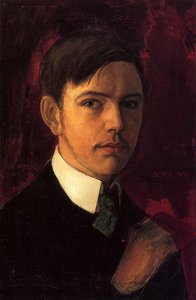
1887–1914, Duitsland
August Macke
Vroege jaren, familie en opleiding Het verhaal van August Macke begint in het Duitse stadje Meschede, waar hij op 3 januari 1887 werd geboren. Hij was de enige zoon van August Friedrich Hermann Macke, een aannemer en amateurkunstenaar, en Maria Florentine. Zijn jeugd werd gevormd door de wisselende fortuinen van het bedrijf van zijn vader, wat de familie naar Keulen en later naar Bonn bracht. Al als kleine jongen was de drang naar visuele expressie duidelijk voelbaar; hij bracht zijn vroege jaren door met het schetsen en ontwerpen van decors voor schooltoneelstukken, waarmee hij al een manier vond om zijn omgeving op papier te vertalen, lang voordat hij ooit een formele academie zou betreden.
Ook van August Macke
 Vrouw in een groene jas1913
 Bathing Girls with Town in Background1913
 De Hut1913
 Portret van de vrouw van de kunstenaar met hoed1909
Essays over Three acts
 German artworks of the 1890sIn 1893, Franz von Stuck created The Sin, a work exploring psychological temptation through a luminous figure and a dark, coiled serpent.
 Comparing Der Blaue Reiter and Die Brücke: Two Paths of German ExpressionismDie Brücke was founded in Dresden in 1905 by architecture students like Ernst Ludwig Kirchner. Why did their raw style clash with Munich's …
 German artworks of the 1910sIn 1911, Franz Marc used blue to represent masculinity and spirituality. See how ten works from the 1910s redefined the purpose of the imag…