

 Voorvertoning
 Verstuur
 Delen
Delen
 Details bekijken
 Gids
Gids

 Download
 Vergelijkbare items
 Röntgenonderzoek
 Diavoorstelling
 Statistieken
Man Reading in a Park


 Lees meer
Handgemaakte olieverfreproductie
Met de hand geschilderd in olieverf op canvas in uw gewenste maat en lijst, op bestelling gemaakt door onze kunstenaars. ( Schakel over naar print Schakel over naar digitale afbeeldingen)




P118B €10

P118H €10

P118W €10

P438Z €10

P508JH €12

P508YH €12

P805H €10

P805Z €10

P919BZ €10

P919G €10

P919XJ €10

P959ZH €10

P968JZ €12

W106C €8

W218G €10

W218JH €8

W218Y €10

W307PJ €10

W316G €10

W316PJ €8

W316Y €10

W398PJ €8

W4111J €10

W500HY €15

W500JH €15

W692G €12

W849H €8

W940BG €15

W953PJ €8




Kies uit onze vooraf ingestelde maten die overeenkomen met de originele verhoudingen van het kunstwerk.

Voer de breedte en hoogte in die u nodig heeft, passend bij uw lijst of uw muur. Omdat dit handgeschilderd is, kan de kunstenaar bij een afmeting met een andere beeldverhouding iets meer rondom het schilderij schilderen of juist iets meer weglaten — u kiest zelf. Wij sturen u een digitaal mockup ter goedkeuring voordat het schilderwerk begint. De afbeelding die op deze pagina wordt getoond, is niet het uiteindelijke resultaat — alleen de mockup geeft dit weer.
Na de bestelling zal het team van OriginalUniqueArt.com per e-mail contact opnemen met de klant voor instructies en een mockup-voorbeeld sturen.
Wereldwijde levering () binnen 3 tot 4 weken in plaats van de standaard 5 weken. (27 oktober). Zonder concessies aan de kwaliteit.

Gratis wereldwijde expressverzending

Hoogwaardig linnen canvas

Volledige verzendverzekering

Garantie op terugbetaling van invoerrechten

Garantie op exacte kleurweergave

Retourbeleid van 100 dagen (alleen bij defecten)

100% Geld-terug-garantie

Korting bij meerdere afnames
 De optie voor glas is alleen beschikbaar bij een formaat kleiner dan 110 cm.

Man Reading in a Park
Druktechniek
Afmetingen reproductie
-


Eindtotaal
€ 264
A Moment Suspended in Time: The Leisure of August Macke
To gaze upon Man Reading in a Park is to step through a veil into a perfect afternoon—a moment so richly imbued with quiet contemplation that it feels almost suspended outside the rush of modern life. This painting by August Macke captures more than just a man on a bench; it encapsulates the very essence of leisure, the profound luxury of simply being present amidst the vibrant chaos of nature and society. The composition draws the eye immediately to the central figure, absorbed in the narrative held within his newspaper, yet the surrounding park life—the distant figures, the delicate perch of a bird against the foliage—reminds us that solitude is often found within community.
The Luminous Brushwork of German Expressionism
Macke’s technique here is a masterful blend of Impressionistic light play and the emotional depth characteristic of early German Expressionism. While his style hints at the bright, almost joyous palette associated with the movement, there is an underlying sense of poignant introspection. Observe the handling of the paint; it possesses a palpable texture, suggesting Macke’s skilled use of impasto that allows the sunlight filtering through the leaves to become visible pigment itself. The background is not merely painted scenery; it breathes. It vibrates with color and suggestion, allowing the viewer's own imagination to fill in the details of conversation or activity happening just beyond our direct focus.
Context and the Fleeting Nature of Joy
Painted in 1914, this work carries the bittersweet resonance of its time. August Macke’s life was tragically cut short by the looming shadow of global conflict, making works like this an artifact imbued with a poignant nostalgia for peace and simple pleasures. The park setting becomes a sanctuary—a temporary haven before the storm. It speaks to a yearning for permanence in an era defined by rapid change, suggesting that true beauty resides in these small, unrepeatable pockets of calm.
Symbolism of Solitude Amidst Life
The symbolism within Man Reading in a Park is wonderfully layered. The newspaper itself acts as a barrier and a portal; it connects the man to the outside world's discourse while simultaneously isolating him in his personal bubble of thought. Meanwhile, the surrounding activity—the other figures enjoying their day—serves as a beautiful counterpoint, reminding us that even when we seek quietude, we are always part of a larger, interconnected human tapestry. The bird perched overhead is nature’s silent witness, observing the ritual of human repose.
Bringing Macke's Atmosphere Home
For collectors and designers alike, this piece offers more than mere decoration; it offers an emotional anchor. Reproducing the luminosity and evocative mood of Man Reading in a Park allows one to infuse a space with sophisticated tranquility. Imagine this scene rendered on a wall—a vibrant conversation starter that whispers tales of sun-drenched afternoons and thoughtful repose, transforming any room into a curated retreat.
Veelgestelde vragen
Kan ik "Man Reading in a Park" door August Macke op mijn eigen muur bekijken voordat ik het koop?
"Man Reading in a Park" heeft een augmented reality-preview: de AR-weergave-pagina van het kunstwerk toont het in uw eigen ruimte op een compatibel apparaat.
Kan ik "Man Reading in a Park" door August Macke onder ander licht bekijken?
De röntgenweergave van "Man Reading in a Park" door August Macke is te vinden op de Röntgenanalyse-pagina van het kunstwerk: een interactieve verkenning van het beeld door middel van elf optische lagen.
Wie heeft "Man Reading in a Park" gemaakt en in welk jaar?
"Man Reading in a Park" is gemaakt door August Macke en dateert uit 1914.
Biografie kunstenaar
A Life Cut Short: The Vibrant World of August Macke
August Robert Ludwig Macke, a name inextricably linked to the brief but intensely vibrant flowering of German Expressionism, lived a life tragically curtailed by the horrors of the First World War. Born in 1887 in Meschede, a small town nestled within the Westphalian countryside, his artistic journey was one of rapid evolution and profound exploration – a relentless pursuit of capturing not just what he *saw*, but how he *felt* about it. Macke’s early years were marked by a restless spirit and an insatiable curiosity, qualities that would shape his distinctive approach to art. Moving with his family to Bonn, he quickly discovered a passion for drawing, abandoning formal schooling at the tender age of seventeen to dedicate himself entirely to his burgeoning talent. This decision, defying societal expectations, laid the foundation for a career defined by artistic freedom and a willingness to challenge conventional norms.Early Influences and Artistic Beginnings
Macke’s formative years were deeply influenced by the artistic currents swirling around him. Initially drawn to the Impressionist movement – captivated by its exploration of light and color—he spent his early days meticulously studying the works of Monet, Renoir, and Pissarro. However, he soon recognized that a purely representational approach wasn't enough to satisfy his creative impulses. Seeking new avenues for expression, Macke enrolled at the Düsseldorf Art Academy in 1904, hoping to refine his skills under the guidance of Adolf Maennchen. Yet, the academy’s rigid curriculum and emphasis on historical accuracy proved stifling to his innovative spirit. He found himself increasingly frustrated by the prevailing artistic dogma, yearning for a more personal and expressive voice. Supplementing his formal training with stage design work – a surprisingly demanding profession—he honed his compositional skills and developed a keen eye for color and form. It was during this period that he began experimenting with bold, non-naturalistic colors, foreshadowing the vibrant palette that would become his signature style.The Parisian Awakening: Orphism and Beyond
A pivotal moment in Macke’s artistic development arrived in 1907 when he traveled to Paris – a city teeming with artistic innovation and intellectual ferment. There, he encountered Robert Delaunay, a leading proponent of Orphism—a radical branch of Cubism focused on pure abstraction and the harmonious interplay of colors. This encounter proved transformative, introducing Macke to the concept of simultaneous contrast and fundamentally altering his approach to composition. He began to break down forms into fragmented planes of color, creating dynamic and visually arresting images that seemed to vibrate with energy. Simultaneously, he forged a deep friendship with Franz Marc, a fellow artist and member of Der Blaue Reiter—a group dedicated to exploring the spiritual dimensions of art. Marc’s influence encouraged Macke to embrace abstraction and experiment with symbolic imagery, while also fostering a sense of camaraderie and shared artistic vision. His time in Paris was not just about absorbing new techniques; it was about fundamentally reshaping his understanding of what art could be—a vehicle for expressing emotion, spirituality, and the beauty of the natural world.Der Blaue Reiter and the Pursuit of Harmony
Macke’s membership in Der Blaue Reiter marked a crucial turning point in his career. The group, founded by Wassily Kandinsky and Franz Marc, provided a platform for artists to challenge conventional artistic norms and explore new modes of expression. Macke contributed significantly to the group's exhibitions and publications, helping to disseminate its radical ideas about art and spirituality. However, he remained true to his own unique vision, refusing to be confined by any single stylistic category. Unlike some of his colleagues who leaned towards darker, more angst-ridden themes, Macke consistently sought to portray beauty and harmony in the world around him. His paintings—such as *Bathing Girls with Town in the Background*—exemplify this approach: vibrant colors, simplified forms, and a sense of idyllic tranquility characterize his work. He masterfully blended elements of Fauvism, Cubism, and Futurism into a distinctly personal style, creating compositions that are both visually striking and emotionally resonant. His exploration of color was particularly profound; he didn’t simply replicate the hues of nature but used them to evoke specific emotions and create a sense of atmosphere.A Tragic End and Lasting Legacy
The outbreak of World War I brought a sudden and devastating end to Macke’s promising career. Driven by patriotic fervor, he volunteered for military service in 1914, tragically losing his life just weeks later on September 26th at the front near Champagne, France, at the young age of 27. His final painting, *Farewell*, poignantly captures the somber mood that descended upon Europe as war engulfed the continent. Despite his untimely death, August Macke’s legacy endures. His paintings—characterized by their vibrant colors, dynamic compositions, and optimistic vision—continue to captivate and inspire viewers today. He remains a significant figure in the history of Expressionism, celebrated for his ability to infuse ordinary subjects with extraordinary beauty and emotion. His work serves as a powerful reminder of the transformative potential of art and the enduring human need for connection, joy, and meaning. Exploring his paintings through online databases such as OriginalUniqueArt allows for a closer examination of his technique and subject matter, revealing the enduring appeal of this remarkable artist whose life was tragically cut short but whose legacy continues to shine brightly.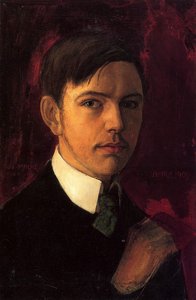
August Macke
1887 - 1914 , Duitsland
Belangrijkste feiten
- Artistic Movement Or Style: Expressionisme
- Artists Or Movements Influenced By This Artist: ['Der Blaue Reiter']
- Artists Who Influenced This Artist:
- Robert Delaunay
- Franz Marc
- Date Of Birth: 3 januari 1887
- Date Of Death: 26 september 1914
- Full Name: August Robert Ludwig Macke
- Nationality: Duits
- Notable Artworks:
- Bathing Girls
- Café
- Tuin
- Place Of Birth: Meschede, Duitsland
Gerelateerde artikelen

Unmasking Emotion: A Journey Through the Raw Power and Visceral Beauty of German Expressionism
Explore the raw emotional power of German Expressionism. From Kirchner to Die Brücke, discover how artists used distortion and vibrant color to unmask the human psyche. A deep dive into art history for the discerning collector and enthusiast.

Top 10 Expressionistische Meesterwerken: Kunst die de Ziel Raakt | OriginalUniqueArt
Ontdek de 10 meest iconische Expressionistische meesterwerken! Duik in de emotionele wereld van Kirchner, Kandinsky & Nolde. Museumkwaliteit kunst reproducties voor uw interieur. Exploreer de collectie op OriginalUniqueArt.com.
August Macke: Expressionist Visions of Harmony & Modern Life
Explore the vibrant Expressionist paintings of August Macke (1887-1914). Discover his key role in Der Blaue Reiter, Fauvist influences, and captivating depictions of modern life. A comprehensive guide for art enthusiasts & collectors.

Top 10 Impressionistische Landschappen: Meesterwerken voor uw Interieur
Ontdek de 10 meest iconische impressionistische landschappen! Leer over Monet, Renoir & andere meesters. Prachtige schilderijen voor uw interieur. Museumkwaliteit reproducties op OriginalUniqueArt.com.
The Visceral Cry of a Nation: Exploring Emotion & Distortion in German Expressionism
Explore the powerful world of German Expressionism with OriginalUniqueArt. Discover Kirchner, Nolde & Die Brücke's emotive masterpieces. Learn about this pivotal art movement and its lasting impact on modern art.


