
 Voorvertoning
 Verstuur
 Delen
Delen
 Details bekijken
 Gids
Gids

 Download
 Vergelijkbare items
 Röntgenonderzoek
 Diavoorstelling
 Q&A
Q&A Statistieken
Fashion Shop

- 60.0 x 50.0 cm


 Lees meer
Giclée / Kunstafdrukken
Giclée- of canvasafdruk van museumkwaliteit met een snelle productie en flexibele afwerkingsmogelijkheden. ( Bestel handgeschilderde reproductie Schakel over naar digitale afbeeldingen)




P118B €10

P118H €10

P118W €10

P438Z €10

P508JH €12

P508YH €12

P805H €10

P805Z €10

P919BZ €10

P919G €10

P919XJ €10

P959ZH €10

P968JZ €12

W106C €8

W218G €10

W218JH €8

W218Y €10

W307PJ €10

W316G €10

W316PJ €8

W316Y €10

W398PJ €8

W4111J €10

W500HY €15

W500JH €15

W692G €12

W849H €8

W940BG €15

W953PJ €8




Kies uit onze vooraf ingestelde maten die overeenkomen met de originele verhoudingen van het kunstwerk.

Voer de gewenste breedte en hoogte in, passend bij uw lijst of muur. Een afdruk kan alleen worden ingekort en nooit groter worden gemaakt dan het origineel; een formaat met andere verhoudingen zal daarom een deel van de afbeelding verliezen. Wij sturen u een digitaal mockup ter goedkeuring voordat we tot drukwerk overgaan. De afbeelding op deze pagina toont niet de werkelijke uitsnede — dit is alleen te zien op het mockup.
Wereldwijde levering () binnen 2 weken in plaats van de standaard 4/5 weken. (1 november)

Gratis wereldwijde expressverzending

Hoogwaardig linnen canvas

Volledige verzendverzekering

Garantie op terugbetaling van invoerrechten

Garantie op exacte kleurweergave

Retourbeleid van 100 dagen (alleen bij defecten)

100% Geld-terug-garantie

Korting bij meerdere afnames
 De optie voor glas is alleen beschikbaar bij een formaat kleiner dan 110 cm.

Fashion Shop
Giclée / Kunstafdrukken
Afmetingen reproductie
-


Eindtotaal
€ 72
August Macke’s Fashion Shop – A Snapshot of Modern Life in Expressionist Color
August Robert Ludwig Macke (1887-1914) stands as one of the most poignant figures within German Expressionism, a movement born from anxieties surrounding the burgeoning industrial age and fueled by an urgent desire to convey raw emotion. His painting “Fashion Shop,” completed in 1913, encapsulates this spirit perfectly—a deceptively simple depiction of a bustling street scene transformed into a vibrant testament to artistic innovation and psychological depth. This artwork isn’t merely a representation of commerce; it's a carefully constructed visual dialogue about the relationship between humanity and its environment during a period of profound societal change.- Style: Macke’s “Fashion Shop” firmly establishes itself within the Orphism movement, a stylistic offshoot of Fauvism championed by artists like Henri Matisse. Unlike Impressionists who sought to capture fleeting moments of light and color, Orphists prioritized pure pigment—unmixed hues applied directly onto canvas—to achieve an emotional resonance that transcended mere visual accuracy. This bold chromatic approach distinguishes Macke’s work from its contemporaries and underscores his commitment to conveying feeling rather than observation.
- Technique: Macke employed a distinctive layering technique, applying thin washes of color over thicker impasto strokes. The resulting surface texture is palpable—a deliberate choice designed to heighten the painting's expressive power. Notice how the dominant reds and yellows pulsate with energy, mirroring the dynamism of the street scene while simultaneously projecting an inner turmoil that hints at Macke’s own preoccupation with existential themes.
- Historical Context: Created in 1913, “Fashion Shop” arrived during a turbulent period marked by escalating tensions leading up to World War I. The painting reflects the anxieties of its time—the rapid urbanization and industrialization reshaping European society—but also embodies a yearning for beauty and harmony amidst chaos. Macke’s deliberate use of color serves as an antidote to the grim realities of the era, offering instead a glimpse into a world brimming with vitality and potential.
- Symbolism: The inclusion of a bird perched atop the building is significant. Birds often symbolize freedom and aspiration in Symbolist art—a tradition Macke embraced—representing a desire for transcendence beyond the confines of everyday life. Simultaneously, it introduces an element of nature into the urban landscape, subtly suggesting that even amidst industrial progress, beauty and contemplation can endure.
- Emotional Impact: Viewing “Fashion Shop” evokes a feeling of both excitement and unease. The vibrant colors are invigorating, capturing the energy of the street, yet they’re tempered by the textured surface and Macke's masterful manipulation of pigment—a technique that conveys profound psychological depth. It’s a painting that invites contemplation on the complexities of modern existence and celebrates the transformative power of artistic vision.
Veelgestelde vragen
In welk jaar werd "Fashion Shop" door August Macke gemaakt?
"Fashion Shop" dateert uit 1914. Deze datum plaatst het werk binnen de carrière van August Macke en het betreffende tijdperk.
Welk onderwerp en welke sfeer combineert "Fashion Shop" door August Macke?
"Fashion Shop" door August Macke combineert cityscape, urban life, people walking, storefront, bird, color palette, harmony met een Serene atmosfeer.
Wat zijn de vorm en afmetingen van "Fashion Shop" door August Macke?
Het formaat van "Fashion Shop" is Landscape en het origineel heeft de afmetingen 60 x 50 cm. Beide zijn nuttig bij het plannen van een reproductie.
Biografie kunstenaar
A Life Cut Short: The Vibrant World of August Macke
August Robert Ludwig Macke, a name inextricably linked to the brief but intensely vibrant flowering of German Expressionism, lived a life tragically curtailed by the horrors of the First World War. Born in 1887 in Meschede, a small town nestled within the Westphalian countryside, his artistic journey was one of rapid evolution and profound exploration – a relentless pursuit of capturing not just what he *saw*, but how he *felt* about it. Macke’s early years were marked by a restless spirit and an insatiable curiosity, qualities that would shape his distinctive approach to art. Moving with his family to Bonn, he quickly discovered a passion for drawing, abandoning formal schooling at the tender age of seventeen to dedicate himself entirely to his burgeoning talent. This decision, defying societal expectations, laid the foundation for a career defined by artistic freedom and a willingness to challenge conventional norms.Early Influences and Artistic Beginnings
Macke’s formative years were deeply influenced by the artistic currents swirling around him. Initially drawn to the Impressionist movement – captivated by its exploration of light and color—he spent his early days meticulously studying the works of Monet, Renoir, and Pissarro. However, he soon recognized that a purely representational approach wasn't enough to satisfy his creative impulses. Seeking new avenues for expression, Macke enrolled at the Düsseldorf Art Academy in 1904, hoping to refine his skills under the guidance of Adolf Maennchen. Yet, the academy’s rigid curriculum and emphasis on historical accuracy proved stifling to his innovative spirit. He found himself increasingly frustrated by the prevailing artistic dogma, yearning for a more personal and expressive voice. Supplementing his formal training with stage design work – a surprisingly demanding profession—he honed his compositional skills and developed a keen eye for color and form. It was during this period that he began experimenting with bold, non-naturalistic colors, foreshadowing the vibrant palette that would become his signature style.The Parisian Awakening: Orphism and Beyond
A pivotal moment in Macke’s artistic development arrived in 1907 when he traveled to Paris – a city teeming with artistic innovation and intellectual ferment. There, he encountered Robert Delaunay, a leading proponent of Orphism—a radical branch of Cubism focused on pure abstraction and the harmonious interplay of colors. This encounter proved transformative, introducing Macke to the concept of simultaneous contrast and fundamentally altering his approach to composition. He began to break down forms into fragmented planes of color, creating dynamic and visually arresting images that seemed to vibrate with energy. Simultaneously, he forged a deep friendship with Franz Marc, a fellow artist and member of Der Blaue Reiter—a group dedicated to exploring the spiritual dimensions of art. Marc’s influence encouraged Macke to embrace abstraction and experiment with symbolic imagery, while also fostering a sense of camaraderie and shared artistic vision. His time in Paris was not just about absorbing new techniques; it was about fundamentally reshaping his understanding of what art could be—a vehicle for expressing emotion, spirituality, and the beauty of the natural world.Der Blaue Reiter and the Pursuit of Harmony
Macke’s membership in Der Blaue Reiter marked a crucial turning point in his career. The group, founded by Wassily Kandinsky and Franz Marc, provided a platform for artists to challenge conventional artistic norms and explore new modes of expression. Macke contributed significantly to the group's exhibitions and publications, helping to disseminate its radical ideas about art and spirituality. However, he remained true to his own unique vision, refusing to be confined by any single stylistic category. Unlike some of his colleagues who leaned towards darker, more angst-ridden themes, Macke consistently sought to portray beauty and harmony in the world around him. His paintings—such as *Bathing Girls with Town in the Background*—exemplify this approach: vibrant colors, simplified forms, and a sense of idyllic tranquility characterize his work. He masterfully blended elements of Fauvism, Cubism, and Futurism into a distinctly personal style, creating compositions that are both visually striking and emotionally resonant. His exploration of color was particularly profound; he didn’t simply replicate the hues of nature but used them to evoke specific emotions and create a sense of atmosphere.A Tragic End and Lasting Legacy
The outbreak of World War I brought a sudden and devastating end to Macke’s promising career. Driven by patriotic fervor, he volunteered for military service in 1914, tragically losing his life just weeks later on September 26th at the front near Champagne, France, at the young age of 27. His final painting, *Farewell*, poignantly captures the somber mood that descended upon Europe as war engulfed the continent. Despite his untimely death, August Macke’s legacy endures. His paintings—characterized by their vibrant colors, dynamic compositions, and optimistic vision—continue to captivate and inspire viewers today. He remains a significant figure in the history of Expressionism, celebrated for his ability to infuse ordinary subjects with extraordinary beauty and emotion. His work serves as a powerful reminder of the transformative potential of art and the enduring human need for connection, joy, and meaning. Exploring his paintings through online databases such as OriginalUniqueArt allows for a closer examination of his technique and subject matter, revealing the enduring appeal of this remarkable artist whose life was tragically cut short but whose legacy continues to shine brightly.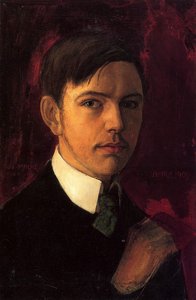
August Macke
1887 - 1914 , Duitsland
Belangrijkste feiten
- Artistic Movement Or Style: Expressionisme
- Artists Or Movements Influenced By This Artist: ['Der Blaue Reiter']
- Artists Who Influenced This Artist:
- Robert Delaunay
- Franz Marc
- Date Of Birth: 3 januari 1887
- Date Of Death: 26 september 1914
- Full Name: August Robert Ludwig Macke
- Nationality: Duits
- Notable Artworks:
- Bathing Girls
- Café
- Tuin
- Place Of Birth: Meschede, Duitsland
Gerelateerde artikelen

Top 10 Expressionistische Meesterwerken: Kunst die de Ziel Raakt | OriginalUniqueArt
Ontdek de 10 meest iconische Expressionistische meesterwerken! Duik in de emotionele wereld van Kirchner, Kandinsky & Nolde. Museumkwaliteit kunst reproducties voor uw interieur. Exploreer de collectie op OriginalUniqueArt.com.
Voorbij het Zicht: De Tactiele Dimensies en Illusie van Diepte in Abstracte Schilderkunst
Ontdek de tactiele dimensies en illusie van diepte in abstracte schilderkunst. Expert analyse van technieken, materialen & invloeden. Vind uw perfecte kunstwerk bij OriginalUniqueArt!

Decoding Impasto: The Emotional Power and Texture of Van Gogh's Brushstrokes
Explore the profound emotional depth of Van Gogh's impasto technique. Discover how his sculptural brushstrokes and textured oil layers define Post-Impressionism through an expert art-historical lens, perfect for discerning collectors and fine art enthusiasts.
The Eloquent Brushstroke: A Historical & Technical Exploration of Texture, Intent & Expression in Painting
Explore the rich history & techniques of impasto painting – from Renaissance masters to Van Gogh's expressive strokes. Discover how artists use texture to convey emotion and create lasting impact. Learn more!
The Tactile Canvas: Exploring Texture as Subject, Materiality & Meaning in Art History
Explore the rich history of texture in art! Discover how artists from Van Gogh to contemporary masters use materiality & technique to create captivating tactile experiences. Deepen your art appreciation with OriginalUniqueArt.


