Symbolist Painting · 1879
Spring Evening (Arnold Böcklin, 1879)
Arnold Böcklin (1827–1901) maakte Spring Evening. Het dateert uit 1879. Het behoort tot de Symbolist Painting-stroming. Het is gemaakt van Oil On Panel. Het is te vinden in Szépművészeti Múzeum in Boedapest, Hongarije. De afmetingen zijn 67 × 129 cm.
- 1879
- Oil On Panel
- 67 × 129 cm
- Szépművészeti Múzeum, Boedapest

 Voorvertoning

 Met de hand geschilderd olieverfwerk
 Verstuur
 Delen
 Informatieblad


 Download
 Vergelijkbare items
 Röntgenonderzoek
 Diavoorstelling
 Vraag & antwoord

 Statistieken
Spring Evening, in het kort
- Titel
- Spring Evening
- Kunstenaar
- Arnold Böcklin (1827–1901)
- Geboren in [jaar]
- Bazel, Zwitserland
- Datum
- 1879
- Medium
- Oil On Panel
- Afmetingen
- 67 × 129 cm
- Te zien in
- Szépművészeti Múzeum, Boedapest, Hongarije
- Beweging
- Symbolist Painting
- Onderwerp
- mythology, nymphs, pan, forest, evening, landscape
Wat stelt Spring Evening voor?
The Ethereal Embrace of Spring Evening
Arnold Böcklin’s “Spring Evening,” painted in 1879, isn't merely a depiction of a woodland scene; it’s an immersion into a realm of melancholic beauty and profound symbolism. Created during his time in Florence – a city that profoundly shaped his artistic vision – the painting captures a fleeting moment of enchantment, steeped in the atmosphere of late Romanticism and foreshadowing the rise of Symbolism. The canvas breathes with a quiet intensity, dominated by muted greens, blues, and browns, creating an almost dreamlike quality that immediately draws the viewer into its hushed world.
At the heart of the composition stands a woman, her posture suggesting both contemplation and vulnerability. Her hand gently resting on her head is a gesture simultaneously of yielding and quiet strength – she’s not passively observing but actively engaged with the scene unfolding before her. Beside her sits a man, seemingly lost in thought as he peruses a book, his presence offering a grounding element to the ethereal atmosphere. A bear, rendered with surprising tenderness, interacts playfully with both figures, blurring the lines between human and animal, nature and civilization. This carefully orchestrated tableau speaks of harmony, connection, and the delicate balance of the natural world.
A Symphony of Symbolism
Böcklin’s work is deeply rooted in mythology and folklore, drawing heavily on ancient Greek and Roman traditions. The central figure, often interpreted as Pan – the god of nature, shepherds, and wild music – plays his pipes, summoning a chorus of unseen nymphs from the surrounding forest. These dryads, with their flowing hair and graceful movements, represent the spirit of the woods, embodying both beauty and danger. The bear itself is a potent symbol, frequently associated with strength, wisdom, and primal instincts—a reminder of humanity’s connection to the earth.
The painting's muted palette contributes significantly to its symbolic weight. The cool blues and greens evoke a sense of melancholy and introspection, while the browns ground the scene in the tangible reality of the forest floor. The lighting is soft and diffused, creating an atmosphere of twilight—a liminal space between day and night, representing transition, mystery, and perhaps even mortality. Böcklin masterfully uses color not to simply depict a landscape but to convey complex emotions and ideas.
Technique and Artistic Influences
“Spring Evening” exemplifies Böcklin’s distinctive artistic style, characterized by meticulous detail, rich textures, and an almost obsessive attention to the natural world. He employed a technique of layering thin glazes of oil paint, building up color gradually to achieve remarkable depth and luminosity. The brushwork is subtle yet expressive, conveying both the smoothness of the forest floor and the intricate details of the foliage.
Böcklin’s artistic journey was profoundly influenced by his time in Düsseldorf, where he studied under Schirmer and became associated with the Düsseldorf School of Painting. However, it was in Florence that he truly developed his unique Symbolist vision, drawing inspiration from the city's rich cultural heritage and its connection to antiquity. The painting also reflects the influence of Romanticism, particularly the emphasis on emotion, imagination, and the sublime beauty of nature—themes central to the movement.
A Timeless Resonance
“Spring Evening” continues to resonate with viewers today because it taps into universal themes of longing, connection, and the search for meaning. Its evocative atmosphere and symbolic richness invite contemplation and offer a glimpse into the artist’s deeply personal vision. The painting's enduring appeal lies in its ability to transport us to another time and place—a world where myth and reality intertwine, and where the beauty of nature is inextricably linked to the mysteries of the human soul.
In welk museum bevindt Spring Evening zich?
Szépművészeti Múzeum
Boedapest, Hongarije
Oorsprong en geschiedenis van het Szépművészeti Múzeum De oprichting van het Szépművészeti Múzeum werd formeel bezegeld door de Millenniumwet van 1896. Deze wetgevende beslissing was gericht op het creëren van een specifieke instelling voor schone kunsten in het hart van Boedapest, Hongarije. De locatie die hiervoor werd gekozen, was de plek waar voorheen het Rotunda-paviljoen stond, een structuur die oorspronkelijk werd gebouwd om de Feszty-körkép tentoon te stellen.


Hoogwaardige afbeeldingen van Spring Evening

Publiek domein: de kunstenaar is overleden in 1901.
Andere formaten, uitsneden en citatie →Arnold Böcklin, Spring Evening (1879), Szépművészeti Múzeum. Publiek domein
Vragen over Spring Evening, beantwoord
Waar kan ik het originele werk "Spring Evening" door Arnold Böcklin bewonderen?
Het originele "Spring Evening" door Arnold Böcklin wordt bewaard in Szépművészeti Múzeum, Boedapest, Hongarije. Een reproductie maakt het mogelijk om het werk thuis tentoon te stellen.
In welk jaar werd "Spring Evening" door Arnold Böcklin gemaakt?
"Spring Evening" dateert uit 1879. Deze datum plaatst het werk binnen de carrière van Arnold Böcklin en het betreffende tijdperk.
Met welke techniek is "Spring Evening" gemaakt?
"Spring Evening" is uitgevoerd in Oil On Panel.
Wat zijn de afmetingen van het originele "Spring Evening"?
Het originele werk "Spring Evening" door Arnold Böcklin heeft de afmetingen 67 x 129 cm.
Wat stelt "Spring Evening" door Arnold Böcklin voor?
De onderwerpen van "Spring Evening" zijn mythology, nymphs, pan, forest, evening, landscape, symbolism, böcklin.
Is de afbeelding van "Spring Evening" door Arnold Böcklin vrij van auteursrecht?
De auteursrechtelijke status van "Spring Evening" door Arnold Böcklin: het werk is bevindt zich in het publiek domein - de auteursrechten zijn verlopen. Dit bepaalt of reproducties van de afbeelding vrijelijk mogen worden gemaakt.
Aan welke kunstenaar wordt "Spring Evening" toegeschreven?
"Spring Evening" wordt toegeschreven aan Arnold Böcklin.
Bij welke kunststroming behoort "Spring Evening" door Arnold Böcklin?
De kunststroming die verbonden is aan "Spring Evening" door Arnold Böcklin is Symbolist Painting. Deze classificatie plaatst het werk binnen een context van verwante kunstenaars en kunstwerken.
In welke periode van de carrière van Arnold Böcklin valt "Spring Evening"?
Binnen de carrière van Arnold Böcklin valt "Spring Evening" in de Late Period. Deze fase helpt om het werk te vergelijken met andere werken van de kunstenaar.
Over de kunstenaar, Arnold Böcklin
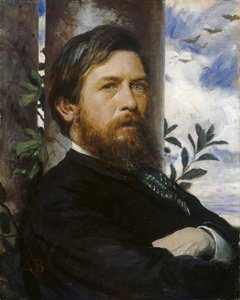
1827–1901, Zwitserland
Arnold Böcklin
De Schaduw van het Eiland Basel, Zwitserland, vormt het vertrekpunt voor een leven dat wordt gedefinieerd door de spanning tussen het tastbare en het spectrale. Geboren op 16 oktober 1827, als zoon van Christian Frederick Böcklin en Ursula Lippe, zou de jonge man zich uiteindelijk bewegen van de zijdehandel van zijn vader naar de rigoureuze zalen van de Düsseldorf Academy. Onder de begeleiding van Schirmer begon hij de taal van het landschap te absorberen, een vaardigheid die later zou worden gebruikt om de geografie van de menselijke ziel in kaart te brengen. Hij schilderde niet louter decor, hij creëerde werelden waarin het klassieke en het macabere met elkaar botsen.
Ook van Arnold Böcklin
 Het eiland der doden (Eerste versie)1880
 Zelfportret met de dood die viool speelt
 De Oorlog1896
 Eiland der Doden (Versie 5)1886

Essays over Spring Evening
 French artworks of the 1880sFrench Impressionist masterpieces by Claude Monet, Pierre-Auguste Renoir, and Georges Seurat. Find museum-quality reproductions on Original…
 Symphony of Sunlight: The Luminous Legacy of Pine Tree Landscapes in Art HistoryExplore the luminous history of pine landscapes through Sorolla and Shishkin. Discover the magic of forest art today.
 En Plein Air Serenity: Exploring the Luminous Beauty of Impressionist Garden ArtExplore the luminous history of Impressionist garden art through Monet and Van Gogh. Discover the magic of plein air painting today.