Schakel over naar print
 Lees meer







































 Voor kunstwerken of reproducties die aan één zijde groter zijn dan 105 cm (ongeveer 41 inch), wordt de lijst als een losse set verzonden. Deze methode garandeert een veilige levering en voorkomt schade tijdens het transport.


The Arresting Power of the Everyday
In the vibrant landscape of 1963, Andy Warhol unleashed a visual provocation that would forever alter the trajectory of modern art. Untitled (3181) is not merely a depiction of a common street fixture; it is an intentional disruption of the viewer's gaze. A singular, crimson stop sign dominates the canvas, its bold red hue acting as a visceral command to pause and contemplate. Behind this iconic symbol, a muted cityscape unfolds—a delicate, almost ghostly architecture that provides a somber contrast to the foreground's intensity. This juxtaposition creates a profound tension between the familiar, regulated world of urban life and the raw, unyielding energy of Pop Art, inviting anyone who stands before it to find extraordinary meaning within the ordinary.
The Mechanics of Mass Production
To understand the soul of this piece, one must look through the lens of Warhol’s revolutionary technique. Eschewing the traditional, heavy layers of oil paint favored by the Abstract Expressionists, Warhol embraced the silkscreen printing process—a method borrowed directly from the world of commercial advertising and industrial manufacturing. By transferring photographic images onto acetate and rolling them repeatedly over paper, he achieved a level of uniformity that mirrored the mass-produced goods of the era. The subtle presence of halftone dots creates a textured surface that mimics the grain of newsprint or magazine advertisements, blurring the line between fine art and consumer media. This calculated use of repetition serves as a profound commentary on the burgeoning culture of replication, where the unique is replaced by the infinitely reproducible.
A Reflection of a Changing World
Emerging during the height of the Kennedy administration, Untitled (3181) captures the pulse of an America caught between unprecedented economic prosperity and a growing fascination with celebrity and mass media. Warhol’s work acts as a mirror to a society increasingly defined by what it consumes. By elevating a mundane traffic sign to the status of a masterpiece, he challenged the elitism of the art world, suggesting that the true icons of our age are found in the streets and on the supermarket shelves. For the contemporary collector or interior designer, this piece offers more than just a striking visual; it provides a sophisticated dialogue between history and modernity. Its bold colors and graphic clarity make it an unparalleled centerpiece for any space, injecting a sense of historical weight and avant-garde spirit into a modern aesthetic.
Veelgestelde vragen
Voor welke kamer wordt "untitled (3181)" door Andy Warhol aanbevolen?
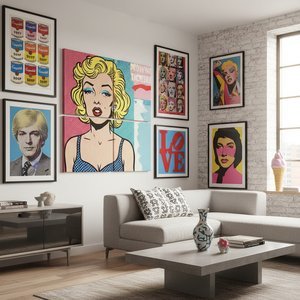
"untitled (3181)" door Andy Warhol wordt aanbevolen voor een Living Room. Deze suggestie is gebaseerd op het onderwerp, de kleuren en de sfeer van het werk.
Waar kan ik handgeschilderde reproducties van "untitled (3181)" door Andy Warhol kopen?
U kunt een met de hand geschilderde reproductie van "untitled (3181)" door Andy Warhol rechtstreeks bestellen op de Handgeschilderde reproductie pagina: een met de hand geschilderde olieverfreproductie op linnen canvas, op bestelling vervaardigd.
Hoeveel mensen bekijken "untitled (3181)"?
Statistieken over "untitled (3181)" door Andy Warhol zijn te vinden op de Statistieken-pagina van het kunstwerk: maandelijkse weergaven van het kunstwerk, weergaven van de werken van de kunstenaar en een uitsplitsing naar land en taal van recente bezoekers.
 Voorvertoning
 Verstuur
 Delen
Delen
 Details bekijken
 Gids
Gids

 Download
 Vergelijkbare items
 Röntgenonderzoek
 Diavoorstelling
 Vraag & antwoord
 Statistieken