

 Bekijk op ware grootte
 Verstuur
 Delen
Delen
 Details bekijken
 Gids voor studentenkunstwerken

 Download
 Vergelijkbare items
 Röntgenonderzoek
 Diavoorstelling
 Statistieken
Autumn Flowers


 Lees meer
Giclée / Kunstafdrukken
Giclée- of canvasafdruk van museumkwaliteit met een snelle productie en flexibele afwerkingsmogelijkheden. ( Koop handgeschilderd kunstwerk Schakel over naar digitale afbeeldingen)




P118B €10

P118H €10

P118W €10

P438Z €10

P508JH €12

P508YH €12

P805H €10

P805Z €10

P919BZ €10

P919G €10

P919XJ €10

P959ZH €10

P968JZ €12

W106C €8

W218G €10

W218JH €8

W218Y €10

W307PJ €10

W316G €10

W316PJ €8

W316Y €10

W398PJ €8

W4111J €10

W500HY €15

W500JH €15

W692G €12

W849H €8

W940BG €15

W953PJ €8




Kies uit onze vooraf ingestelde maten die overeenkomen met de originele verhoudingen van het kunstwerk.

U kunt uw eigen afmetingen opgeven om in een specifieke lijst of ruimte te passen. Als de door u gekozen maat niet overeenkomt met de proporties van het originele kunstwerk, zullen wij de afbeelding bijsnijden of uitbreiden met een gespiegelde of effen rand. Een digitaal mockup wordt ter goedkeuring naar u verzonden voordat de productie begint.
Houd er rekening mee dat de preview op het scherm de werkelijke bijsneding of uitbreiding niet weergeeft. Alleen de mockup toont de uiteindelijke compositie nauwkeurig.
Hoewel aangepaste maten beschikbaar zijn, raden wij aan een afmeting uit de vooraf bepaalde lijst te kiezen om de originele proporties te behouden.
Wereldwijde levering () binnen 2 weken in plaats van de standaard 4/5 weken. (3 oktober)

Gratis wereldwijde expressverzending

Hoogwaardig linnen canvas

Volledige verzendverzekering

Garantie op terugbetaling van invoerrechten

Garantie op exacte kleurweergave

Retourbeleid van 100 dagen (alleen bij defecten)

100% Geld-terug-garantie

Korting bij meerdere afnames
 De optie voor glas is alleen beschikbaar bij een formaat kleiner dan 110 cm.

Autumn Flowers
Giclée / Kunstafdrukken
Formaat reproductie
-


Totaalprijs
€ 70
A Portrait of a Moment: The Enigmatic Beauty of *Autumn Flowers*
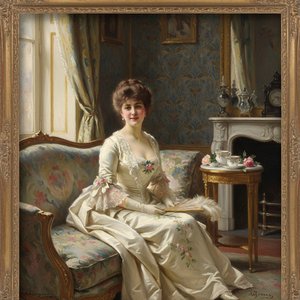
Alfred Stevens’s *Autumn Flowers*, painted in 1867, isn't merely a depiction of a woman amidst flowers; it’s an exquisitely crafted meditation on stillness, light, and the subtle poetry of everyday life. At first glance, the painting presents a seemingly simple arrangement: a seated lady, her posture suggesting quiet contemplation, surrounded by a still-life tableau of fabrics, blossoms, and a delicately rendered table. Yet, beneath this surface lies a profound exploration of form, color, and the very essence of observation – a hallmark of Stevens’s unique artistic vision.
Stevens, a pivotal figure in 19th-century Belgian art, deliberately eschewed the prevailing trends of his time. Rejecting the fleeting effects of Impressionism's vibrant light and atmosphere, he instead focused on capturing an immutable quality – the frozen gesture, the fixed expression, the enduring presence of the subject. This deliberate choice is powerfully evident in *Autumn Flowers*. The woman’s hand, poised as if about to touch a flower, isn’t caught in motion; it's suspended, imbued with a sense of timelessness. Her gaze, directed slightly off-canvas, invites us into her private world, suggesting an inner life beyond the immediate scene.
The Language of Color and Texture: Stevens’s Masterful Technique
What immediately draws the eye is Stevens's extraordinary command of color and texture. He employs a remarkably restrained palette – primarily shades of grey, black, and muted browns – punctuated by flashes of pastel pink, chestnut brown, and the glossy sheen of the table cover. This deliberate limitation isn’t a sign of restraint but rather a strategic choice to emphasize form and light. The artist masterfully utilizes chiaroscuro, creating dramatic contrasts between light and shadow that sculpt the figures and objects with remarkable precision. Notice how the highlights on the woman's chignon and the delicate folds of her dress draw our attention while simultaneously deepening the shadows around her face, lending a sense of mystery and depth.
Stevens’s technique is equally noteworthy for its meticulous detail. He employs a smooth, almost polished surface – reminiscent of 17th-century Dutch masters like Rembrandt and Vermeer – achieved through careful layering of paint and the use of a knife to blend colors seamlessly. This creates an illusion of tactile reality, inviting us to reach out and touch the fabrics, feel the texture of the flowers, and appreciate the subtle variations in color and tone. The artist’s attention to detail extends beyond mere representation; it's a deliberate attempt to capture the *essence* of each element within the composition.
Symbolism and the Portrait of Modernity
Beyond its technical brilliance, *Autumn Flowers* is rich in symbolic meaning. The woman herself represents a type of modern femininity – poised, elegant, and seemingly detached from the bustle of Parisian life. Her attire, with its jet frills and flounces, speaks to the fashionable trends of the era while simultaneously conveying a sense of quiet dignity. The surrounding still-life elements—the fabrics, flowers, and table—are not merely decorative; they function as a carefully constructed visual language, hinting at themes of luxury, domesticity, and the fleeting beauty of life.
Stevens’s comparison to Gustave Vanzype – that the painting is a still life composed of the fabrics in which she is dressed and the things around her – reveals a deeper intention. He wasn't simply depicting a woman; he was creating a miniature world, a carefully orchestrated tableau that captures a specific moment in time and reflects the values and aesthetics of his era. The reference to Whistler’s ambition to “use colours to compete with the musician who uses sounds” underscores Stevens’s own desire to elevate color from mere decoration to an expressive element within the painting.
A Legacy of Stillness: Stevens's Enduring Appeal
*Autumn Flowers* stands as a testament to Alfred Stevens’s singular artistic vision. It is a painting that rewards careful observation, inviting us to linger and contemplate its subtle nuances. Its enduring appeal lies not in dramatic gestures or fleeting effects but in its quiet beauty, its masterful technique, and its profound exploration of the human condition. Reproductions of this captivating work offer a window into a bygone era, capturing the elegance and sophistication of 19th-century Parisian life while simultaneously reminding us of the timeless power of stillness and observation.
Vragen & Antwoorden
Kan ik "Autumn Flowers" door Alfred Stevens op mijn eigen muur bekijken voordat ik het koop?
"Autumn Flowers" heeft een augmented reality-preview: de AR-voorvertoning-pagina van het kunstwerk toont het in uw eigen ruimte op een compatibel apparaat.
Hoe oud was Alfred Stevens bij het creëren van "Autumn Flowers" in 1867?
Alfred Stevens was 44 jaar oud bij het creëren van "Autumn Flowers" in 1867. De leeftijd is berekend op basis van het geboortejaar van de kunstenaar, 1823.
Hoe brengt "Autumn Flowers" licht en donker in evenwicht?
De helderheid van "Autumn Flowers" door Alfred Stevens is vastgelegd op deep_shadow, met een luminantie van Dark.
Wie is de kunstenaar achter "Autumn Flowers"?
De kunstenaar achter "Autumn Flowers" is Alfred Stevens. Het werk is gecatalogiseerd onder de naam van Alfred Stevens.
In welk jaar werd "Autumn Flowers" door Alfred Stevens gemaakt?
"Autumn Flowers" door Alfred Stevens werd gemaakt in 1867.
Is "Autumn Flowers" door Alfred Stevens een portret, landschap of vierkante compositie?
"Autumn Flowers" door Alfred Stevens is een Portrait compositie. Het is raadzaam de verhoudingen te controleren voordat u een afmeting voor de print kiest.
Zijn er werken die lijken op "Autumn Flowers"?
Werken die lijken op "Autumn Flowers" staan vermeld op de Vergelijkbare werken-pagina van het kunstwerk.
Biografie van de kunstenaar
vroege jaren en opleiding
Alfred Émile Léopold Stevens, een vooraanstaande Belgische schilder, werd op 11 mei 1823 geboren in Brussel. Zijn familie was diep geworteld in de visuele kunsten; zijn oudere broer Joseph (1816–1892) en zijn zoon Léopold (1866–1935) waren beiden schilders, terwijl een andere broer, Arthur (1825–99), werkzaam was als kunsthandelaar en criticus.artistieke carrière
Stevens begon zijn artistieke reis aan de Académie Royale des Beaux-Arts in Brussel, waar hij onder de begeleiding van François Navez studeerde, een neoklassiek schilder. In 1843 verhuisde hij naar Parijs om zich bij zijn broer Joseph te voegen en werd hij toegelaten tot de École des Beaux-als. Hoewel het onderwerp van discussie is of hij een leerling van Jean Auguste Dominique Ingres was, tonen Stevens' vroege werken, zoals The Pardon or Absolution (Hermitage, Sint-Petersburg), gesigneerd en gedateerd in 1849, zijn meesterschap in de conventionele naturalistische stijl, sterk beïnvloed door de 17e-eeuwse Nederlandse genreschilderkunst.opkomst naar roem
Het werk van Stevens werd voor het eerst publiekelijk tentoongesteld in 1851 op de Brusselse Salon, wat hem een derde-klasse medaille opleverde tijdens de Parijse Salon in 1853 en een tweede-klasse medaille op de Universele Expositie in Parijs in 1855. Zijn schilderij Ce qu'on appelle le vagabondage (Musée d'Orsay, Parijs) trok de aandacht van Napoleon III, wat uiteindelijk leidde tot een significante verandering in de behandeling van de armen.opmerkelijke werken en nalatenschap
- La Dame en Rose, of Vrouw in Roze (Musées Royaux des Beaux-Arts de Belgique, Brussel), geschilderd in 1866, is een perfect voorbeeld van Stevens' werk uit deze periode, waarbij hij een modieus geklede vrouw combineert met een gedetailleerde studie van Japanse objecten.
- Stevens werd in 1863 door de Franse regering benoemd tot Ridder (Chevalier) in de Eer van Frankrijk en werd in 1867 gepromoveerd tot Officier van de Eer van Frankrijk.

Alfred Stevens
1823 - 1906 , België
Snelle feiten
- Artistic Movement Or Style: Academisch Realisme
- Artists Who Influenced This Artist:
- Jean Auguste Dominique Ingres
- Nederlandse Meesters
- Date Of Birth: 11 mei 1823
- Date Of Death: 1906
- Full Name: Alfred Émile Léopold Stevens
- Nationality: Belgisch
- Notable Artworks:
- La Dame en Rose
- Bezoek aan het atelier
- Voorbereidende tekening voor 'Panorama van de eeuw', 'Keizerin Joséphine en haar hof'
- Place Of Birth: Brussel, België
Gerelateerde artikelen

Sir Alfred James Munnings: Top 25 Meesterwerken voor Kunstliefhebbers | OriginalUniqueArt.nl
Ontdek de top 25 schilderijen van Sir Alfred James Munnings, meester van paardenkunst & Engelse impressionisme. Leer over zijn leven, techniek en iconische werken. Museumkwaliteit reproducties op OriginalUniqueArt.com! Ontdek alle meesterwerken online.

Alfred Stevens: Capturing Parisian Life with Intimate Realism & Symbolist Flair
Explore the captivating world of Alfred Stevens, a pioneer of intimate realism & Symbolist painting. Discover his elegant portraits of Parisian women and learn about his Dutch influences & lasting legacy. Art history insights at OriginalUniqueArt.
Alfred Stevens: Capturing Parisian Elegance & Fin-de-Siècle Intimacy
Discover the captivating world of Alfred Stevens, master of Parisian elegance & intimate portraiture. Explore his techniques, influences, and legacy – a prized collection for discerning art enthusiasts.

Romantic Realism's Finest: 10 Masterpieces for Your Home | OriginalUniqueArt
Explore 10 defining masterpieces of Romantic Realism! Discover Courbet, Millet & Daumier's powerful paintings—capturing emotion and social realities. Find museum-quality reproductions for your home at OriginalUniqueArt.com.
Top 10 Realistische Kunstwerken: Meesterwerken & Verhalen voor aan de Muur
Ontdek de 10 meest iconische realistische kunstwerken! Van Courbet tot Millet, leer over meesterlijke technieken & verhalen achter deze tijdloze schilderijen. Vind museumkwaliteit reproducties voor jouw interieur op OriginalUniqueArt.com.