Cubism · 1938
Nude (Alexander Archipenko, 1938)
Alexander Archipenko (1887–1964) maakte Nude. Het dateert uit 1938. Het behoort tot de Cubism-stroming. Het is gemaakt van Oil. De afmetingen zijn 56 × 71 cm.
- 1938
- Oil
- 56 × 71 cm

 Voorvertoning

 Met de hand geschilderd olieverfwerk
 Verstuur
 Delen
 Informatieblad


 Download
 Vergelijkbare items
 Röntgenonderzoek
 Diavoorstelling
 Vraag & antwoord

 Statistieken
Nude, in het kort
- Titel
- Nude
- Kunstenaar
- Alexander Archipenko (1887–1964)
- Geboren in [jaar]
- Kiev, Oekraïne
- Datum
- 1938
- Medium
- Oil
- Afmetingen
- 56 × 71 cm
- Beweging
- Cubism
- Periode
- Modern
- Onderwerp
- nude figure, abstract form, dark swirls, melancholy mood, dynamic pose, emotional art
Wat stelt Nude voor?
Identification of Nude by Alexander Archipenko
The artwork titled Nude is a creation of the artist Alexander Archipenko. He was born in Kyiv, Ukraine, in 1887. This specific piece emerged around 1938, a period of significant transition in his creative output. The work captures a singular moment of human form through a lens of abstraction.
Archipenko’s hand shaped this vision, moving away from the rigid academicism of his early training. The figure exists within a space defined by tension and shadow. It is a study of the body stripped of ornament, focusing instead on the essential weight of the subject. The silhouette rests against a backdrop of deep, swirling tones.
The composition relies on the interplay of light and dark to define the subject. There is a quiet gravity to the pose. The figure remains still.
Composition and Visual Elements
A dark, swirling shape dominates the space, an enclosure that swallows the edges of the frame. Within this shadow, a nude female figure reclines in a dynamic, abstracted pose. Her form does not sit apart from the void; instead, the body blends into the surrounding darkness through organic, flowing shapes. The composition lacks traditional depth, utilizing a flattened perspective that pushes the subject toward the viewer's immediate gaze.
Color arrives in sharp, warm collisions. Oranges and golds strike against deep blues and browns, creating a sense of heat amidst the gloom. Lighting is dramatic, catching the contours of the figure to pull them from the dark, while casting heavy shadows that obscure the periphery. Expressive, fluid lines trace the movement of the limbs, prioritizing the suggestion of emotion over the precision of a literal likeness. The weight of the piece rests in this tension between light and the engulfing dark.
Technique and Artistic Style
The work leans toward expressionism, using color and form to carry the weight of emotion. Oil paint is applied in heavy, deliberate layers. These strokes build a tactile surface where light catches on the ridges of the pigment. Dry-brush techniques appear in the transitions, leaving a scratchy, physical trace of the tool against the canvas. The texture is not smooth but built through these repeated, rhythmic movements of the brush.
A dramatic interplay of light and shadow defines the composition. Warm oranges and golds collide with deep blues and browns, creating a sense of enclosure. The perspective is flattened, stripping away traditional depth to focus entirely on the subject's form. This approach prioritizes feeling over realistic depiction, turning the human body into a vessel for introspection and solitude. The fluid, expressive lines suggest a movement that is felt rather than seen.
Related Works by the Same Artist
The artist’s exploration of the human form often moves through fractured planes and heavy shadows. In 1912, he produced the bronze sculpture Walking Woman, a work that utilizes concave modeling to define the silhouette. This piece seeks to capture a sense of perpetual motion through the interplay of solid mass and empty space. The bronze holds the memory of a step, frozen in a rhythmic, geometric stride.
Other investigations into the body reveal a fascination with both strength and vulnerability. His 1913 work Boxing Match employs cubic and ovoid forms to translate the raw energy of combat into nonrepresentational shapes. By 1914, he had produced Torso, further deconstructing the physical presence of the subject. These studies focus on the tension between the material and the void.
The artist continued to refine these themes in later years. His 1921 work, Female Nude (Frauenakt), utilizes the same principles of fragmentation to explore intimacy. Each piece acts as a quiet study of how light meets a surface, whether that surface is a polished bronze or a painted plane. The shadow remains a constant companion to the form.
Hoogwaardige afbeeldingen van Nude
Auteursrechtelijk beschermd: deze bestanden zijn uitsluitend voor persoonlijk gebruik en vormen geen licentie voor herpublicatie.
Alexander Archipenko, Nude (1938).
Alexander Archipenko (1887–1964), Nude, 1938, oil. Afbeelding: OriginalUniqueArt.com.
Veelgestelde vragen over Nude
In welk jaar werd "Nude" door Alexander Archipenko gemaakt?
"Nude" door Alexander Archipenko werd gecreëerd in 1938.
Met welk medium is "Nude" door Alexander Archipenko uitgevoerd?
"Nude" is uitgevoerd in Oil.
Wat zijn de werkelijke afmetingen van "Nude" door Alexander Archipenko?
De afmetingen van "Nude" door Alexander Archipenko zijn 56 x 71 cm. Reproducties kunnen in andere formaten worden besteld met behoud van dezelfde verhoudingen.
Wat stelt "Nude" door Alexander Archipenko voor?
"Nude" door Alexander Archipenko toont: nude figure, abstract form, dark swirls, melancholy mood, dynamic pose, emotional art, contemplative theme.
Is "Nude" vrij van auteursrecht?
"Nude" door Alexander Archipenko valt onder nog steeds auteursrechtelijk beschermd. Deze status bepaalt hoe de afbeelding van het werk mag worden gereproduceerd.
Wie heeft "Nude" gemaakt?
De kunstenaar achter "Nude" is Alexander Archipenko. Het werk is gecatalogiseerd onder de naam van Alexander Archipenko.
Bij welke kunststroming behoort "Nude" door Alexander Archipenko?
"Nude" door Alexander Archipenko behoort tot de Cubism-stroming. Deze stroming biedt de stilistische context van het werk.
Tot welke periode in de carrière van Alexander Archipenko behoort "Nude"?
"Nude" vertegenwoordigt de Mature Period van Alexander Archipenko.
Op welke leeftijd maakte Alexander Archipenko "Nude"?
Alexander Archipenko was 51 jaar oud bij het creëren van "Nude" in 1938. De leeftijd is berekend op basis van het geboortejaar van de kunstenaar, 1887.
Over de kunstenaar, Alexander Archipenko
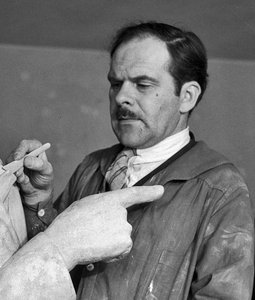
1887–1964, Oekraïne
Alexander Archipenko
A Pioneer of Cubist Sculpture: The Life and Art of Alexander Archipenko Alexander Porfyrovitsch Archipenko, geboren in Kyiv, Oekraïne, in 1887, was een figuur van ongekende invloed in de wereld van beeldhouwkunst. Zijn leven en werk getuigen van een onverminderlijke zoektocht naar nieuwe vormen en expressiemogelijkheden, die de traditionele definities van sculptuur radicaal ondergingen. Van zijn vroege jaren in Oekraïne tot zijn latere leven als Amerikaans staatsburger, Archipenko’s reis was doordrenkt met artistieke experimentatie, internationale contacten en een onwrikbare passie voor het verkennen van de grenzen van de beeldhouwkunst. Vroege Jaren in Kyiv: Archipenko ontving zijn eerste artistieke training aan de kunstacademie in Kyiv, waar hij al vroeg tekening en sculptuur studeerde.
Over Alexander Archipenko Bekende werken van Alexander Archipenko
Ook van Alexander Archipenko
 The Boxers (La Lutte)1914
 Mask1911
 Woman combing her hair1914
 The Past1926
Essays over Nude
 Ukrainian artworks of the 1870sIn 1873, Ilya Repin painted Barge Haulers on the Volga, a work that defined the shift from academicism to the realism of the 1870s.
 Abstract Harmony: A Designer's Guide to Pairing Bold Textures with Modern Luxury InteriorsMaster the art of luxury hospitality design with our expert guide on pairing bold abstract textures and impasto paintings with modern furni…
 25 Iconic Aleksandr Rodchenko Artworks: A Visual Journey Through ConstructivismIn 1923, the impulse to create About That emerged from a desire to bridge the gap between poetic text and visual structure through photomon…