
 Voorvertoning
 Verstuur
 Delen
Delen
 Details bekijken
 Gids
Gids

 Download
 Vergelijkbare items
 Röntgenonderzoek
 Diavoorstelling
 Vraag & antwoord
 Statistieken
The Lamentation

- 293.0 x 416.0 cm


 Lees meer
Ontvang een bestand dat klaar is voor drukwerk en de kwaliteit van het online voorbeeld ver overstijgt. Elke digitale afbeelding die wij verkopen, is afkomstig van een high-resolution master uit onze database — meestal tussen de 5.000 en 15.000 pixels breed — zodat u met vertrouwen groot kunt afdrukken, nauwkeurig kunt bijsnijden of fijne details kunt reproduceren.
Geen enkel bestand verlaat ons atelier onbewerkt. Een digitaal expert controleert de kleuren aan de hand van het originele schilderij en corrigeert deze indien nodig, om vervolgens de helderheid en details te verbeteren met professionele retoucheertechnieken — waarbij de penseelstreek en stijl van de kunstenaar altijd strikt worden gerespecteerd. Het resultaat is een afbeelding die oogt als het schilderij zelf, en niet als een gescande foto met een filter.
U keurt de afbeelding goed voordat de bestelling wordt afgerond: onze expert stuurt u binnen 72 uur een e-mail ter beoordeling. Niet tevreden? Vraag om aanpassingen of correcties, of vraag een terugbetaling aan als de kwaliteit niet aan de verwachtingen voldoet.
Dit is de kwaliteit waarop uitgevers, designstudio's, galeries en drukkerijen vertrouwen.
Digitale afbeeldingen
Download een bestand met hoge resolutie voor persoonlijke weergave, afdrukken en creatieve projecten. ( Schakel over naar print Bestel handgeschilderde reproductie)
Inbegrepen bij elke bestelling van een digitale afbeelding
Professionele digitale levering, gegarandeerd
Wanneer u kiest voor OriginalUniqueArt.com, ontvangt u niet alleen een afbeelding – u krijgt een professioneel verbeterd digitaal kunstwerk, met precisie vervaardigd en voorzien van een tevredenheidsgarantie. Dit is alles wat automatisch bij uw bestelling is inbegrepen:

Snelle levering per e-mail
Uw hoogwaardige digitale afbeeldingsbestand wordt binnen 72 uur na bestelling naar u gemaild – klaar voor direct gebruik.

AI-verbeterd digitaal bestand
Uw kunstwerk wordt professioneel geoptimaliseerd met behulp van geavanceerde AI-tools en handmatige bewerkingen, waardoor maximale details, helderheid en kleurnauwkeurigheid worden gegarandeerd.

Gratis levenslange herlevering van digitale bestanden
Je bestand per ongeluk verwijderd of kwijtgeraakt? Geen zorgen – we sturen het u op elk gewenst moment gratis opnieuw toe.

Geen invoerkosten – nooit
Geniet direct van uw kunstwerk zonder invoerrechten, belastingen of verzendkosten – digitale downloads zijn altijd belastingvrij.

Garantie op kleurgetrouwheid
Met behulp van professionele hulpmiddelen en kleurbeheer zorgen wij ervoor dat uw digitale afbeelding de originele kleuren zo nauwkeurig mogelijk weergeeft.

100 dagen tevredenheidsgarantie
Mocht u niet tevreden zijn met uw digitale afbeelding, dan passen wij deze aan of storten wij 100% terug binnen 100 dagen – zonder vragen te stellen.

100% Geld-terug-garantie
Niet tevreden? Ontvang een volledige terugbetaling binnen 100 dagen na ontvangst van uw digitale bestand – zonder vragen te stellen.

Korting bij grote bestellingen
Koop 3 afbeeldingen, bespaar 10% - Koop 5, bespaar 15% - Koop 10+, bespaar 20%. Ideaal voor creatieve projecten, galerieën en bureaus.
A Symphony of Sorrow: The Soul of Dürer’s Lamentation
In the quiet, silvered lines of Albrecht Dürer’s The Lamentation, one finds more than a mere religious scene; one encounters a profound meditation on the human condition. Created during the height of the Northern Renaissance, this masterpiece captures the heavy, breathless moment following the Crucifixion. The composition is anchored by the weight of Christ’s lifeless body, draped across the lap of Mary Magdalene, creating a focal point that pulls the viewer into a tight, intimate circle of mourning. As your eyes move through the piece, you encounter a constellation of grief—the Virgin Mary lifting Christ’s head, the solemn presence of John the Evangelist, and the weary shadows of Nicodemus and Joseph of Arimathea. It is a scene where every gesture, from a bowed head to a slumped shoulder, speaks of an unbearable loss that transcends time.
The technical brilliance of this work lies in Dürer’s mastery of the silverpoint technique, a method that demands absolute precision and leaves no room for error. Unlike the fluid freedom of charcoal, silverpoint requires a steady hand to etch fine, delicate lines onto a specially prepared surface. This painstaking process allows for an extraordinary level of detail, where the subtle hatching and cross-hatching create a sense of three-dimensional volume and atmospheric depth. The resulting textures—the heavy folds of mourning drapery, the weathered skin of the elders, and the soft, tragic contours of Christ’s form—are rendered with a breathtaking realism that feels almost tactile. For the collector, this level of detail offers a mesmerizing visual experience that rewards prolonged contemplation.
Symbolism and the Landscape of Loss
Beyond its anatomical perfection, The Lamentation is rich with the symbolic language characteristic of the German Renaissance. Dürer utilizes a pyramidal composition to establish a spiritual hierarchy, guiding the viewer’s gaze upward from the earthly tragedy at the base toward the heavens. Even the landscape serves as a silent participant in this drama; the presence of a barren tree, bearing only withered fruit, acts as a poignant emblem of mortality and the spiritual emptiness left in the wake of death. The interplay of light and shadow—achieved through meticulous tonal gradations—does not merely illuminate the figures but emphasizes their vulnerability, casting a somber glow upon the faces of those left to navigate a world transformed by grief.
For interior designers and connoisseurs of fine art, a high-quality reproduction of this work offers an unparalleled opportunity to introduce a sense of historical gravity and intellectual depth into a space. Whether placed in a quiet study, a formal gallery, or a sophisticated living area, the monochromatic elegance of Dürer’s silverpoint style provides a timeless aesthetic that complements both classical and contemporary decor. It is not simply a decoration; it is an invitation to reflect, a piece of history that brings the profound emotional resonance of the 16th century into the modern home, serving as a constant reminder of the enduring power of faith, memory, and the beauty found within sorrow.
Veelgestelde vragen
Wat stelt "The Lamentation" door Albrecht Dürer voor?
"The Lamentation" door Albrecht Dürer toont: mourning, grief, religious devotion, composition, detail, silverpoint drawing, renaissance.
Kan ik "The Lamentation" in meer detail bekijken?
De Röntgenanalyse-pagina van "The Lamentation" door Albrecht Dürer is een interactieve viewer waarmee u door elf optische lagen van het kunstwerk kunt glijden, inclusief een weergave in röntgenstijl.
Hoe intens zijn de kleuren in "The Lamentation" door Albrecht Dürer?
De kleuren in "The Lamentation" door Albrecht Dürer hebben een Monochromatic intensiteit.
Kunstenaarsbiografie
A Life Forged in Nuremberg: The Early Years and Apprenticeship
Albrecht Dürer, a name synonymous with the German Renaissance, emerged from the bustling artisan city of Nuremberg in 1471. His father, Albrecht Dürer the Elder, was a successful goldsmith who had immigrated from Hungary, bringing with him a lineage steeped in craftsmanship. It was within this environment—the scent of metal and the meticulous precision of handiwork—that young Albrecht’s artistic inclinations first took root. Though his father envisioned a similar path for him, apprenticing him initially in the family trade, it soon became undeniable that Albrecht possessed an exceptional gift for drawing. At thirteen, he transitioned to the workshop of Michael Wolgemut, Nuremberg's leading artist at the time. This was no mere technical training; it was immersion into a world of illuminated manuscripts, painted panels, and—crucially—the burgeoning art of woodcut illustration. The sheer volume of work produced by Wolgemut’s workshop, including the extensive illustrations for the *Nuremberg Chronicle*, provided Dürer with an unparalleled foundation in design, composition, and the mechanics of image-making. A remarkable silverpoint self-portrait from 1484, created when he was barely a teenager, stands as astonishing evidence of his precocious talent—a testament to a burgeoning artistic identity already taking shape.
The Italian Influence and Artistic Maturation
Dürer’s ambition extended far beyond the confines of Nuremberg. Driven by an insatiable curiosity and a desire to master the art of painting, he embarked on his first journey to Italy in 1494. This was not simply a sightseeing trip; it was a pilgrimage to the heart of the Renaissance. He encountered the works of masters like Raphael, Giovanni Bellini, and Leonardo da Vinci—artists who were redefining the possibilities of form, perspective, and human expression. The impact of this exposure was profound. Dürer absorbed the classical motifs, harmonious compositions, and subtle sfumato techniques that characterized Italian art, yet he never abandoned his Northern European sensibility for meticulous detail and symbolic depth. A second sojourn to Italy between 1505 and 1507 further solidified these influences, allowing him to study ancient Roman ruins and refine his understanding of anatomy and proportion. This synthesis of Northern precision and Italian grace became the hallmark of Dürer’s unique artistic style.
Mastering the Mediums: Painting, Engraving, and Woodcut
Dürer was a master of multiple mediums, each offering him distinct avenues for creative expression. His paintings, though fewer in number than his prints, demonstrate a remarkable command of oil paint and an ability to capture both physical likeness and psychological depth. Works like the *Feast of the Rose Garlands* reveal a vibrant palette influenced by Venetian colorism. However, it was in the realm of printmaking—particularly engraving and woodcut—that Dürer truly revolutionized artistic practice. He elevated these techniques from mere reproductive methods to independent art forms, capable of conveying complex narratives and profound emotions. The *Apocalypse* series (1498), a collection of fourteen woodcuts illustrating the Book of Revelation, showcased his mastery of this medium despite its inherent limitations. Later engravings like *Melencolia I* (1514) and *Saint Jerome in His Study* (1514) are testaments to his unparalleled skill—intricate compositions filled with symbolic meaning and executed with breathtaking precision. He didn’t just depict reality; he imbued it with layers of intellectual and spiritual significance.
A Theorist and Innovator: The Legacy of Albrecht Dürer
Dürer was not merely an artist; he was a scholar, a theorist, and an innovator who sought to understand the underlying principles governing artistic creation. He believed in the mathematical foundations of art and dedicated himself to establishing a scientific approach to representation. His treatises on geometry, proportion, and human anatomy—most notably *Four Books of Human Proportion* (1528)—were groundbreaking for their time, demonstrating his commitment to rigorous observation and rational analysis. These writings were not simply academic exercises; they were intended to elevate the status of artists from mere craftsmen to intellectual practitioners. Dürer’s legacy extends far beyond his individual artworks. He bridged the gap between Northern European traditions and Italian Renaissance ideals, introducing classical motifs into Northern art while maintaining its distinctive character. His theoretical contributions helped establish a new framework for artistic practice, inspiring generations of artists with his technical skill, innovative spirit, and profound vision. He remains, to this day, one of the most important figures in the history of Western art.
Influences and Enduring Impact
- Michael Wolgemut: Dürer’s initial mentor, providing foundational skills in drawing, painting, and woodcut techniques.
- Leonardo da Vinci: Inspired Dürer’s exploration of anatomy, perspective, and sfumato—the subtle blending of tones.
- Raphael: Influenced Dürer’s compositional harmony and idealized forms.
- Giovanni Bellini: Contributed to Dürer's understanding of color and Venetian painting traditions.
Dürer’s influence reverberates through centuries of art history. His meticulous realism, his innovative use of printmaking, and his theoretical writings continue to inspire artists and scholars alike. He demonstrated that art could be both technically masterful and intellectually rigorous—a legacy that continues to shape the artistic landscape today. His work stands as a testament to the power of observation, the pursuit of knowledge, and the enduring human desire to create beauty and meaning.
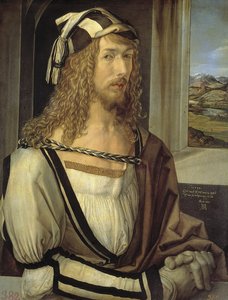
Albrecht Dürer
1471 - 1528 , Duitsland
Belangrijkste feiten
- Artistic Movement Or Style: Renaissance
- Artists Or Movements Influenced By This Artist:
- Wolgemut
- Nuremberg
- Artists Who Influenced This Artist:
- Leonardo da Vinci
- Raphael
- Bellini
- Date Of Birth: 21 mei 1471
- Date Of Death: 6 april 1528
- Full Name: Albrecht Dürer
- Nationality: Duits
- Notable Artworks:
- Apocalypse
- Melencolia I
- St. Jerome
- Place Of Birth: Nuremberg, Duitsland