

 Voorvertoning
 Verstuur
 Delen
Delen
 Details bekijken
 Gids
Gids

 Download
 Vergelijkbare items
 Röntgenonderzoek
 Diavoorstelling
 Statistieken
Evening on the Prairie


 Lees meer
Giclée / Kunstafdrukken
Giclée- of canvasafdruk van museumkwaliteit met een snelle productie en flexibele afwerkingsmogelijkheden. ( Bestel handgeschilderde reproductie Schakel over naar digitale afbeeldingen)




P118B €10

P118H €10

P118W €10

P438Z €10

P508JH €12

P508YH €12

P805H €10

P805Z €10

P919BZ €10

P919G €10

P919XJ €10

P959ZH €10

P968JZ €12

W106C €8

W218G €10

W218JH €8

W218Y €10

W307PJ €10

W316G €10

W316PJ €8

W316Y €10

W398PJ €8

W4111J €10

W500HY €15

W500JH €15

W692G €12

W849H €8

W940BG €15

W953PJ €8




Kies uit onze vooraf ingestelde maten die overeenkomen met de originele verhoudingen van het kunstwerk.

Voer de gewenste breedte en hoogte in, passend bij uw lijst of muur. Een afdruk kan alleen worden ingekort en nooit groter worden gemaakt dan het origineel; een formaat met andere verhoudingen zal daarom een deel van de afbeelding verliezen. Wij sturen u een digitaal mockup ter goedkeuring voordat we tot drukwerk overgaan. De afbeelding op deze pagina toont niet de werkelijke uitsnede — dit is alleen te zien op het mockup.
Wereldwijde levering () binnen 2 weken in plaats van de standaard 4/5 weken. (27 oktober)

Gratis wereldwijde expressverzending

Hoogwaardig linnen canvas

Volledige verzendverzekering

Garantie op terugbetaling van invoerrechten

Garantie op exacte kleurweergave

Retourbeleid van 100 dagen (alleen bij defecten)

100% Geld-terug-garantie

Korting bij meerdere afnames
 De optie voor glas is alleen beschikbaar bij een formaat kleiner dan 110 cm.

Evening on the Prairie
Giclée / Kunstafdrukken
Afmetingen reproductie
-


Eindtotaal
€ 71
A Symphony of Light and Wilderness: Albert Bierstadt’s “Evening on the Prairie”
Albert Bierstadt's "Evening on the Prairie," painted in 1870, isn’t merely a landscape; it’s an immersive experience. It transports the viewer to the heart of the American West, capturing not just the visual grandeur but also the profound emotional resonance that defined the Romantic era and Bierstadt’s own artistic vision. This monumental canvas, currently residing in the Thyssen-Bornemisza Museum in Madrid, speaks volumes about America's burgeoning fascination with its untamed frontier and the artist’s ability to translate that wonder onto the canvas.
Bierstadt, a pivotal figure within the Hudson River School movement, rejected the strict realism of earlier landscape painters. Instead, he embraced a Romantic sensibility, prioritizing atmosphere, drama, and the sublime—the feeling of awe inspired by nature’s immense power. “Evening on the Prairie” exemplifies this perfectly. The scene unfolds as twilight descends upon a vast prairie, dominated by a winding river that acts as a powerful visual guide, drawing the eye into the distant, hazy horizon. The composition is meticulously balanced, utilizing horizontal lines of the riverbanks and hills to create a sense of stability against the turbulent energy of the sky.
Technique and Luminism: A Masterful Blend
Bierstadt’s technical skill is immediately apparent in the painting's rich detail and masterful use of light. He employed a technique often referred to as “luminism,” characterized by intense, saturated colors and dramatic contrasts between light and shadow. Thick impasto brushstrokes—noticeable particularly in the clouds and foliage—lend texture and depth to the scene, inviting the viewer to almost feel the roughness of the bark on the trees or the warmth of the setting sun. The artist’s careful layering of glazes creates a luminous quality, as if the light itself is emanating from within the canvas. The use of complementary colors – the deep blues and greens of the foreground contrasted with the fiery oranges and yellows of the sunset – intensifies the visual impact.
Furthermore, Bierstadt’s background in Düsseldorf instilled a rigorous attention to detail and an understanding of atmospheric perspective. Distant elements are rendered in paler hues, creating a convincing illusion of depth and distance. The solitary rider on horseback, positioned prominently in the foreground, serves as a poignant focal point, inviting contemplation about the vastness of the landscape and the human experience within it.
Symbolism and the American Ideal
Beyond its technical brilliance, “Evening on the Prairie” is laden with symbolic meaning. The prairie itself represents the untamed spirit of America—a land of opportunity, challenge, and boundless potential. The rider, often interpreted as a pioneer or explorer, embodies the westward expansion and the drive to conquer new frontiers. The dramatic sunset evokes feelings of both beauty and melancholy, suggesting the fleeting nature of time and the inherent loneliness of venturing into the unknown. It’s a scene that resonates with the American dream—the promise of prosperity and self-reliance in a vast and challenging landscape.
Interestingly, the painting draws parallels to European Romantic landscapes, particularly those influenced by Andreas Achenbach. Bierstadt skillfully blended these influences with his own unique vision, creating an image that is both familiar and strikingly original. The inclusion of elements like the low horizon line and the solitary figure further reinforce this connection to the pastoral traditions of German landscape painting.
A Legacy Endures: Reproductions and Inspiration
Today, “Evening on the Prairie” remains a celebrated masterpiece, captivating viewers with its breathtaking beauty and evocative power. High-quality reproductions are now available, allowing art lovers to bring this iconic image into their homes and offices. These meticulously crafted prints capture the essence of Bierstadt’s original work, offering a tangible connection to a pivotal moment in American art history. Whether you're an admirer of Romanticism, a collector of Western landscapes, or simply seeking a piece of art that inspires awe and wonder, “Evening on the Prairie” is a timeless treasure.
Veelgestelde vragen
Welke emotionele toon gaat gepaard met de Hudson River School-stijl van "Evening on the Prairie"?
"Evening on the Prairie" ademt een Tranquil emotionele toon uit binnen de Hudson River School-stroming.
Wat stelt "Evening on the Prairie" door Albert Bierstadt voor?
De onderwerpen van "Evening on the Prairie" zijn american west, prairie landscape, sunset scene, horses, western art, romanticism, nature, vastness.
Wat is het aanbevolen formaat en de oriëntatie voor de afdruk van "Evening on the Prairie"?
Formaat Large, Landscape oriëntatie: dit is de aanbevolen printinstelling voor "Evening on the Prairie" door Albert Bierstadt.
Biografie kunstenaar
A Pioneer of the American West: The Life and Art of Albert Bierstadt
Albert Bierstadt’s story is deeply intertwined with the very formation of America itself. His family's early emigration to New Bedford, Massachusetts, when he was just a year old, planted the seeds for a lifelong fascination with the landscapes that would ultimately define his artistic legacy. Though initially self-taught, sketching with crayons as a youth, Bierstadt quickly recognized the need for formal training and embarked on studies in Düsseldorf, Germany, in 1853. This European grounding proved crucial, providing him with technical mastery—a meticulous attention to detail and a sophisticated understanding of light and atmosphere—that he would later apply to his depictions of the American wilderness. It wasn’t merely replication that Bierstadt sought; he aimed to convey the sublime power and beauty of nature, evoking an emotional response in the viewer.Capturing the Majesty: The Hudson River School and Beyond
Upon his return to the United States in 1857, Bierstadt swiftly became associated with the Hudson River School, a group of artists dedicated to portraying the American landscape with both accuracy and romantic idealism. While sharing their reverence for nature, Bierstadt soon distinguished himself through his ambitious scale and dramatic compositions. He wasn’t content to simply paint pretty pictures; he aimed to create immersive experiences that transported viewers directly into the heart of the wilderness. His breakthrough came in 1858 with a Swiss landscape exhibited at the National Academy of Design, earning him immediate acclaim and honorary membership. However, it was his subsequent expeditions westward—first with land surveyor Frederick W. Lander in 1859, then with author Fitz Hugh Ludlow in 1863 to Yosemite Valley—that truly ignited his artistic vision. These journeys weren’t merely acts of observation; they were profound immersions, allowing Bierstadt to absorb the grandeur of the Rocky Mountains, the vastness of the plains, and the awe-inspiring scale of canyons and waterfalls. He meticulously documented these experiences through countless sketches and studies, which served as the foundation for his monumental paintings.The Painter of Empires: Shaping Perceptions of the West
Bierstadt’s paintings weren't simply landscapes; they were statements about national identity and Manifest Destiny. His canvases—often enormous in size—depicted the American West not as a harsh, untamed frontier, but as a land of promise, abundance, and divine beauty. The Rocky Mountains, Lander’s Peak, completed in 1863 and purchased for an astonishing $25,000 (equivalent to nearly $400,000 today), exemplifies this approach. The painting isn't a precise topographical rendering; it’s a carefully constructed vision of idealized grandeur, bathed in golden light and imbued with a sense of spiritual significance. This ability to evoke emotion, to inspire awe, made Bierstadt immensely popular during his lifetime. He wasn’t just an artist; he was a cultural ambassador, shaping how Americans—and the world—perceived the West. His work fueled westward expansion by presenting it as a noble and divinely ordained undertaking. The dramatic lighting, often referred to as *luminism*, created a sense of ethereal beauty, transforming the rugged wilderness into a scene of almost religious reverence.Influences and Techniques
Bierstadt’s artistic development was shaped by several key influences. His early training in Düsseldorf instilled in him a mastery of technique—a meticulous attention to detail and a sophisticated understanding of light and atmosphere. He studied the works of German Romantic painters, particularly Caspar David Friedrich, whose emphasis on sublime landscapes profoundly influenced his own approach. However, Bierstadt’s style also evolved over time, incorporating elements of American Realism and Luminism. His expeditions westward provided him with firsthand experience of the American wilderness, which he translated into his paintings through detailed sketches and studies. He was a master of color, using rich, vibrant hues to capture the beauty of the natural world. Furthermore, Bierstadt’s use of scale—often creating monumental canvases that filled entire rooms—contributed significantly to the immersive quality of his work.Legacy and Influence
While Bierstadt's popularity waned somewhat in the late 19th century as artistic tastes shifted towards Impressionism and photography, his influence on American landscape painting remains undeniable. He demonstrated the power of large-scale canvases to create immersive experiences, a technique later adopted by many artists. His meticulous attention to detail and masterful use of light continue to inspire painters today. Beyond his technical achievements, Bierstadt’s work serves as a valuable historical document, offering insights into the evolving perceptions of the American West during a period of rapid change and expansion. He captured a moment in time—a vision of pristine wilderness before it was irrevocably altered by human intervention. His paintings are not just beautiful images; they are windows into a pivotal era in American history, reminding us of both the promise and the cost of westward expansion. His legacy endures, ensuring that his breathtaking landscapes will continue to captivate and inspire generations to come.
Albert Bierstadt
1830 - 1902 , Duitsland
Belangrijkste feiten
- Artistic Movement Or Style: Hudson River School
- Artists Or Movements Influenced By This Artist: ['Rocky Mountain School']
- Artists Who Influenced This Artist: ['Europees landschap']
- Date Of Birth: 7 jan 1830
- Date Of Death: 18 feb 1902
- Full Name: Albert Bierstadt
- Nationality: Duits-Amerikaans
- Notable Artworks:
- Rocky Mountains
- Yosemite
- Place Of Birth: Solingen, Duitsland
Gerelateerde artikelen

Top 10 Meesterwerken van het Amerikaans Realisme | Kunst & Decoratie
Ontdek de 10 meest iconische meesterwerken van het Amerikaans Realisme! Van Edward Hopper tot Andrew Wyeth, leer over de kunstenaars en hun tijdloze schilderijen. Vind museumkwaliteit reproducties & decoratie op OriginalUniqueArt.com.

Grant Wood & American Regionalism: Identity, Myth & the Rural Landscape
Explore the world of Grant Wood & American Regionalism with OriginalUniqueArt. Discover the symbolism behind 'American Gothic', recurring themes, and the movement's lasting impact on art history. High-quality reproductions available.
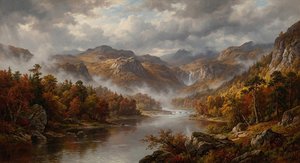
Top 10 Meesterwerken van de Hudson River School: Kunst voor uw interieur
Ontdek de 10 meesterwerken van de Hudson River School! Leer over Thomas Cole, Frederic Church & meer. Prachtige landschappen uit de 19e eeuw voor uw interieur. Kunst reproducties van museumkwaliteit op OriginalUniqueArt.com.

Albert Bierstadt: Luminosity, Landscape & the American Ideal
Explore the breathtaking landscapes of Albert Bierstadt, master of the American West & a leading figure in the Hudson River School. Discover his luminous style and iconic paintings – a timeless investment for art lovers.

American Regionalism: The Soul of the Heartland and the Mastery of Grant Wood
Explore the profound history of American Regionalism. Discover how Grant Wood captured the heart of the Midwest through masterpieces like American Gothic. An expert guide to the movement, its cultural impact, and the enduring beauty of American Realism.


