
 Voorvertoning
 Verstuur
 Delen
Delen
 Details bekijken
 Gids
Gids

 Download
 Vergelijkbare items
 Röntgenonderzoek
 Diavoorstelling
 Vraag & antwoord
 Statistieken
De Triumph van het Kruis


 Lees meer
Giclée / Kunstafdrukken
Giclée- of canvasafdruk van museumkwaliteit met een snelle productie en flexibele afwerkingsmogelijkheden. ( Bestel handgeschilderde reproductie Schakel over naar digitale afbeeldingen)




P118B €10

P118H €10

P118W €10

P438Z €10

P508JH €12

P508YH €12

P805H €10

P805Z €10

P919BZ €10

P919G €10

P919XJ €10

P959ZH €10

P968JZ €12

W106C €8

W218G €10

W218JH €8

W218Y €10

W307PJ €10

W316G €10

W316PJ €8

W316Y €10

W398PJ €8

W4111J €10

W500HY €15

W500JH €15

W692G €12

W849H €8

W940BG €15

W953PJ €8




Kies uit onze vooraf ingestelde maten die overeenkomen met de originele verhoudingen van het kunstwerk.

Voer de gewenste breedte en hoogte in, passend bij uw lijst of muur. Een afdruk kan alleen worden ingekort en nooit groter worden gemaakt dan het origineel; een formaat met andere verhoudingen zal daarom een deel van de afbeelding verliezen. Wij sturen u een digitaal mockup ter goedkeuring voordat we tot drukwerk overgaan. De afbeelding op deze pagina toont niet de werkelijke uitsnede — dit is alleen te zien op het mockup.
Wereldwijde levering () binnen 2 weken in plaats van de standaard 4/5 weken. (6 november)

Gratis wereldwijde expressverzending

Hoogwaardig linnen canvas

Volledige verzendverzekering

Garantie op terugbetaling van invoerrechten

Garantie op exacte kleurweergave

Retourbeleid van 100 dagen (alleen bij defecten)

100% Geld-terug-garantie

Korting bij meerdere afnames
 De optie voor glas is alleen beschikbaar bij een formaat kleiner dan 110 cm.

De Triumph van het Kruis
Giclée / Kunstafdrukken
Afmetingen reproductie
-


Eindtotaal
€ 72
De Triumph van het Kruis: Een Laat Gotische Visie op Religieuze Vereering
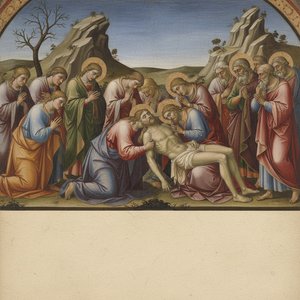
Agnolo Gaddi’s “De Triumph van het Kruis” is een fresco dat een belangrijke overgang markeert tussen de laatste glorie van het hooggotisch kunstenaarschap en de eerste tekenen van de Renaissance. Het werk, geplaatst in Santa Croce te Florence rond 1380, biedt een prachtige illustratie van een tijd waarin religieuze symboliek en artistieke innovatie hand in hand gingen. Een kunstenaar die niet alleen maar een stijl volgde, maar die deze subtiel transformeerde, waardoor hij een brug sloot tussen de oude wereld en het nieuwe licht van een opkomende kunstperiode. Het fresco vertoont een dramatische scène: Jezus Christus wordt gekruiseerd onder een kruis, omringd door een verzamelde groep mensen – soldaten, priesters en andere gelovigen. Een imposante paardenhouder staat centraal, mogelijk een Romeinse militair of een symbool van macht, terwijl de achtergrond gevormd wordt door een kastel, wat een prachtige architecturale dimensie aan het kunstwerk geeft. Gaddi’s aandacht voor detail is opvallend; elke figuur wordt zorgvuldig uitgewerkt en gekleurd, gebruikmakend van een techniek die sterk doet denken aan Giotto di Bondone, maar ook nieuwe mogelijkheden biedt voor expressie en lichtgebruik. De kleuren zijn rijkelijk gebruikt, waarbij warme tinten zoals rood en goud het oog aanspelen en de emotionele lading van de scène versterken. Een bijzonder belangrijk element is het gebruik van licht – een techniek die Gaddi leerde bij Giotto en waarmee hij een gevoel voor ruimte en dramatische compositie wist te creëren, iets wat essentieel zou blijken voor toekomstige kunstenaars. Het kunstwerk draagt een enorme historische betekenis met zich mee. Het werd geschilderd tijdens een periode van intense religieuze beweging in Florence, waarin de kerk een dominante rol speelde en het kruis een centraal symbool was van hoop en redding. De afbeelding van Jezus Christus op het kruis spreekt tot de kern van het christelijke geloof en onderstreept de waarde van zelfopoffering en liefde voor God. Bovendien biedt het fresco een fascinerende kijk op de manier waarop kunstenaars in die tijd religieuze ideeën probeerden over te brengen, waarbij lichtgebruik en kleurgebruik werden gebruikt om emoties en gevoelens aan te wakkeren bij het publiek. Een prachtige reproductie van deze klassieke fresco kan een unieke aanvulling vormen op elke kunstcollectie en een bron van inspiratie zijn voor iedereen die waarde hecht aan schoonheid en kunsthistorische kennis. Het fresco is een bewijs van Gaddi’s artistieke genialiteit en een belangrijke bijdrage aan de ontwikkeling van de Renaissance kunst in Italië. Zijn werk blijft tot op de dag van vandaag een bron van verwondering en inspiratie voor kunstliefhebbers wereldwijd. Een zorgvuldige studie van het kunstwerk kan ons veel leren over de kunstpraktijken, symboliek en emotionele impact van die tijdperiode. Een hoogwaardige reproductie biedt een prachtige manier om deze historische schoonheid te delen met toekomstige generaties.Veelgestelde vragen
Hoe kan ik kunstwerken ontdekken die lijken op "De Triumph van het Kruis" door Agnolo Gaddi?
Op de pagina Vergelijkbare werken van "De Triumph van het Kruis" door Agnolo Gaddi vindt u gerelateerde kunstwerken.
Welk palet en welke hoofdkleur bepalen "De Triumph van het Kruis"?
"De Triumph van het Kruis" door Agnolo Gaddi maakt gebruik van een Aardse tinten palet, met Espresso (#554135) als dominante kleur.
Welke afmeting van "De Triumph van het Kruis" door Agnolo Gaddi past in de aanbevolen kamer?
Voor een Hotellobby's is de aanbevolen afmeting voor de print van "De Triumph van het Kruis" door Agnolo Gaddi Groot formaat.
Biografie kunstenaar
Agnolo Gaddi (1350-1396): Florentine Painter & Last Major Follower of Giotto
Agnolo Gaddi, born in Florence around 1350, occupies a fascinating, pivotal position in the history of Italian painting. He wasn’t merely an artist; he was the inheritor of a powerful lineage, the son of Taddeo Gaddi, himself a devoted and gifted pupil of the revolutionary Giotto di Bondone. This familial connection immediately placed Agnolo within the epicenter of artistic innovation that Florence had become in the 14th century. While often described as the last great Florentine painter directly descended from Giotto’s style, to label him simply as an imitator would be a profound disservice. Gaddi wasn't just continuing a tradition; he was subtly transforming it, bridging the gap between the late Gothic sensibilities and the burgeoning promise of the Early Renaissance. His life, though relatively undocumented compared to some of his contemporaries, reveals a man deeply embedded in the artistic and commercial fabric of Florence, a city brimming with creative energy and economic prosperity. He wasn’t solely dedicated to painting; records suggest he engaged in mercantile pursuits as well, particularly later in life, demonstrating a pragmatic side often unseen in the biographies of celebrated artists.From Giotto's Shadow: Artistic Development and Influences
The influence of Giotto is undeniable in Gaddi’s early work. The monumental figures, the emotional resonance, and the narrative clarity that characterized Giotto’s frescoes are all present in Agnolo’s initial paintings. However, Gaddi quickly developed a style distinctly his own. Where Giotto often favored robust simplicity, Gaddi embraced a more refined elegance, incorporating intricate details and a heightened sense of decorative flourish. The Gothic influence is particularly noticeable in his work – a love for dramatic lighting effects, richly textured fabrics, and an overall emphasis on ornate beauty. This isn’t to say he abandoned the naturalism pioneered by Giotto; rather, he layered it with a sophisticated aesthetic sensibility that reflected the evolving tastes of Florentine society. He wasn't afraid to experiment with color, employing vibrant hues and delicate gradations to create visually arresting compositions. Consider his early frescoes at San Jacopo tra i Fossi – “The Resurrection of Lazarus” – where Gaddi captures Giotto’s expressive pathos while simultaneously elevating the composition with meticulous attention to textural detail. This careful balance exemplifies the core of Gaddi's artistic vision: honoring tradition while pushing boundaries toward a more nuanced and aesthetically compelling representation of reality.Masterpieces in Stone and Paint: Key Works and Commissions
Agnolo Gaddi’s artistic reputation rests largely on his extensive frescoes within the Basilica di Santa Croce in Florence. These monumental works, depicting scenes from *The Legend of the True Cross*, are a testament to his skill as a narrative painter and his ability to manage complex compositions. The cycle unfolds across eight frescoes in the Cappella Baroncelli and the choir, telling the story from the discovery of the tree’s seed to its eventual use in Christ's crucifixion. These aren’t merely illustrations; they are vibrant dramas populated with expressive figures and set within meticulously rendered architectural landscapes. The fresco “The Resurrection of Lazarus” stands out for its masterful depiction of grief and compassion—a poignant portrayal that resonates deeply with viewers centuries later. Beyond Santa Croce, Gaddi received commissions for altarpieces and devotional panels that showcase his versatility as an artist. The Coronation of the Virgin, now housed in the National Gallery of Art in Washington D.C., is a prime example – a luminous depiction of celestial glory filled with delicate details and graceful figures. His *Madonna and Child* paintings, often adorned with saints and angels, reveal his sensitivity to portraying maternal tenderness and divine grace. He also designed trefoils for the Loggia dei Lanzi, demonstrating his skill extended beyond painting into decorative arts.A Teacher and a Legacy: Gaddi’s Impact on Italian Art
Agnolo Gaddi wasn't just a painter; he was an educator. Among his pupils was Cennino Cennini, who would go on to become a highly influential art theorist and author of *Il Libro dell’Arte* – a treatise that served as a foundational text for generations of artists. This mentorship underscores Gaddi’s commitment to passing on his knowledge and techniques, ensuring the continuation of artistic traditions in Florence. Giorgio Vasari recognized Gaddi's importance in *Lives of the Most Excellent Painters, Sculptors, and Architects*, solidifying his place within the canon of Italian art history. He helped to refine and transmit Giotto’s style, preparing the ground for the innovations of the Early Renaissance—a crucial step in shaping the artistic landscape of Florence and beyond. His legacy continues to inspire artists today who strive to achieve both expressive power and technical mastery.Further Exploration
- Museums & Collections: Explore works by Agnolo Gaddi at the Lindenau-Museum (Germany), the National Gallery of Art (Washington D.C.), and the Galleria degli Uffizi (Florence).
- Online Resources: Delve deeper into his life and art through resources like Wikipedia (https://en.wikipedia.org/wiki/Agnolo_Gaddi) and the National Gallery of Art website (https://www.nga.gov/artists/1327-agnolo-gaddi).
- Contextual Study: To fully appreciate Gaddi’s work, research the art of Giotto and Taddeo Gaddi, as well as the broader context of 14th-century Florentine painting.

Agnolo Gaddi
1350 - 1396 , Italië
Belangrijkste feiten
- Artistic Movement Or Style: Gothic, Early Renaissance
- Artists Or Movements Influenced By This Artist: ['Cennino Cennini']
- Artists Who Influenced This Artist:
- Taddeo Gaddi
- Giotto
- Date Of Birth: Florence, ca. 1350
- Date Of Death: aldaar, 1396
- Full Name: Agnolo Gaddi
- Nationality: Italian
- Notable Artworks:
- The Last Supper
- Crucifixion
- Discovery of True Cross
- Place Of Birth: Florence, Italy
Gerelateerde artikelen

The Enduring Legacy of Fresco Painting: Techniques, History & Contemporary Relevance
Explore the rich history & enduring artistry of fresco painting – from Giotto to Michelangelo! Discover techniques, conservation efforts, & modern applications. Learn how OriginalUniqueArt brings this timeless art form to your home.

The Enduring Legacy of Fresco: Technique, History & Artistic Expression Across Cultures
Explore the rich history & enduring legacy of fresco painting! Discover ancient techniques, Giotto's masterpieces, and modern applications. Expert insights for art lovers & professionals.
Giotto di Bondone: Revolutionizing Late Medieval Painting through Narrative Innovation
Explore the revolutionary art of Giotto di Bondone! Discover his groundbreaking techniques, iconic frescoes like those in the Arena Chapel, and lasting impact on Renaissance painting. A deep dive for art enthusiasts.

De Fresco als Familielegatie: Schilder Je Erfgoed op de Muren
Ontdek de fascinerende wereld van fresco schilderkunst! Leer over technieken, geschiedenis en restauratie. Expertise & hoogwaardige reproducties bij .

Giotto di Bondone's 25 Meesterwerken: Renaissance Kunst voor uw Interieur | OriginalUniqueArt
Ontdek de 25 meesterwerken van Giotto di Bondone, pionier van de Renaissance. Verlies u in zijn fresco's & religieuze kunst. Museumkwaliteit reproducties voor uw interieur op OriginalUniqueArt.com.
