Olieverfversie
 Alles over Second Class - the parting:







































 Voor kunstwerken of reproducties die aan één zijde groter zijn dan 105 cm (ongeveer 41 inch), wordt de lijst als een losse set verzonden. Deze methode garandeert een veilige levering en voorkomt schade tijdens het transport.


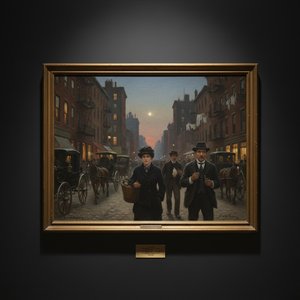
From the early 1800s, the British were encouraged to emigrate to Australia and become wealthy by working the land or, from the 1850s, by trying their luck on the goldfields. This work represents the changing popular response to emigration to Australia.When Abraham Solomon painted Second Class in 1854, circumstances in England and Australia had changed dramatically. Gold had been discovered in Australia, transportation had virtually ceased and the political print had lost its popularity in England. Solomon’s painting shows a young man leaving for the goldfields, his family accompanying him on the train journey. The work is aimed at a sentimental middle-class market – when will the mother see her son again?This painting forms part of a wider genre presenting free settlers (and gold rush emigrants) to Australia and other British empire colonies. After receiving accolades at the Royal Academy, Second Class, together with its counterpart First Class 1954, became popular through printed reproductions,being produced as a lithographic print both in England and Germany.Roger ButlerText © National Gallery of Australia, Canberra 2010From: Anne Gray (ed), Australian art in the National Gallery of Australia, National Gallery of Australia, Canberra, 2002
Veelgestelde vragen
Is Second Class - the parting: handgeschilderd of een print?
Met de hand geschilderd: een professioneel kunstenaar kopieert Second Class - the parting: in olieverf op linnen canvas.
Welke maat moet ik kiezen voor Second Class - the parting: ?
Het origineel heeft de afmetingen 966 x 694 cm. De afmetingen variëren van 25.8 x 38.7 cm (€179) tot 164.8 x 246.8 cm (€1363); in de tabel op deze pagina vindt u de verschillende opties en de bijbehorende prijzen.
Hoe lang duurt de bezorging?
De levertijd bedraagt 4 tot 5 weken, inclusief gratis wereldwijde expressverzending; op deze pagina wordt een optie voor spoedproductie aangeboden. U kunt het binnen 100 dagen zonder voorwaarden retourneren voor een volledige terugbetaling.
Waar is het origineel van Second Class - the parting: ?
Het origineel maakt deel uit van de collectie van het National Gallery of Australia, Canberra.
 Voorvertoning

 Verstuur
 Delen
 Details bekijken
 Informatieblad


 Download
 Vergelijkbare items
 Röntgenonderzoek
 Diavoorstelling
 Vraag & antwoord

 Statistieken