

 Voorvertoning
 Verstuur
 Delen
Delen
 Details bekijken

 Download
 Vergelijkbare items
 Röntgenonderzoek
 Diavoorstelling
 Statistieken
Khagen Babu


 Lees meer
Handgemaakte olieverfreproductie
Met de hand geschilderd in olieverf op canvas in uw gewenste maat en lijst, op bestelling gemaakt door onze kunstenaars. ( Schakel over naar print Schakel over naar digitale afbeelding)




P118B $10

P118H $10

P118W $10

P438Z $10

P508JH $12

P508YH $12

P805H $10

P805Z $10

P919BZ $10

P919G $10

P919XJ $10

P959ZH $10

P968JZ $12

W106C $8

W218G $10

W218JH $8

W218Y $10

W307PJ $10

W316G $10

W316PJ $8

W316Y $10

W398PJ $8

W4111J $10

W500HY $15

W500JH $15

W692G $12

W849H $8

W940BG $15

W953PJ $8




Kies uit onze vooraf ingestelde maten die overeenkomen met de originele verhoudingen van het kunstwerk.

U kunt uw eigen afmetingen invoeren om in een specifieke lijst of ruimte te passen. Als de door u gekozen maat niet overeenkomt met de verhoudingen van het originele beeld, zullen we het kunstwerk bijsnijden of het schilderij uitbreiden met extra handgeschilderde elementen. Een digitale mockup wordt ter goedkeuring naar u verzonden voordat de productie begint.
Houd er rekening mee dat de preview op het scherm niet de werkelijke uitsnede of uitbreiding weergeeft. Alleen de mockup toont de uiteindelijke compositie nauwkeurig.
Hoewel aangepaste afmetingen mogelijk zijn, raden we aan een maat uit de vooraf gedefinieerde lijst te selecteren om de originele verhoudingen te behouden.
Na de bestelling zal het team van OriginalUniqueArt.com per e-mail contact opnemen met de klant voor instructies en een mockup-voorbeeld sturen.
Wereldwijde levering () binnen 3 tot 4 weken in plaats van de standaard 5 weken. (13 september). Zonder concessies aan de kwaliteit.

Gratis wereldwijde expressverzending

Hoogwaardig linnen canvas

Volledige verzendverzekering

Garantie op terugbetaling van invoerrechten

Garantie op exacte kleurweergave

Retourbeleid van 100 dagen (alleen bij defecten)

100% Geld-terug-garantie

Korting bij meerdere afnames
 De optie voor glas is alleen beschikbaar bij een formaat kleiner dan 110 cm.

Khagen Babu
Druktechniek
Afmetingen reproductie
-


Eindtotaal
$ 300
A Portrait of Quiet Contemplation: Khagen Babu by Abanindranath Tagore
Abanindranath Tagore’s “Khagen Babu” is more than just a portrait; it's a carefully constructed meditation on Indian identity and the burgeoning movement towards a distinctly modern, yet deeply rooted, artistic expression. Painted in 1907, during a pivotal moment in India’s cultural awakening, this black-and-white photograph – meticulously reproduced as a fine art print – captures a sense of dignified introspection within a man identified simply as “Khagen Babu.” The image, originally intended for the Indian Society of Oriental Art's exhibition, immediately draws the viewer into a world where traditional Indian aesthetics are subtly interwoven with Western artistic sensibilities.
The subject himself is rendered with a remarkable restraint. His face, framed by a neatly trimmed mustache and a thoughtful gaze directed towards the camera, exudes an air of quiet contemplation. Tagore’s masterful use of light and shadow creates a subtle depth, emphasizing the lines of his face and hinting at a lifetime of experience. The background, a simple green expanse – reminiscent of traditional Indian gardens – provides a serene backdrop that allows the subject to command the entire composition. It's a deliberate choice, grounding the portrait firmly within an Indian context while simultaneously inviting a universal connection.
The Bengal School and its Hybrid Style
“Khagen Babu” is a quintessential example of the Bengal School of Art, founded by Tagore himself. This revolutionary movement sought to break away from the dominant Western artistic trends that had infiltrated India during the colonial period. Instead, it drew inspiration from ancient Indian art forms – particularly Mughal and Rajput miniature paintings – alongside elements of Japanese aesthetics, notably in its use of composition and color palettes. Tagore’s approach was not simply a revival; he skillfully blended these influences to create something entirely new: a distinctly ‘Indian’ modernism.
Notice the deliberate simplification of forms, reminiscent of traditional Indian painting styles. The brushstrokes are visible, lending a sense of immediacy and intimacy to the portrait. The use of monochrome – a conscious rejection of vibrant Western color schemes – further emphasizes the spiritual and contemplative nature of the subject. This stylistic choice was deeply symbolic, aligning with the Swadeshi movement’s emphasis on self-reliance and rejecting foreign influences.
Symbolism and the Essence of Indian Identity
Beyond its formal qualities, “Khagen Babu” is rich in symbolism. The man's posture – upright and dignified – reflects a sense of honor and tradition. The subtle details, such as the folds of his garment and the arrangement of his hands, are imbued with meaning within the context of Indian culture. Tagore’s intention was to capture not just a likeness but also an essence—a representation of the soul of India itself.
The photograph's composition echoes traditional Indian temple murals, further reinforcing this connection to national identity. The subject is presented as a figure of authority and wisdom, embodying the values of self-sufficiency, spirituality, and cultural pride that were central to the Swadeshi movement. It’s a powerful statement about reclaiming artistic agency within a nation grappling with its own history and future.
A Timeless Masterpiece for Your Space
Reproduced as a high-quality print, “Khagen Babu” offers a captivating glimpse into a pivotal moment in Indian art history. Its serene beauty and profound symbolism make it an ideal addition to any collection or interior space. Whether you’re an art enthusiast, a collector seeking unique pieces, or simply someone who appreciates the power of visual storytelling, this portrait invites contemplation and celebrates the enduring legacy of Abanindranath Tagore.
The original dimensions of 25 x 17 cm make it suitable for a variety of settings, from smaller studies to larger wall displays. Its timeless appeal ensures that “Khagen Babu” will continue to resonate with viewers for generations to come.
Biografie van de kunstenaar
Vroege Leven en Achtergrond
- Geboren: 7 mei 1861, Joransanko, Calcutta, Brits-Indië
- Overleden: 5 december 1951
- Familie: Lid van de vooraanstaande Tagore-familie; neef van Rabindranath Tagore. Zijn grootvader was Girindranath Tagore, en zijn vader was Gunendranath Tagore.
- Opleiding: Studeerde in de jaren 1880 aan het Sanskrit College in Kolkata en volgde later de Calcutta School of Art.
Artistieke Ontwikkeling en Invloeden
- Vroege Training: Leerde pasteltechnieken van O. Ghilardi en olieverfschilderen van Charles Palmer aan de Calcutta School of Art.
- Mughal- en Rajputstijlen: Streefde naar de modernisering van deze stijlen door westerse kunstmodellen te verwerpen.
- Swadeshi-waarden: Verweefde Swadeshi-waarden in zijn kunst om Indiase tradities te bevorderen.
- Whistlers Aestheticisme: Beïnvloed door de esthetische principes van Whistler.
- Japanse Invloed: Integreerde later Chinese en Japanse kalligrafische tradities in zijn stijl na ontmoetingen met de kunstenaars Tikan en Hesida.
Belangrijke Werken en Artistieke Bijdragen
- Rohini II: Een opmerkelijk werk dat zijn artistieke vaardigheid ten toon legt.
- Passing of Shajahan: Een ander significant schilderij dat zijn stijl weerspiegelt.
- Season Flower in a Vase: Demonstreert zijn meesterschap in techniek en onderwerp.
- Arabian Nights Serie (1930): Beschouwd als een van zijn grootste prestaties, waarbij hij verhalen uit de Duizend-en-één Nacht gebruikte om het koloniale Calcutta te verkennen.
- Bharat Mata: Een betekenisvol schilderij dat Moeder India symboliseert.
- Oprichter van de Bengal School of Art: Speelde een cruciale rol in de vorming van de moderne Indiase schilderkunst en het bevorderen van nationalistische kunst.
- Indian Society of Oriental Art (1907): Richtte deze vereniging op om traditionele Indiase kunstvormen te promoten.
Nalatenschap en Historisch Belang
- Pionier van de Moderne Indiase Schilderkunst: Erkend als een sleutelfiguur in de ontwikkeling van de moderne Indiase kunst.
- Invloed op Latere Kunstenaars: Mentor van vooraanstaande kunstenaars zoals Nandalal Bose, Asit Halder, Kshitindranath Majumdar en Jamini Roy.
- Revival van Traditionele Kunstvormen: Pleitte voor een terugkeer naar traditionele Indiase technieken en stijlen.
- Impact op de Bengaalse Kinderliteratuur: Schreef invloedrijke kinderboeken zoals Rajkahini, Budo Angla, Nalak en Khirer Putul.
- Nationale Kunstschatten: Zijn werken worden beschouwd als nationale kunstschatten.

Abanindranath Tagore
1871 - 1951 , India
Belangrijkste feiten
- Artistic Movement Or Style: Bengal School of Art
- Artists Or Movements Influenced By This Artist:
- Nandalal Bose
- Kshitindranath Majumdar
- Jamini Roy
- Artists Who Influenced This Artist:
- Whistler
- Mogol-kunstenaars
- Rajput-kunstenaars
- Date Of Birth: 7 mei 1871
- Date Of Death: 5 december 1951
- Full Name: Abanindranath Tagore
- Nationality: Indisch
- Notable Artworks:
- Rohini II
- Passing of Shajahan
- Season Flower in a Vase
- Place Of Birth: Jorasanko, India
Gerelateerde artikelen

The Allure of the Exotic: Orientalism in 19th-Century Art
Explore the captivating world of 19th-century Orientalist art! Discover iconic painters like Gérôme & Benjamin-Constant, key themes, and collecting insights. Expert analysis at OriginalUniqueArt.

The Alluring Gaze: Orientalism in 19th-Century Art – Representation, Reception & Construction of the 'Orient'
Explore the complex history of Orientalism in 19th-century art. Discover how Western artists depicted the 'Orient,' its cultural impact, and Edward Said's critical analysis. A deep dive for art lovers & historians.

Panoramic Visions of Empire: The Daniells’ Artistic Collaboration & Legacy
Explore the captivating 'Oriental Scenery' by Thomas & William Daniell. Discover their pioneering aquatint prints of India, imperial context, artistic collaboration, and lasting legacy. A deep dive for history lovers.
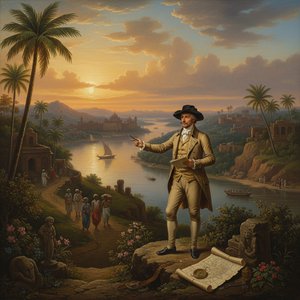
Thomas Daniell: Navigating Light, Landscape & Cultural Exchange in Early 19th-Century India
Explore the captivating landscapes of Thomas Daniell, a pioneering artist who documented India's beauty in the 19th century. Discover his 'Oriental Scenery,' aquatint technique & lasting legacy. Hand-painted reproductions available at OriginalUniqueArt.

Raja Ravi Varma: Bridging Tradition & Modernity in 19th-Century Indian Art
Explore the life & art of Raja Ravi Varma, a pioneer who fused European techniques with Indian iconography. Discover his iconic paintings, lasting legacy, and influence on modern Indian art at OriginalUniqueArt.
