Portret van Kawanabe Kyōsai

De 72 beroemdste schilderijen van Kawanabe Kyōsai, elk uniek

Bijgewerkt in oktober 2026 · gerangschikt op basis van onze populariteitsscore (zoekopdrachten, bezoeken en bestellingen per kunstwerk) · 72 werken van Kawanabe Kyōsai in onze catalogus

Kortom

Three Kyōgen Dancers (801) is het schilderij van Kawanabe Kyōsai dat de meeste aandacht trekt; het origineel bevindt zich in het Metropolitan Museum of Art, New York. Daarna gaat de blik naar Sketches of East Asian Legendary Figures (801) en Yang Guifei Adjusting her Hair (1850). Van de 72 werken van Kawanabe Kyōsai in onze catalogus zijn dit de 72 bekendste, elk een uniek origineel gepresenteerd met het jaar, het museum en de reden waarom het blijft voortbestaan.

1831 – 1889, Koga Ukiyo-e Meeste werken: Metropolitan Museum of Art

Top 10 schilderijen van Kawanabe Kyōsai, door de ogen van de galerie

1
Three Kyōgen Dancers (801) door Kawanabe Kyōsai

Three Kyōgen Dancers

This appears to be a preliminary drawing by Kyōsai for a painting of kyōgen (humorous dramatic) performance. The annotations are also in the artist’s hand, giving instructions how to color or finish off the drawings. The partial seal in the upper right corner is that of his pupil Mano Kyōtei (Yasokichi, 1874/5–1937) who assisted him on many projects and inherited many Kyōsai drawings.

2
Sketches of East Asian Legendary Figures (801) door Kawanabe Kyōsai

Sketches of East Asian Legendary Figures

The sketches here show Japanese such as Daikoku and Urashima Tarō and images of Chinese immortals or figure of the Twenty-Four Paragons of Filial Piety. Though long attributed to Kyōsai, these sketches do not seem to be in hand of the master, and could have been created by a late nineteenth Kano artist of the day.

De beroemde schilderijen van Kawanabe Kyōsai, nummer 11 tot 72

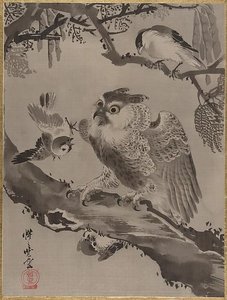
11Hell Courtesan (1880) door Kawanabe KyōsaiHell Courtesan1880 12Jurōjin [center of a triptych] (1884) door Kawanabe KyōsaiJurōjin [center of a triptych]1884 · Minneapolis Institute of Art 13Theatre Curtain of Shintomi-za, with an Impromputu Sketch Monster (1880) door Kawanabe KyōsaiTheatre Curtain of Shintomi-za, with an Impromputu Sketch Monster1880 14Squirrels Eating Chestnuts (1886) door Kawanabe KyōsaiSquirrels Eating Chestnuts1886 · Los Angeles County Museum of Art 15A Beauty in Front of King Enma's Mirror (1887) door Kawanabe KyōsaiA Beauty in Front of King Enma's Mirror1887 16Urashima Tarō Riding on a Tortoise (1888) door Kawanabe KyōsaiUrashima Tarō Riding on a Tortoise1888 · Metropolitan Museum of Art 17Two Children Playing with Goldfish (1887) door Kawanabe KyōsaiTwo Children Playing with Goldfish1887 · Metropolitan Museum of Art 18Two Birds on a Branch (1887) door Kawanabe KyōsaiTwo Birds on a Branch1887 · Metropolitan Museum of Art 19Singing Bird on a Branch (1887) door Kawanabe KyōsaiSinging Bird on a Branch1887 · Metropolitan Museum of Art 20滝に燕図 Swallows by a Waterfall (1887) door Kawanabe Kyōsai滝に燕図 Swallows by a Waterfall1887 · Metropolitan Museum of Art 21Tale of the Tongue-cut Sparrow (1800) door Kawanabe KyōsaiTale of the Tongue-cut Sparrow1800 · Los Angeles County Museum of Art 22Sketches of Birds and Animals (1870) door Kawanabe KyōsaiSketches of Birds and Animals1870 · Metropolitan Museum of Art 23Three Crossbills on a Leafless Tree (1878) door Kawanabe KyōsaiThree Crossbills on a Leafless Tree1878 · Minneapolis Institute of Art 24Chinese-style Landscape with Man Fishing from a Boat by Moonlight [right of a triptych] (1884) door Kawanabe KyōsaiChinese-style Landscape with Man Fishing from a Boat by Moonlight [right of a triptych]1884 · Minneapolis Institute of Art 25Landscape with River in Mountainous Country [left of a triptych] (1884) door Kawanabe KyōsaiLandscape with River in Mountainous Country [left of a triptych]1884 · Minneapolis Institute of Art 26猿を襲う鷲図 Eagle Attacking a Monkey (1885) door Kawanabe Kyōsai猿を襲う鷲図 Eagle Attacking a Monkey1885 · Metropolitan Museum of Art 27兎を追う鷲図 Eagle Pursuing Rabbit (1885) door Kawanabe Kyōsai兎を追う鷲図 Eagle Pursuing Rabbit1885 · Metropolitan Museum of Art 28Eagle Attacking a Mountain Lion (1885) door Kawanabe KyōsaiEagle Attacking a Mountain Lion1885 · Metropolitan Museum of Art 29White Eagle Eyeing a Mountain Lion (1885) door Kawanabe KyōsaiWhite Eagle Eyeing a Mountain Lion1885 · Metropolitan Museum of Art 30Rocky Landscape (1887) door Kawanabe KyōsaiRocky Landscape1887 · Metropolitan Museum of Art 31Crow on a Branch (1887) door Kawanabe KyōsaiCrow on a Branch1887 · Metropolitan Museum of Art 32Untitled (D2X7KF) (1887) door Kawanabe KyōsaiUntitled (D2X7KF)1887 · Metropolitan Museum of Art 33Fox Catching Bird (1887) door Kawanabe KyōsaiFox Catching Bird1887 · Metropolitan Museum of Art 34Bird and Frog (1887) door Kawanabe KyōsaiBird and Frog1887 · Metropolitan Museum of Art 35松に鴉図 Two Crows on a Pine Branch (1887) door Kawanabe Kyōsai松に鴉図 Two Crows on a Pine Branch1887 · Metropolitan Museum of Art 36Cranes in Marsh (1887) door Kawanabe KyōsaiCranes in Marsh1887 · Metropolitan Museum of Art 37Buffalo and Herdsman (1887) door Kawanabe KyōsaiBuffalo and Herdsman1887 · Metropolitan Museum of Art 38柳に鴉図 Crow and Willow Tree (1887) door Kawanabe Kyōsai柳に鴉図 Crow and Willow Tree1887 · Metropolitan Museum of Art 39岩に鴉図 Crow on a Rock (1887) door Kawanabe Kyōsai岩に鴉図 Crow on a Rock1887 · Metropolitan Museum of Art 40Owl Mocked by Small Birds (1887) door Kawanabe KyōsaiOwl Mocked by Small Birds1887 · Metropolitan Museum of Art 41木に鴉図 Crow on a Branch (1887) door Kawanabe Kyōsai木に鴉図 Crow on a Branch1887 · Metropolitan Museum of Art 42竹に鴉図 Crow on a Bamboo Branch (1887) door Kawanabe Kyōsai竹に鴉図 Crow on a Bamboo Branch1887 · Metropolitan Museum of Art 43旭に群鴉図 Flock of Crows at Dawn (1887) door Kawanabe Kyōsai旭に群鴉図 Flock of Crows at Dawn1887 · Metropolitan Museum of Art 44ムクドリ図 Starlings on a Branch (1887) door Kawanabe Kyōsaiムクドリ図 Starlings on a Branch1887 · Metropolitan Museum of Art 45Fish in a Whirlpool (1887) door Kawanabe KyōsaiFish in a Whirlpool1887 · Metropolitan Museum of Art 46富士図 Mount Fuji (1887) door Kawanabe Kyōsai富士図 Mount Fuji1887 · Metropolitan Museum of Art 47Rocky Landscape (1887) door Kawanabe KyōsaiRocky Landscape1887 · Metropolitan Museum of Art 48瓜に鼠図 Mice in a Melon (1887) door Kawanabe Kyōsai瓜に鼠図 Mice in a Melon1887 49Eagle Attacking Fish (1887) door Kawanabe KyōsaiEagle Attacking Fish1887 · Metropolitan Museum of Art 50Squirrels Gathering Chestnuts (1887) door Kawanabe KyōsaiSquirrels Gathering Chestnuts1887 · Metropolitan Museum of Art 51Monkey Hanging from Grapevines (1887) door Kawanabe KyōsaiMonkey Hanging from Grapevines1887 · Metropolitan Museum of Art 52雪中鴉図 Crow Flying in the Snow (1887) door Kawanabe Kyōsai雪中鴉図 Crow Flying in the Snow1887 · Metropolitan Museum of Art 53Waterfall, Eagle and Monkey (1887) door Kawanabe KyōsaiWaterfall, Eagle and Monkey1887 · Metropolitan Museum of Art 54月に鴉図 Crow and the Moon (1887) door Kawanabe Kyōsai月に鴉図 Crow and the Moon1887 · Metropolitan Museum of Art 55Pheasant Caught by a Snake (1887) door Kawanabe KyōsaiPheasant Caught by a Snake1887 · Metropolitan Museum of Art 56Shakyamuni Conquering the Demons (Shaka Gōma zu) (1888) door Kawanabe KyōsaiShakyamuni Conquering the Demons (Shaka Gōma zu)1888 · Metropolitan Museum of Art 57Eagle Holding Small Bird (1887) door Kawanabe KyōsaiEagle Holding Small Bird1887 · Metropolitan Museum of Art 58Monkeys (1888) door Kawanabe KyōsaiMonkeys1888 · Metropolitan Museum of Art 59Deer and Monkeys (1887) door Kawanabe KyōsaiDeer and Monkeys1887 · Metropolitan Museum of Art 60Rabbits (1887) door Kawanabe KyōsaiRabbits1887 · Metropolitan Museum of Art 61Cat Catching a Frog (1887) door Kawanabe KyōsaiCat Catching a Frog1887 · Metropolitan Museum of Art 62水辺に鴉図 Crow and Reeds by a Stream (1887) door Kawanabe Kyōsai水辺に鴉図 Crow and Reeds by a Stream1887 · Metropolitan Museum of Art 63白衣観音図 White Robed Kannon (1887) door Kawanabe Kyōsai白衣観音図 White Robed Kannon1887 · Metropolitan Museum of Art 64Playful Demon door Kawanabe KyōsaiPlayful DemonYale University Art Gallery 65Frolicking Animals, Nekomata and Tanuki Badger door Kawanabe KyōsaiFrolicking Animals, Nekomata and Tanuki Badger 66Long Arms [right of a pair of Long Legs and Long Arms] door Kawanabe KyōsaiLong Arms [right of a pair of Long Legs and Long Arms]Minneapolis Institute of Art 67Long Legs [left of a pair of Long Legs and Long Arms] door Kawanabe KyōsaiLong Legs [left of a pair of Long Legs and Long Arms]Minneapolis Institute of Art 68Seven Otafukus door Kawanabe KyōsaiSeven OtafukusMinneapolis Institute of Art 69Tanuki (Racoon Dog) Viewing Its Reflection in Water (801) door Kawanabe KyōsaiTanuki (Racoon Dog) Viewing Its Reflection in Water801 · Metropolitan Museum of Art 70Boy’s Day Carp Streamer and Shōki Banner (1870) door Kawanabe KyōsaiBoy’s Day Carp Streamer and Shōki Banner1870 · Metropolitan Museum of Art 71Figure Sketches door Kawanabe KyōsaiFigure Sketches 72Frolicking Figures and Animals door Kawanabe KyōsaiFrolicking Figures and Animals

De beroemde schilderijen van Kawanabe Kyōsai, periode voor periode

De onderwerpen die de aandacht van Kawanabe Kyōsai troffen

De vier onderwerpen die het meest voorkomen in deze originelen, elk met zijn mooiste voorbeeld.

De musea waar de originele werken van Kawanabe Kyōsai worden bewaard

De 5 musea met de meeste schilderijen op deze pagina.

Museum Stad Werken van Kawanabe Kyōsai Schilderijen uit deze lijst
Metropolitan Museum of Art, New YorkMetropolitan Museum of Art New York 48 Three Kyōgen Dancers, Sketches of East Asian Legendary Figures, Frolicking Figures and Animals
Minneapolis Institute of Art, MinneapolisMinneapolis Institute of Art Minneapolis 8 Wisteria Maiden and Demon Priest, Jurōjin [center of a triptych], Three Crossbills on a Leafless Tree
Los Angeles County Museum of Art, Los AngelesLos Angeles County Museum of Art Los Angeles 4 Yang Guifei Adjusting her Hair, Yamauba and Kintarō, Squirrels Eating Chestnuts
Cleveland Museum of Art, ClevelandCleveland Museum of Art Cleveland 2 Hell Courtesan, Painting Party
Yale University Art Gallery, New HavenYale University Art Gallery New Haven 1 Playful Demon

Kawanabe Kyōsai door de decennia heen: elk een uniek origineel

Werken per decennium

Kies een decennium om het origineel te zien dat dit tijdperk definieert.

Schilderijen van Kawanabe Kyōsai: vragen voor de galerie

Wat is het bekendste werk van Kawanabe Kyōsai?Onthul het antwoord

Three Kyōgen Dancers (801), Metropolitan Museum of Art, New York. Sketches of East Asian Legendary Figures (801) en Yang Guifei Adjusting her Hair (1850) volgen.

Welke tien schilderijen van Kawanabe Kyōsai zijn het meest bekend?Onthul het antwoord

Three Kyōgen Dancers, Sketches of East Asian Legendary Figures, Yang Guifei Adjusting her Hair, Yamauba and Kintarō, Hell Courtesan, Frolicking Figures and Animals, Calligraphy and Painting Party, Wisteria Maiden and Demon Priest, Painting Party en Night Procession of One Hundred Demons. De bovenstaande ranglijst vermeldt het jaar en het museum van elk werk.

Hoeveel werken van Kawanabe Kyōsai zijn er bekend?Onthul het antwoord

Onze catalogus bevat 72 werken van Kawanabe Kyōsai, daterend van 1850 tot 1888.

Waar kunnen de beroemdste originelen van Kawanabe Kyōsai worden bekeken?Onthul het antwoord

Voornamelijk in Metropolitan Museum of Art (New York), Minneapolis Institute of Art (Minneapolis) en Los Angeles County Museum of Art (Los Angeles). De bovenstaande museumtabel bevat een volledig overzicht.

In welke periode creëerde Kawanabe Kyōsai de bekendste schilderijen?Onthul het antwoord

In 1880s: 52 van de 72 werken op deze pagina werden toen gemaakt, waaronder Painting Party.

Welk beroemd schilderij van Kawanabe Kyōsai is de vroegste, en welke de laatste?Onthul het antwoord

Op deze pagina is het vroegste Yang Guifei Adjusting her Hair (1850) en het laatste Urashima Tarō Riding on a Tortoise (1888).

Welke onderwerpen had Kawanabe Kyōsai de voorkeur?Onthul het antwoord

Animals (9), Japanese folklore (3) en Ink wash painting (3), verspreid over de 72 werken op deze pagina.

Bij welke stroming behoort het werk van Kawanabe Kyōsai?Onthul het antwoord

Ukiyo-e, te oordelen aan de originelen op deze pagina.

Welke originele werken van Kawanabe Kyōsai kan ik zien in het Metropolitan Museum of Art?Onthul het antwoord

Three Kyōgen Dancers, Sketches of East Asian Legendary Figures en Frolicking Figures and Animals: het Metropolitan Museum of Art, New York herbergt 48 van de werken op deze pagina.

Kawanabe Kyōsai: een portret van de kunstenaar

A Life of Ink and Rebellion

Kawanabe Kyōsai entered the world in 1831 in Koga, born into a samurai family. His early years were marked by a sudden, visceral encounter with mortality when, at age nine, he discovered a human head separated from a corpse in the Kanda river. This early shock preceded a formal education under the masters of the Kanō school and Utagawa Kuniyoshi. While he mastered the precise brushwork required by tradition, his spirit gravitated toward the more liberated styles of the popular schools. He moved to Edo, where his father joined the official firefighters of the Shogunate, and there, Kyōsai began to develop a persona that would define his career.

His path was never one of quiet conformity. During the political shifts from the Edo period to the Meiji era, he became a figure of both fascination and friction. He was arrested three times by the authorities of the Shogunate, often for the satirical nature of his work which mocked government officials and criticized prevailing policies. These brushes with the law did not dampen his output; instead, they reinforced his reputation as an independent thinker. His art reflected the chaos of a nation transforming from a feudal state into a modern power.

The Demon of the Brush

Kyōsai’s technical skill was matched by a wild, undisciplined energy. He earned the nickname Shuchu gaki, or "the Painting Demon," a title he embraced through his use of various seals in his work. His subject matter was vast and often strange, ranging from the religious to the grotesque. He populated his canvases with demons, skeletons, frogs, and animals, often imbuing them with human-like humor or political significance. One notable long painting on a handscroll, The battle of the farts, captured the political ferment of his era through sheer caricature.

His creative process was as legendary as his subjects. It was said that he could paint after an entire night of drinking, entering a state where the brush moved with instinctive speed. This spontaneous style, sometimes referred to as kyōga or "crazy pictures," allowed for a fluid draughtsmanship that felt alive. While he possessed the technical foundations of the Kanō school, his work leaned into chaos and comedy rather than quiet reverence. He was a skilled woodblock print artist, producing works like Kyōsai hyakuzu and various namazu-e prints that resonated with the public.

A Legacy in Lines

Beyond his individual paintings, Kyōsai contributed to the evolution of visual storytelling. In 1874, he helped create what is considered the first manga magazine, Eshinbun Nipponchi, alongside Kanagaki Robun. Though the publication lasted only three issues, it represented an early attempt at a new form of graphic media. His influence reached far beyond Japan, as his works found their way into collections such as the British Museum and the Guimet Museum in Paris. Even Western visitors, including architects like Josiah Conder, documented his extraordinary abilities.

The artist passed away in 1889 due to gastric cancer. He left behind an immense body of work, estimated at over 10,000 pieces, spanning prints, sketches, and albums. His life was a mirror of the era he inhabited—turbulent, transitioning, and deeply complex. Through his ink, the transition from the Middle Ages to a modern industrialized society found its most expressive voice.