Portret van Eustache Le Sueur

Schilderijen van Eustache Le Sueur: De 100 bekendste, door de ogen van een galerie

Bijgewerkt in november 2026 · gerangschikt op basis van onze populariteitsscore (zoekopdrachten, bezoeken en bestellingen per kunstwerk) · 113 werken van Eustache Le Sueur in onze catalogus

Kortom

Volgens de visie van de galerie is het beroemdste schilderij van Eustache Le Sueur MORT DE RAYMOND DIOCRES, waarvan het origineel in het Louvre in Parijs hangt. Christ Healing the Blind Man en Ludwig IX. der Heilige (1635) maken het trio compleet dat elk oog herkent. Van de 113 werken van Eustache Le Sueur in onze catalogus presenteert de galerie hieronder de 100 bekendste werken, elk een origineel met de jaartal, het museum en wat het uniek maakt.

1616 – 1655, Parijs Baroque Meeste werken: Louvre

De top 10 schilderijen van Eustache Le Sueur in de galerie

1
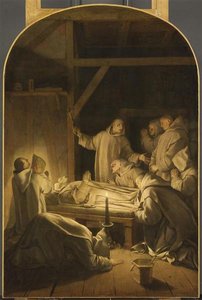
MORT DE RAYMOND DIOCRES door Eustache Le Sueur

MORT DE RAYMOND DIOCRES

Oil On Canvas · Louvre, Parijs

A single bed occupies the center of a quiet, dim room. Upon it lies Raymond Diocres, his body surrendered to the stillness of death. The air in the chamber feels heavy, thick with the scent of old wood and the weight of passing time. Around the bed, figures gather like shadows caught in a sudden beam of light. They lean in, their faces etched with the quiet gravity of those…

2
Christ Healing the Blind Man door Eustache Le Sueur

Christ Healing the Blind Man

Oil On Canvas

In this work, titled Christ Healing the Blind Man, Eustache Le Sueur presents a profound moment of divine intervention. The subject matter is drawn directly from the Bible, capturing the specific instance where Christ restores sight to a man. It is a quiet, focused encounter that centers on the act of healing. Through this narrative, the painting conveys a message of hope and redemption.

3
Ludwig IX. der Heilige (1635) door Eustache Le Sueur

Ludwig IX. der Heilige

1635 · Oil On Canvas · Bayerische Staatsgemäldesammlungen, München

This oil painting, dated 1635, presents a religious scene rendered in a grayscale, monochromatic palette. The composition is contained within an oval format, creating a vignette effect that centers the viewer's attention on a group of figures within an architectural interior. The setting appears to be a cathedral or a chapel, defined by receding arches that establish a sense of depth. Light enters from the upper right, creating a high-contrast…

4
The Sacrifice of Manoah (1626) door Eustache Le Sueur

The Sacrifice of Manoah

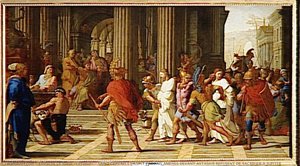
1626 · Oil On Canvas · Musée des Augustins, Toulouse

The Sacrifice of Manoah by Eustache Le Sueur captures a singular moment of spiritual revelation. The scene centers on a divine communication that interrupts the earthly ritual of a sacrifice. From the rising grey smoke of the altar, an angel emerges to meet the gaze of the faithful. This celestial presence breaks the silence of the landscape, turning a simple offering into a profound encounter between the mortal and the…

5
Raymond Diocrès Responds After His Death (1646) door Eustache Le Sueur

Raymond Diocrès Responds After His Death

1646 · Oil On Canvas

Raymond Diocrès Responds After His Death is a painting by Eustache Le Sueur. The canvas captures the figure of Raymond Diocrès, a professor at the Sorbonne, in a moment of spiritual transition. This work belongs to a larger cycle of twenty-two paintings depicting the life of Saint Bruno. These images were created between 1645 and 1648 for the small cloister of the Chartreuse de Paris.

6
Cupid, Reprimanded by His Mother, Takes Refuge in the Arms of Ceres (1646) door Eustache Le Sueur

Cupid, Reprimanded by His Mother, Takes Refuge in the Arms of Ceres

1646 · Oil On Canvas

This large-scale, horizontal oil painting from 1646 presents a mythological scene unfolding within a sky of voluminous, pale clouds. The composition is organized into three distinct groups of figures set against an atmospheric background of grays and whites. On the left, a woman draped in a deep blue mantle reclines upon dark clouds, her hand extended in a gesture toward the center of the frame. In the middle ground, a…

7
Pope Victor III Confirms the Institution of the Carthusians (1646) door Eustache Le Sueur

Pope Victor III Confirms the Institution of the Carthusians

1646 · Oil On Canvas

The oil on canvas titled Pope Victor III Confirms the Institution of the Carthusians was painted by Eustache Le Sueur. Created about 1646, the work captures a moment of religious interaction and monastic life. It centers on a papal portrait within a formal monastic setting, documenting a significant historical figure and the establishment of the Carthusian order.

8
Saint Bruno in Prayer (1646) door Eustache Le Sueur

Saint Bruno in Prayer

1646 · Oil

In a dense, shadowy woodland, three monks occupy a space defined by deep browns, muted greens, and ochre. The composition is organized through layers of depth within the dark forest. In the foreground left, a monk in white robes kneels, leaning forward with hands clasped near his face, holding a tool resembling a pickaxe. To the lower right, another monk in a similar white habit kneels, using a shovel to…

9
Ascension of the Lord, (1646) door Eustache Le Sueur

Ascension of the Lord,

1646 · Oil · Groninger Museum, Groningen

The Ascension of the Lord, by Eustache Le Sueur, is a vertically oriented oil painting created about 1646. The composition directs the viewer's gaze upward from a group of terrestrial figures toward the ascending figure of Christ. This upward movement is reinforced by the use of perspective, which establishes a sense of ascension from the grounded figures at the bottom toward the nebulous, cloud-filled sky above. The arrangement of the…

10
Meeting of Saint Bruno and Count Roger of Sicily (1646) door Eustache Le Sueur

Meeting of Saint Bruno and Count Roger of Sicily

1646 · Oil On Canvas

The forest breathes in shades of sepia and cream. A large white horse, its muscular flank catching a soft light from the upper left, anchors the composition. Beside it, a man kneels in the dirt, his arm raised in a sudden gesture of reverence or perhaps startled recognition. He is met by a standing figure dressed in monastic habit, a presence of quiet authority amidst the dense, dark foliage. A…

Schilderijen van Eustache Le Sueur, gerangschikt van 11 tot 100

11The Ark of the Covenant (Procession from the Temple) (1642) door Eustache Le SueurThe Ark of the Covenant (Procession from the Temple)1642 12Bacchus and Ariadne (1640) door Eustache Le SueurBacchus and Ariadne1640 · Museum of Fine Arts 13Marine Gods Paying Homage to Love (1636) door Eustache Le SueurMarine Gods Paying Homage to Love1636 · J. Paul Getty Museum 14The Rape of Tamar (1640) door Eustache Le SueurThe Rape of Tamar1640 · Metropolitan Museum of Art 15Cupid Ordering Mercury to Announce his Power to the Universe (1647) door Eustache Le SueurCupid Ordering Mercury to Announce his Power to the Universe1647 · Louvre 16Saint Bruno and His Companions Distributing Their Goods to the Poor (1655) door Eustache Le SueurSaint Bruno and His Companions Distributing Their Goods to the Poor1655 17Jacob Sending His Son Joseph to Seek His Brothers at Sichem (1650) door Eustache Le SueurJacob Sending His Son Joseph to Seek His Brothers at Sichem1650 18Portrait of a Man (1650) door Eustache Le SueurPortrait of a Man1650 19Hercules fighting Cacus (1653) door Eustache Le SueurHercules fighting Cacus1653 · Muzeum Palacu Króla Jana Iii w Wilanowie 20The Annunciation (1650) door Eustache Le SueurThe Annunciation1650 · Toledo Museum of Art 21Allegory of Magnificence (1654) door Eustache Le SueurAllegory of Magnificence1654 · Dayton Art Institute 22Christ in the House of Mary and Martha (1650) door Eustache Le SueurChrist in the House of Mary and Martha1650 · Bayerische Staatsgemäldesammlungen 23St. Bruno in Prayer (1650) door Eustache Le SueurSt. Bruno in Prayer1650 · Gemäldegalerie 24Sleeping Venus (1639) door Eustache Le SueurSleeping Venus1639 · Legion of Honor 25St. Gervase and St. Protase Brought before Anastasius (1652) door Eustache Le SueurSt. Gervase and St. Protase Brought before Anastasius1652 · Louvre 26The Birth of Cupid (1647) door Eustache Le SueurThe Birth of Cupid1647 · Louvre 27Saint Paul preaching at Ephesus (1649) door Eustache Le SueurSaint Paul preaching at Ephesus1649 · National Gallery 28TERPSICHORE door Eustache Le SueurTERPSICHORELouvre 29SAINT BRUNO EN PRIERE DANS SON ORATOIRE door Eustache Le SueurSAINT BRUNO EN PRIERE DANS SON ORATOIRELouvre 30PHAETON DEMANDE A APOLLON LA CONDUITE DU CHAR DU SOLEIL door Eustache Le SueurPHAETON DEMANDE A APOLLON LA CONDUITE DU CHAR DU SOLEILLouvre 31Portrait of a Young Man (1640) door Eustache Le SueurPortrait of a Young Man1640 · Wadsworth Atheneum Museum of Art 32L'AMOUR DEROBE LA FOUDRE A JUPITER door Eustache Le SueurL'AMOUR DEROBE LA FOUDRE A JUPITERLouvre 33Christ on the Cross with the Magdalen, the Virgin Mary and Saint John the Evangelist (1643) door Eustache Le SueurChrist on the Cross with the Magdalen, the Virgin Mary and Saint John the Evangelist1643 · National Gallery 34Solomon and the Queen of Sheba (1650) door Eustache Le SueurSolomon and the Queen of Sheba1650 · The Barber Institute of Fine Arts 35Christ on the Cross with the Virgin and Saints door Eustache Le SueurChrist on the Cross with the Virgin and Saints 36SONGE DE SAINT BRUNO door Eustache Le SueurSONGE DE SAINT BRUNOLouvre 37ARRIVEE DE SAINT BRUNO A ROME door Eustache Le SueurARRIVEE DE SAINT BRUNO A ROMELouvre 38LA SALUTATION ANGELIQUE door Eustache Le SueurLA SALUTATION ANGELIQUELouvre 39Casrmelite in extasy door Eustache Le SueurCasrmelite in extasy 40Alms door Eustache Le SueurAlmsMusée d'art et d'histoire de Narbonne 41The Madonna and Child door Eustache Le SueurThe Madonna and Child 42Marriage of Tobias and Sarah door Eustache Le SueurMarriage of Tobias and SarahNationaal Museum in Warschau 43LA NAISSANCE DE L'AMOUR door Eustache Le SueurLA NAISSANCE DE L'AMOURLouvre 44URANIE door Eustache Le SueurURANIELouvre 45Le Christ sur la Croix door Eustache Le SueurLe Christ sur la Croix 46ARRIVEE DE SAINT BRUNO A GRENOBLE, CHEZ SAINT HUGUES door Eustache Le SueurARRIVEE DE SAINT BRUNO A GRENOBLE, CHEZ SAINT HUGUESLouvre 47L'AMOUR, REPRIMANDE PAR SA MERE, SE REFUGIE DANS LES BRAS DE CERES door Eustache Le SueurL'AMOUR, REPRIMANDE PAR SA MERE, SE REFUGIE DANS LES BRAS DE CERESLouvre 48VOYAGE A LA CHARTREUSE door Eustache Le SueurVOYAGE A LA CHARTREUSELouvre 49VENUS PRESENTE L'AMOUR A JUPITER door Eustache Le SueurVENUS PRESENTE L'AMOUR A JUPITERLouvre 50L'AMOUR ORDONNE A MERCURE D'ANNONCER SON POUVOIR A L'UNIVERS door Eustache Le SueurL'AMOUR ORDONNE A MERCURE D'ANNONCER SON POUVOIR A L'UNIVERSLouvre 51SAINT BRUNO PREND L'HABIT MONASTIQUE door Eustache Le SueurSAINT BRUNO PREND L'HABIT MONASTIQUELouvre 52SAINT BRUNO EST ENLEVE AU CIEL door Eustache Le SueurSAINT BRUNO EST ENLEVE AU CIELLouvre 53LE RETOUR DE TOBIE door Eustache Le SueurLE RETOUR DE TOBIELouvre 54VENUS PRESENTE L'AMOUR A JUPITER, JUNON, NEPTUNE ET AMPHITRITE door Eustache Le SueurVENUS PRESENTE L'AMOUR A JUPITER, JUNON, NEPTUNE ET AMPHITRITELouvre 55SAINT BRUNO EN PRIERE door Eustache Le SueurSAINT BRUNO EN PRIERELouvre 56RAYMOND DIOCRES REPOND APRES SA MORT door Eustache Le SueurRAYMOND DIOCRES REPOND APRES SA MORTLouvre 57PLAN DE LA CHARTREUSE DE PARIS PORTE PAR DEUX ANGES door Eustache Le SueurPLAN DE LA CHARTREUSE DE PARIS PORTE PAR DEUX ANGESLouvre 58SAINT BRUNO ASSISTE AU SERMON DE RAYMOND DIOCRES door Eustache Le SueurSAINT BRUNO ASSISTE AU SERMON DE RAYMOND DIOCRESLouvre 59SAINT BRUNO REFUSE L'ARCHEVEQUE DE REGGIO QUE LUI OFFRE URBAIN II door Eustache Le SueurSAINT BRUNO REFUSE L'ARCHEVEQUE DE REGGIO QUE LUI OFFRE URBAIN IILouvre 60JESUS PORTANT SA CROIX door Eustache Le SueurJESUS PORTANT SA CROIXLouvre 61LE PAPE VICTOR III CONFIRME L'INSTITUTION DES CHARTREUX door Eustache Le SueurLE PAPE VICTOR III CONFIRME L'INSTITUTION DES CHARTREUXLouvre 62SAINT BRUNO EXAMINE UN DESSIN DES THERMES DE DIOCLETIN, EMPLACEMENT DE LA FUTURE CHARTREUSE DE ROME door Eustache Le SueurSAINT BRUNO EXAMINE UN DESSIN DES THERMES DE DIOCLETIN, EMPLACEMENT DE LA FUTURE CHARTREUSE DE ROMELouvre 63Clio, Euterpe et Thalie door Eustache Le SueurClio, Euterpe et ThalieLouvre 64Poliphile s'agenouille devant la reine Eleutherilide door Eustache Le SueurPoliphile s'agenouille devant la reine Eleutherilide 65GANYMEDE ENLEVE PAR JUPITER door Eustache Le SueurGANYMEDE ENLEVE PAR JUPITERLouvre 66L'AMOUR RECOIT LES DONS DE DIANE, D'APOLLON ET DE MERCURE door Eustache Le SueurL'AMOUR RECOIT LES DONS DE DIANE, D'APOLLON ET DE MERCURELouvre 67Agar et l'ange door Eustache Le SueurAgar et l'angeMusée des Beaux-Arts 68DEDICACE D'UNE EGLISE DE CHARTREUX door Eustache Le SueurDEDICACE D'UNE EGLISE DE CHARTREUXLouvre 69L'AMOUR RECOIT L'HOMMAGE DE DIANE, D'APOLLON ET DE MERCURE door Eustache Le SueurL'AMOUR RECOIT L'HOMMAGE DE DIANE, D'APOLLON ET DE MERCURELouvre 70Sainte Marie Madeleine en prière door Eustache Le SueurSainte Marie Madeleine en prièrePalais des Beaux-Arts de Lille 71Descente de Croix door Eustache Le SueurDescente de CroixLouvre 72Saint Bruno reçoit un message du pape door Eustache Le SueurSaint Bruno reçoit un message du papeLouvre 73JESUS APPARAIT A LA MADELEINE door Eustache Le SueurJESUS APPARAIT A LA MADELEINELouvre 74The Muse Terpsichore (1652) door Eustache Le SueurThe Muse Terpsichore1652 · Louvre 75SAINT BRUNO FAIT CONSTRUIRE LE MONASTERE door Eustache Le SueurSAINT BRUNO FAIT CONSTRUIRE LE MONASTERELouvre 76MELPOMENE, ERATO ET POLYMNIE door Eustache Le SueurMELPOMENE, ERATO ET POLYMNIELouvre 77Presentation of the Virgin (1641) door Eustache Le SueurPresentation of the Virgin1641 · Hermitage Museum 78CALLIOPE door Eustache Le SueurCALLIOPELouvre 79SAINT BRUNO DONNE L'HABIT A PLUSIEURS PERSONNES door Eustache Le SueurSAINT BRUNO DONNE L'HABIT A PLUSIEURS PERSONNESLouvre 80SAINT GERVAIS ET SAINT PROTAIS AMENES DEVANT ASTASIUS REFUSENT DE SACRIFIER A JUPITER door Eustache Le SueurSAINT GERVAIS ET SAINT PROTAIS AMENES DEVANT ASTASIUS REFUSENT DE SACRIFIER A JUPITERLouvre 81St Bruno Appearing to Comte Roger (1645) door Eustache Le SueurSt Bruno Appearing to Comte Roger1645 · Louvre 82A Gathering Of Friends door Eustache Le SueurA Gathering Of Friends 83L'AMOUR, ENTOURE DE LA JEUNESSE ET DE LA BEAUTE, ORDONNE A MERCURE D'ANNONCER SON POUVOIR A L'UNIVERS door Eustache Le SueurL'AMOUR, ENTOURE DE LA JEUNESSE ET DE LA BEAUTE, ORDONNE A MERCURE D'ANNONCER SON POUVOIR A L'UNIVERSLouvre 84Caligula Depositing The Ashes Of His Mother And Brother In The Tomb Of His Ancestors door Eustache Le SueurCaligula Depositing The Ashes Of His Mother And Brother In The Tomb Of His AncestorsRoyal Collection 85L'Ange Raphaël révèle sa véritable nature à Tobie et à sa famille et s'élève au ciel La famille de Tobie remerciant Dieu après le départ de l'ange Raphaël (Ancien titre) door Eustache Le SueurL'Ange Raphaël révèle sa véritable nature à Tobie et à sa famille et s'élève au ciel La famille de Tobie remerciant Dieu après le départ de l'ange Raphaël (Ancien titre) 86SAINT BRUNO ENGAGE SES DISCIPLES ET SES AMIS A QUITTER LE MONDE door Eustache Le SueurSAINT BRUNO ENGAGE SES DISCIPLES ET SES AMIS A QUITTER LE MONDELouvre 87Poliphile au bain avec les nymphes door Eustache Le SueurPoliphile au bain avec les nymphesMusée National Magnin 88Diane découvrant la grossesse de Callisto door Eustache Le SueurDiane découvrant la grossesse de CallistoMusée National Magnin 89SAINT BRUNO ET SES COMPAGNONS, AVANT DE PARTIR POUR GRENOBLE, DISTRIBUENT TOUS LEURS BIENS AUX PAUVRES door Eustache Le SueurSAINT BRUNO ET SES COMPAGNONS, AVANT DE PARTIR POUR GRENOBLE, DISTRIBUENT TOUS LEURS BIENS AUX PAUVRESLouvre 90Alexander and his Doctor door Eustache Le SueurAlexander and his Doctor 91APPARITION DE LA VIERGE ACCOMPAGNEE DE SAINTE AGNES ET DE SAINTE THECLE A SAINT MARTIN DIT AUTREFOIS APPARITION DE SAINTE SCHOLASTIQUE A SAINT BENOIT door Eustache Le SueurAPPARITION DE LA VIERGE ACCOMPAGNEE DE SAINTE AGNES ET DE SAINTE THECLE A SAINT MARTIN DIT AUTREFOIS APPARITION DE SAINTE SCHOLASTIQUE A SAINT BENOITLouvre 92Alexander and his Doctor door Eustache Le SueurAlexander and his DoctorNational Gallery 93The Preaching of St. Paul at Ephesus (1649) door Eustache Le SueurThe Preaching of St. Paul at Ephesus1649 · Louvre 94MORT DE SAINT BRUNO LE 6 OCTOBRE 1101 door Eustache Le SueurMORT DE SAINT BRUNO LE 6 OCTOBRE 1101Louvre 95A Gathering of Friends door Eustache Le SueurA Gathering of FriendsLouvre 96Melpomene, Erato and Polyhymnia door Eustache Le SueurMelpomene, Erato and Polyhymnia 97Madonna and Child with Saint John the Baptist (1635) door Eustache Le SueurMadonna and Child with Saint John the Baptist1635 98Justice (1650) door Eustache Le SueurJustice1650 · Musée des Beaux-Arts 99Meekness (Douceur or Mansuétude) (1650) door Eustache Le SueurMeekness (Douceur or Mansuétude)1650 · Art Institute of Chicago 100The Muses: Clio, Euterpe and Thalia (1652) door Eustache Le SueurThe Muses: Clio, Euterpe and Thalia1652 · Louvre

De beroemde schilderijen van Eustache Le Sueur, periode voor periode

De onderwerpen die de aandacht van Eustache Le Sueur troffen

De vier onderwerpen die het meest voorkomen in deze originelen, elk met zijn mooiste voorbeeld.

De musea waar de originele werken van Eustache Le Sueur worden bewaard

De 8 musea met de meeste schilderijen op deze pagina.

Museum Stad Werken van Eustache Le Sueur Schilderijen uit deze lijst
Louvre, ParijsLouvre Parijs 56 MORT DE RAYMOND DIOCRES, Cupid Ordering Mercury to Announce his Power to the Universe, St. Gervase and St. Protase Brought before Anastasius
National Gallery, LondenNational Gallery Londen 3 Saint Paul preaching at Ephesus, Christ on the Cross with the Magdalen, the Virgin Mary and Saint John the Evangelist, Alexander and his Doctor
Bayerische Staatsgemäldesammlungen, MünchenBayerische Staatsgemäldesammlungen München 2 Ludwig IX. der Heilige, Christ in the House of Mary and Martha
Musée National Magnin, DijonMusée National Magnin Dijon 2 Poliphile au bain avec les nymphes, Diane découvrant la grossesse de Callisto
Musée des Augustins, ToulouseMusée des Augustins Toulouse 1 The Sacrifice of Manoah
Groninger Museum, GroningenGroninger Museum Groningen 1 Ascension of the Lord,
Museum of Fine Arts, BostonMuseum of Fine Arts Boston 1 Bacchus and Ariadne
J. Paul Getty Museum, Los AngelesJ. Paul Getty Museum Los Angeles 1 Marine Gods Paying Homage to Love

Eustache Le Sueur, één iconisch schilderij per decennium

Werken per decennium

Kies een decennium om het origineel te zien dat dit tijdperk definieert.

Schilderijen van Eustache Le Sueur: de galerie geeft antwoord

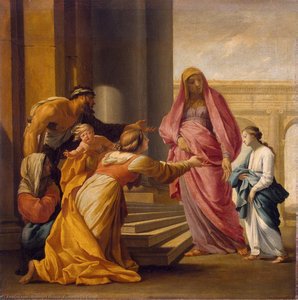
Welk schilderij van Eustache Le Sueur is het beroemdste van allemaal?Onthul het antwoord

MORT DE RAYMOND DIOCRES, Louvre, Parijs. Christ Healing the Blind Man en Ludwig IX. der Heilige (1635) volgen.

Wat zijn de top 10 schilderijen van Eustache Le Sueur?Onthul het antwoord

MORT DE RAYMOND DIOCRES, Christ Healing the Blind Man, Ludwig IX. der Heilige, The Sacrifice of Manoah, Raymond Diocrès Responds After His Death, Cupid, Reprimanded by His Mother, Takes Refuge in the Arms of Ceres, Pope Victor III Confirms the Institution of the Carthusians, Saint Bruno in Prayer, Ascension of the Lord, en Meeting of Saint Bruno and Count Roger of Sicily. De bovenstaande ranglijst vermeldt het jaar en het museum van elk werk.

Hoeveel werken heeft Eustache Le Sueur gemaakt?Onthul het antwoord

Onze catalogus bevat 113 werken van Eustache Le Sueur, daterend van 1626 tot 1655.

Waar hangen de beroemdste originele werken van Eustache Le Sueur?Onthul het antwoord

Voornamelijk in Louvre (Parijs), National Gallery (Londen) en Bayerische Staatsgemäldesammlungen (München). De bovenstaande museumtabel bevat een volledig overzicht.

Wanneer creëerde Eustache Le Sueur de beroemdste schilderijen?Onthul het antwoord

In 1640s: 17 van de 100 werken op deze pagina werden toen gemaakt, waaronder Raymond Diocrès Responds After His Death.

Wat zijn de vroegste en laatste beroemde werken van Eustache Le Sueur?Onthul het antwoord

Op deze pagina is het vroegste The Sacrifice of Manoah (1626) en het laatste Saint Bruno and His Companions Distributing Their Goods to the Poor (1655).

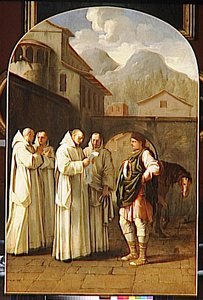
Welke onderwerpen keerde Eustache Le Sueur het vaakst naar terug?Onthul het antwoord

Man (11), Woman (11) en People (10), verspreid over de 100 werken op deze pagina.

In welk medium werkte Eustache Le Sueur het meest?Onthul het antwoord

Oil On Canvas, voor 32 van de 100 werken op deze pagina.

Bij welke stroming wordt Eustache Le Sueur gerekend?Onthul het antwoord

Baroque, te oordelen aan de originelen op deze pagina.

Welke originelen van Eustache Le Sueur zijn in de collectie van het Louvre?Onthul het antwoord

MORT DE RAYMOND DIOCRES, Cupid Ordering Mercury to Announce his Power to the Universe en St. Gervase and St. Protase Brought before Anastasius: het Louvre, Parijs herbergt 53 van de werken op deze pagina.

Eustache Le Sueur: de kunstenaar

Een leven gewijd aan goddelijke visie: De wereld van Eustache Le Sueur

Eustache Le Sueur, een naam die resoneert met de vurigheid en verfijning van de 17e-eeuwse Franse barokschilderkunst, staat als een spilfiguur in de artistieke evolutie van zijn land. Geboren in Parijs op 19 november 1617 en overleden binnen diezelfde stadsmuren op 30 april 1655, wijdde Le Sueur zijn leven aan het vastleggen van religieuze verhalen met een steeds meer neoklassieke gevoeligheid. Zijn reis was er niet een van verre reizen of dramatische persoonlijke omwentelingen; het was eerder een doelgerichte klim binnen de Parijs kunstwereld, die culmineerde in zijn rol als medeoprichter van de prestigieuze Franse Academie voor Schilderkunst en Beeldhouwkunst. Zijn vader, Cathelin Le Sueur, een bekwame draaier en houtsnijder, herkende het ontluikende talent van zijn zoon al vroeg en bracht hem onder in de leer bij Simon Vouet, destijds de dominante kracht in de Franse schilderkunst. Deze fundamentele opleiding bleek cruciaal en gaf de jonge Eustache een meesterschap in tekenkunst en compositie dat zijn gehele carrière zou kenmerken.

Vroege successen en koninklijke opdrachten

Le Sueur onderscheidde zich snel binnen het atelier van Vouet en verkreeg spoedig toegang tot het gilde van meesterschilders. Zijn vroege werken, in het bijzonder de illustraties van scènes uit de Hypnerotomachia Poliphili, een complexe allegorische romance, brachten hem de eerste erkenning. Het was echter zijn reeks decoraties in opdracht voor het landhuis van Lambert de Thorigny die zijn reputatie werkelijk begon te vestigen. Hoewel deze projecten vaak werden onderbroken door andere verplichtingen, toonden ze Le Sueurs groeiende vermogen om dynamische composities te creëren en zijn figuren te voorzien van een dramatische aanwezigheid. Het Louvre zelf werd een canvas voor zijn ambitie, toen hij verschillende schilderijen vervaardigde voor de koninklijke appartementen – werken die helaas verloren zijn gegaan in de geschiedenis, maar wel gedocumenteerd staan in inventarissen uit die periode. Deze opdrachten signaleerden een groeiende acceptatie binnen de hoogste kringen van de Franse samenleiteit, wat de weg vrijmaakte voor verdere kansen en zijn positie als gewilde kunstenaar verstevigde. Hij voerde niet louter decoratieve schema's uit; hij droeg bij aan de visuele taal van macht en vroomheid die het hof van Lodewijk XIII en later Lodewijk XIV definieerde.

De oprichting van de Academie en een neoklassieke wending

Een beslissend moment in de carrière van Le Sueur kwam met de oprichting van de Franse Koninklijke Academie voor Schilderkunst en Beeldhouwkunst in 1648. Hij werd verkozen tot een van de oorspronkelijke twaalf oudsten, belast met het begeleiden van de ontwikkeling van de instelling en het vaststellen van de normen voor artistieke excellentie. Deze rol was niet louter administratief; het weerspiegelde een bredere verschuiving in Le Sueurs esthetische gevoeligheden. Hij werd steeds meer aangetrokken door een neoklassieke stijl, gekenmerkt door helderheid van vorm, ingetogen emotie en een focus op geïdealiseerde schoonheid – een breuk met de flamboyante tendensen van de eerdere barokschilderkunst. Dit Parijse Atticism, zoals het bekend kwam te staan, benadrukte intellectuele strengheid en een terugkeer naar klassieke principes, wat niet alleen zijn eigen werk beïnvloedde maar ook de richting van de Franse kunst voor generaties daarna vormgaf.

Het leven van Sint Bruno: Een meesterwerk van devotie

Misschien wel Le Sueurs meest blijvende nalatenschap ligt in zijn serie die Het leven van Sint Bruno uitbeeldt, in opdracht gemaakt voor het klooster van de Kartuizerorde. Deze schilderijen, die oorspronkiem de muren van de abdij sierden, vormen het hoogtepunt van zijn artistieke visie en technische vaardigheid. Ze zijn niet alleen opmerkelijk om hun narratieve kracht, maar ook om hun diep spirituele kwaliteit. De figuren van Le Sueur bezitten een stille waardigheid en een diep gevoel van devotie, waarmee ze de ascetische idealen van de Kartuizerorde met overtuigende kracht overbrengen. Het gebruik van chiaroscuro – het dramatische samenspel van licht en schaduw – versterkt de emotionele impact van elke scène en trekt de kijker mee in de wereld van Sint Bruno en zijn volgelingen. Ondanks schade en restauraties door de tijd heen, behouden deze werken veel van hun oorspronkelijke schoonheid en bieden ze een blik op Le Sueurs meesterschap in compositie, kleur en psychologisch inzicht.

Nalatenschap en historische betekenis

De invloed van Eustache Le Sueur reikte verder dan zijn eigen schilderijen. Hij leidde talrijke leerlingen op, waaronder de broer van zijn vrouw, Theodore Goussé, en enkele van zijn eigen broers en zussen, waardoor hij een atelier onderhield dat zijn stijl en technieken voortzette. Zijn tekeningen, waarvan er vele bewaard zijn gebleven in het Cabinet des Dessins van het Louvre, getuigen van zijn uitzonderlijke tekenkunst en bieden waardevol inzicht in zijn creatieve proces. Hoewel sommige critici een zekere conventionele aard in zijn werk hebben opgemerkt – een neiging om te vertrouwen op gevestigde typen – is het onmiskenbaar dat Le Sueur een cruciale rol speelde in het vormgeven van het esthetische landschap van het 17e-eeuwse Frankrijk. Hij overbrugde de kloof tussen de eerdere barokke uitbundigheid en het meer ingetogen classicisme dat de Franse kunst onder Lodewijk XIV zou gaan definiëren, en liet een oeuvre na dat nog steeds ontzag en bewondering oproept. Zijn toewijding aan religieuze thema's, gecombineerd met zijn technische briljantie en streven naar artistieke perfectie, verzekert hem zijn plaats als een van de belangrijkste schilders van zijn tijdperk.