Portret van Domenico Beccafumi

De 100 beroemdste schilderijen van Domenico Beccafumi, elk uniek

Bijgewerkt in november 2026 · gerangschikt op basis van onze populariteitsscore (zoekopdrachten, bezoeken en bestellingen per kunstwerk) · 126 werken van Domenico Beccafumi in onze catalogus

Kortom

St. Michael Scaccia and The Rebel Angels is het schilderij van Domenico Beccafumi dat de meeste aandacht trekt. Daarna gaat de blik naar Saint Catherine Receiving the Stigmata (1545) en St Lucy (1521). Van de 126 werken van Domenico Beccafumi in onze catalogus zijn dit de 100 bekendste, elk een uniek origineel gepresenteerd met het jaar, het museum en de reden waarom het blijft voortbestaan.

1484 – 1551, Castelnuovo Berardenga Renaissance mannerism Meeste werken: Pinacoteca Nazionale

Top 10 schilderijen van Domenico Beccafumi, door de ogen van de galerie

1
St. Michael Scaccia and The Rebel Angels door Domenico Beccafumi

St. Michael Scaccia and The Rebel Angels

Oil On Panel

The air in the painting feels heavy, thick with the weight of a sudden, violent descent. St. Michael Scaccia occupies the center, his arms raised in a gesture that anchors the chaos. Around him, the sky is not a void but a crowded arena of motion. Fourteen figures collide in a swirling vortex, caught in the precise moment where the order of heaven meets the rebellion of the fallen. There…

2
Saint Catherine Receiving the Stigmata (1545) door Domenico Beccafumi

Saint Catherine Receiving the Stigmata

1545 · Oil On Panel · Museum Boijmans Van Beuningen, Rotterdam

Domenico Beccafumi painted Saint Catherine Receiving the Stigmata in 1545. The work captures a singular moment of spiritual collision. Saint Catherine is caught in a state of religious ecstasy, her body reacting to the divine arrival of the stigmata. It is a scene of profound, quiet transformation.

3
St Lucy (1521) door Domenico Beccafumi

St Lucy

1521 · Oil On Canvas · Pinacoteca Nazionale, Siena

Domenico di Pace Beccafumi's 1521 painting, *St Lucy*, is not merely a portrait; it’s an enigmatic encounter. This captivating work, depicting a woman with flowing hair and a serene gaze, immediately draws the viewer into a world of quiet contemplation. The subject, identified as Saint Lucy – a figure renowned for her martyrdom and association with light and vision – presents a compelling study in restrained elegance and burgeoning Mannerist…

4
Saint Ignatius of Antioch Disemboweled by Trajan's Torturers (1525) door Domenico Beccafumi

Saint Ignatius of Antioch Disemboweled by Trajan's Torturers

1525 · Oil On Panel · Art Institute of Chicago, Chicago

A circular wooden panel holds a scene of visceral tension. Within this tondo, the pale, muscular body of Saint Ignatius of Antioch is caught in a moment of extreme physical undoing. Two executioners flank him, their forms pressed into a tight, triangular arrangement that fills the frame. The central horror is precise: the saint's entrails are being wound upon two spindles. This gruesome detail refers to an apocryphal account from…

6
Stigmatization of St Catherine of Siena (1515) door Domenico Beccafumi

Stigmatization of St Catherine of Siena

1515 · Oil On Canvas · Pinacoteca Nazionale, Siena

In the heart of the Italian Renaissance, where the boundaries between the earthly and the divine often blurred, Domenico Di Pace Beccafumi captured a moment of profound spiritual transformation. His masterpiece, Stigmatization of St Catherine of Siena, is not merely a painting but a window into a celestial event. Completed in 1515, this monumental work serves as a breathtaking example of Sienese Mannerism, a style that moved away from the…

7
The Miraculous Communion of Saint Catherine of Siena (1513) door Domenico Beccafumi

The Miraculous Communion of Saint Catherine of Siena

1513 · Oil On Panel · J. Paul Getty Museum, Los Angeles

The Miraculous Communion of Saint Catherine of Siena emerges from the brush of Domenico Beccafumi as a profound window into a moment of divine intervention. Painted about 1513, this work captures a sacred episode from the life of the Dominican tertiary and mystic, Saint Catherine of Siena. The scene unfolds with a quiet intensity, focusing on the spiritual connection between the earthly and the celestial. It is a work that…

8
Trinity Tryptych (detail) (1513) door Domenico Beccafumi

Trinity Tryptych (detail)

1513 · Oil

This close-up fragment from the 1513 Trinity Tryptych reveals the intimate, fleshy presence of angelic figures or putti. The composition focuses on the physical weight of these celestial beings, emphasizing their musculature and the soft, organic curves of the human form. Light descends from an unseen source above and to the left, casting the upper surfaces of the faces into relief while allowing the lower portions to recede into deep…

9
The Appearance of St. Michael on the Castel Sant'Angelo to Pope Gregory the Great (1526) door Domenico Beccafumi

The Appearance of St. Michael on the Castel Sant'Angelo to Pope Gregory the Great

1526 · Oil · Carnegie Museum of Art, Pittsburgh

A dramatic religious encounter unfolds within this Renaissance-style oil painting, capturing the moment St. Michael appears atop the Castel Sant'Angelo to Pope Gregory the Great. The composition utilizes an asymmetrical arrangement, placing a group of figures in the left foreground who gaze toward a distant, hazy landscape. On the right, a smaller figure provides a sense of scale against the architectural structure. The scene is defined by a deep perspective,…

10
The Miracle of St. Michael on Mt. Gargano (1526) door Domenico Beccafumi

The Miracle of St. Michael on Mt. Gargano

1526 · Tempera On Panel · Carnegie Museum of Art, Pittsburgh

A rugged, mountainous landscape under a dark, atmospheric sky provides the stage for this dramatic religious encounter. The composition is asymmetrical, concentrating heavy figures on the right while a solitary figure and livestock occupy the left. Luminous white robes of the central figures contrast against a palette of deep browns, mossy greens, and ochre. A pale, misty light illuminates the foreground, casting a soft glow on the white-clad figures while…

De beroemde schilderijen van Domenico Beccafumi, nummer 11 tot 100

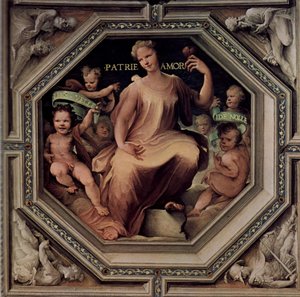
11The Martyrdom of Saint Sigismond and his Family (1520) door Domenico BeccafumiThe Martyrdom of Saint Sigismond and his Family1520 · Museum of Fine Arts 12Saint Dominic and the Burning of the Heretical Books (1520) door Domenico BeccafumiSaint Dominic and the Burning of the Heretical Books1520 · Museum of Fine Arts 13The Annunciation (1545) door Domenico BeccafumiThe Annunciation1545 14Descent of Christ to Limbo (detail, Eva) (1535) door Domenico BeccafumiDescent of Christ to Limbo (detail, Eva)1535 15Saint Markus (1538) door Domenico BeccafumiSaint Markus1538 16Justizia (Detail) (1535) door Domenico BeccafumiJustizia (Detail)1535 17Justizia (1535) door Domenico BeccafumiJustizia1535 18Concordia (1535) door Domenico BeccafumiConcordia1535 19Venus and Cupid with Vulcan (1530) door Domenico BeccafumiVenus and Cupid with Vulcan1530 · New Orleans Museum of Art 20The Flight into Egypt. (1550) door Domenico BeccafumiThe Flight into Egypt.1550 · Musée des beaux-arts de Chambéry 21The Holy Family with Young Saint John (1523) door Domenico BeccafumiThe Holy Family with Young Saint John1523 · Thyssen-Bornemisza Museum 22Birth of the Virgin (1543) door Domenico BeccafumiBirth of the Virgin1543 · Accademia 23Frescoes in the Oratory of St. Benedict in Siena (Italy), Scene: Marriage of Mary with Joseph door Domenico BeccafumiFrescoes in the Oratory of St. Benedict in Siena (Italy), Scene: Marriage of Mary with Joseph 24Coronation of Mary (detail) (1540) door Domenico BeccafumiCoronation of Mary (detail)1540 25Madonna and Child with Infant John the Baptist (1542) door Domenico BeccafumiMadonna and Child with Infant John the Baptist1542 · Art Gallery of New South Wales 26Frescoes in the Oratory of St. Benedict in Siena (Italy), Scene: Marriage of Mary with Joseph (1518) door Domenico BeccafumiFrescoes in the Oratory of St. Benedict in Siena (Italy), Scene: Marriage of Mary with Joseph1518 · Oratory of San Bernardino 27Caritas (1535) door Domenico BeccafumiCaritas1535 28The Continence of Scipio Africanus (1525) door Domenico BeccafumiThe Continence of Scipio Africanus1525 · Museo Nazionale di Palazzo Mansi 29Saint Catherine of Siena receiving the stigmata between Saints Benedict and Jerome (detail) (1517) door Domenico BeccafumiSaint Catherine of Siena receiving the stigmata between Saints Benedict and Jerome (detail)1517 30Saint Catherine of Siena receiving the stigmata between Saints Benedict and Jerome (detail) (1517) door Domenico BeccafumiSaint Catherine of Siena receiving the stigmata between Saints Benedict and Jerome (detail)1517 31Saint Catherine of Siena receiving the stigmata between Saints Benedict and Jerome (detail) (1517) door Domenico BeccafumiSaint Catherine of Siena receiving the stigmata between Saints Benedict and Jerome (detail)1517 32Saint Catherine of Siena receiving the stigmata between Saints Benedict and Jerome (detail) (1517) door Domenico BeccafumiSaint Catherine of Siena receiving the stigmata between Saints Benedict and Jerome (detail)1517 33Saint Catherine of Siena receiving the stigmata between Saints Benedict and Jerome (detail) (1517) door Domenico BeccafumiSaint Catherine of Siena receiving the stigmata between Saints Benedict and Jerome (detail)1517 34Gaius Servilius Ahala presents the body of Spurius Maelius to Cincinnatus (1535) door Domenico BeccafumiGaius Servilius Ahala presents the body of Spurius Maelius to Cincinnatus1535 35Das Opfer Des Seleukus Von Lokris (Detail) (1535) door Domenico BeccafumiDas Opfer Des Seleukus Von Lokris (Detail)1535 36Birth of the Virgin (detail) (1540) door Domenico BeccafumiBirth of the Virgin (detail)1540 37Birth of the Virgin (detail) (1540) door Domenico BeccafumiBirth of the Virgin (detail)1540 38Descent of Christ to Limbo (detail) (1535) door Domenico BeccafumiDescent of Christ to Limbo (detail)1535 39Carundas Von Tiro Und Celius Praetor (1535) door Domenico BeccafumiCarundas Von Tiro Und Celius Praetor1535 40Postumius Tiburzius Tötet Seinen Sohn (Detail) (1535) door Domenico BeccafumiPostumius Tiburzius Tötet Seinen Sohn (Detail)1535 41The Annunciation (1545) door Domenico BeccafumiThe Annunciation1545 42The Holy Family with Angels (1550) door Domenico BeccafumiThe Holy Family with Angels1550 · National Gallery of Art 43The Reconciliation of Marcus Emilius Lepidus and Fulvius Flaccus (1529) door Domenico BeccafumiThe Reconciliation of Marcus Emilius Lepidus and Fulvius Flaccus1529 · Palazzo Pubblico 44Mystical Marriage of St Catherine (1521) door Domenico BeccafumiMystical Marriage of St Catherine1521 · Hermitage Museum 45Patriotism door Domenico BeccafumiPatriotism 46Saint Catherine of Siena Receiving the Stigmata (1513) door Domenico BeccafumiSaint Catherine of Siena Receiving the Stigmata1513 · J. Paul Getty Museum 47Trinity (detail) (1513) door Domenico BeccafumiTrinity (detail)1513 · Pinacoteca Nazionale 48Penelope (1514) door Domenico BeccafumiPenelope1514 · Seminario Patriarcale 49The Holy Family with Young Saint John (1530) door Domenico BeccafumiThe Holy Family with Young Saint John1530 · Galleria degli Uffizi 50Allegory of Justice door Domenico BeccafumiAllegory of JusticePalais des Beaux-Arts de Lille 51Panel painting "The Commission in the Temple" on wood by a follower of Domenico Beccafumi, second half 16th century door Domenico BeccafumiPanel painting "The Commission in the Temple" on wood by a follower of Domenico Beccafumi, second half 16th century 52Holy Family door Domenico BeccafumiHoly Family 53Three Male Nudes door Domenico BeccafumiThree Male Nudes 54TWO MALE NUDES IN A LANDSCAPE door Domenico BeccafumiTWO MALE NUDES IN A LANDSCAPE 55Saint Peter door Domenico BeccafumiSaint Peter 56Tranaquil door Domenico BeccafumiTranaquil 57HEAD OF A BEARDED MAN IN PROFILE door Domenico BeccafumiHEAD OF A BEARDED MAN IN PROFILE 58Fall of the Rebellious Angels door Domenico BeccafumiFall of the Rebellious Angels 59San Antonio and the miracle of the mule door Domenico BeccafumiSan Antonio and the miracle of the mule 60St. Francis receiving the stigmata door Domenico BeccafumiSt. Francis receiving the stigmata 61St Bernard of Siena praying door Domenico BeccafumiSt Bernard of Siena praying 62An Unidentified Scene door Domenico BeccafumiAn Unidentified Scene 63St. Cristophor door Domenico BeccafumiSt. Cristophor 64The killing of Spurius Melius door Domenico BeccafumiThe killing of Spurius Melius 65Reconciliation of Lepidus and Flacco door Domenico BeccafumiReconciliation of Lepidus and FlaccoPalazzo Pubblico 66The Punishment of Heavenly Fire door Domenico BeccafumiThe Punishment of Heavenly Fire 67San Marco door Domenico BeccafumiSan Marco 68Altarpiece of the Stigmata of St. Catherine 2 door Domenico BeccafumiAltarpiece of the Stigmata of St. Catherine 2 69Altarpiece of the Stigmata St. Catherine door Domenico BeccafumiAltarpiece of the Stigmata St. Catherine 70Pennacchio with the Flood door Domenico BeccafumiPennacchio with the Flood 71The sacrifice of Seleucus of Locri 1 door Domenico BeccafumiThe sacrifice of Seleucus of Locri 1 72Altarpiece of the Stigmata of St. Catherine 1 door Domenico BeccafumiAltarpiece of the Stigmata of St. Catherine 1 73Moses breaking the table of the ammendments door Domenico BeccafumiMoses breaking the table of the ammendments 74The suicide of Cato Utica door Domenico BeccafumiThe suicide of Cato Utica 75Precipitated by Marcus Manilius Campoglio door Domenico BeccafumiPrecipitated by Marcus Manilius Campoglio 76The beheading of Spurius Cassius door Domenico BeccafumiThe beheading of Spurius Cassius 77Postumius Tiburcio killing his son door Domenico BeccafumiPostumius Tiburcio killing his son 78Pennacchio with the contest between Minerva Neptune door Domenico BeccafumiPennacchio with the contest between Minerva Neptune 79The tribune Publius Muzio sent to the fire his colleagues door Domenico BeccafumiThe tribune Publius Muzio sent to the fire his colleagues 80The sacrifice of Codrus, King of Athens door Domenico BeccafumiThe sacrifice of Codrus, King of Athens 81Adoration of the golden calf door Domenico BeccafumiAdoration of the golden calfPinacoteca Nazionale 82St. Paul on the Throne door Domenico BeccafumiSt. Paul on the Throne 83The puncturing of the Jews by the Levites door Domenico BeccafumiThe puncturing of the Jews by the Levites 84The sacrifice of Seleucus of Locri door Domenico BeccafumiThe sacrifice of Seleucus of Locri 85Courage of the macedon who witnessed the sacrifice of Alexander door Domenico BeccafumiCourage of the macedon who witnessed the sacrifice of Alexander 86Madonna and Child with St. John door Domenico BeccafumiMadonna and Child with St. John 87Continence of Scipio door Domenico BeccafumiContinence of Scipio 88Scipio appointed tribune of the soldiers door Domenico BeccafumiScipio appointed tribune of the soldiers 89Speusippus Tegeate door Domenico BeccafumiSpeusippus Tegeate 90Caronda shooting door Domenico BeccafumiCaronda shooting 91Annunciation door Domenico BeccafumiAnnunciation 92Transit of the Virgin door Domenico BeccafumiTransit of the Virgin 93Madonna and Child with St John the Baptist door Domenico BeccafumiMadonna and Child with St John the Baptist 94The courage of children who witnessed the sacrifice of Macedonian Alexander door Domenico BeccafumiThe courage of children who witnessed the sacrifice of Macedonian Alexander 95Zeuxis painted the portrait of Helen for the temple of Hera at Croton door Domenico BeccafumiZeuxis painted the portrait of Helen for the temple of Hera at Croton 96Madonna and Child Enthroned with Six Saints and Angels door Domenico BeccafumiMadonna and Child Enthroned with Six Saints and Angels 97The Mutual Benevolence door Domenico BeccafumiThe Mutual Benevolence 98Head of a Youth Seen in Profile door Domenico BeccafumiHead of a Youth Seen in Profile 99St Paul (1515) door Domenico BeccafumiSt Paul1515 · Museo dell'Opera della Metropolitana 100Judith with the Head of Holofernes (1510) door Domenico BeccafumiJudith with the Head of Holofernes1510 · Wallace Collection

De beroemde schilderijen van Domenico Beccafumi, periode voor periode

De onderwerpen die de aandacht van Domenico Beccafumi troffen

De vier onderwerpen die het meest voorkomen in deze originelen, elk met zijn mooiste voorbeeld.

De musea waar de originele werken van Domenico Beccafumi worden bewaard

De 8 musea met de meeste schilderijen op deze pagina.

Museum Stad Werken van Domenico Beccafumi Schilderijen uit deze lijst
Pinacoteca Nazionale, SienaPinacoteca Nazionale Siena 11 St Lucy, Stigmatization of St Catherine of Siena, Trinity (detail)
J. Paul Getty Museum, Los AngelesJ. Paul Getty Museum Los Angeles 2 The Miraculous Communion of Saint Catherine of Siena, Saint Catherine of Siena Receiving the Stigmata
Carnegie Museum of Art, PittsburghCarnegie Museum of Art Pittsburgh 2 The Appearance of St. Michael on the Castel Sant'Angelo to Pope Gregory the Great, The Miracle of St. Michael on Mt. Gargano
Museum of Fine Arts, BostonMuseum of Fine Arts Boston 2 The Martyrdom of Saint Sigismond and his Family, Saint Dominic and the Burning of the Heretical Books
Palazzo Pubblico, SienaPalazzo Pubblico Siena 2 The Reconciliation of Marcus Emilius Lepidus and Fulvius Flaccus, Reconciliation of Lepidus and Flacco
Museum Boijmans Van Beuningen, RotterdamMuseum Boijmans Van Beuningen Rotterdam 1 Saint Catherine Receiving the Stigmata
Art Institute of Chicago, ChicagoArt Institute of Chicago Chicago 1 Saint Ignatius of Antioch Disemboweled by Trajan's Torturers
Victoria and Albert Museum, LondenVictoria and Albert Museum Londen 1 Charity Surrounded by Children Playing with Dogs and Hobby Horses

Domenico Beccafumi door de decennia heen: elk een uniek origineel

Werken per decennium

Kies een decennium om het origineel te zien dat dit tijdperk definieert.

Schilderijen van Domenico Beccafumi: vragen voor de galerie

Wat is het bekendste werk van Domenico Beccafumi?Onthul het antwoord

St. Michael Scaccia and The Rebel Angels. Saint Catherine Receiving the Stigmata (1545) en St Lucy (1521) volgen.

Welke tien schilderijen van Domenico Beccafumi zijn het meest bekend?Onthul het antwoord

St. Michael Scaccia and The Rebel Angels, Saint Catherine Receiving the Stigmata, St Lucy, Saint Ignatius of Antioch Disemboweled by Trajan's Torturers, Charity Surrounded by Children Playing with Dogs and Hobby Horses, Stigmatization of St Catherine of Siena, The Miraculous Communion of Saint Catherine of Siena, Trinity Tryptych (detail), The Appearance of St. Michael on the Castel Sant'Angelo to Pope Gregory the Great en The Miracle of St. Michael on Mt. Gargano. De bovenstaande ranglijst vermeldt het jaar en het museum van elk werk.

Hoeveel werken van Domenico Beccafumi zijn er bekend?Onthul het antwoord

Onze catalogus bevat 126 werken van Domenico Beccafumi, daterend van 1510 tot 1550.

Waar kunnen de beroemdste originelen van Domenico Beccafumi worden bekeken?Onthul het antwoord

Voornamelijk in Pinacoteca Nazionale (Siena), J. Paul Getty Museum (Los Angeles) en Carnegie Museum of Art (Pittsburgh). De bovenstaande museumtabel bevat een volledig overzicht.

In welke periode creëerde Domenico Beccafumi de bekendste schilderijen?Onthul het antwoord

In 1510s: 14 van de 100 werken op deze pagina werden toen gemaakt, waaronder Stigmatization of St Catherine of Siena.

Welk beroemd schilderij van Domenico Beccafumi is de vroegste, en welke de laatste?Onthul het antwoord

Op deze pagina is het vroegste Judith with the Head of Holofernes (1510) en het laatste The Flight into Egypt. (1550).

Welke onderwerpen had Domenico Beccafumi de voorkeur?Onthul het antwoord

Woman (22), Man (12) en People (10), verspreid over de 100 werken op deze pagina.

Met welke materialen schilderde Domenico Beccafumi het meest?Onthul het antwoord

Oil On Panel, voor 18 van de 100 werken op deze pagina.

Bij welke stroming behoort het werk van Domenico Beccafumi?Onthul het antwoord

Renaissance mannerism, te oordelen aan de originelen op deze pagina.

Welke originele werken van Domenico Beccafumi kan ik zien in het Pinacoteca Nazionale?Onthul het antwoord

St Lucy, Stigmatization of St Catherine of Siena en Trinity (detail): het Pinacoteca Nazionale, Siena herbergt 4 van de werken op deze pagina.

Domenico Beccafumi: een portret van de kunstenaar

A Sienese Visionary: The Life and Art of Domenico Beccafumi

Domenico di Pace Beccafumi, a name that resonates less immediately than those of his Florentine contemporaries, nonetheless occupies a pivotal position in the narrative of Italian Renaissance art. Born around 1486 in the small Tuscan town of Montaperto, near Siena, Beccafumi’s artistic journey was one of remarkable development, culminating in a style that bridged the High Renaissance and the burgeoning complexities of Mannerism. His story isn't simply about technical skill; it is about a deeply individual vision—a sensibility steeped in the traditions of his Sienese heritage yet boldly reaching towards new expressive possibilities. His origins were humble: the son of Giacomo di Pace, a peasant who worked on the estate of Lorenzo Beccafumi, his talent was recognized by Lorenzo Beccafumi, who adopted him and provided for his initial artistic training with Mechero, a local Sienese artist. This early grounding in the Sienese school would prove foundational, even as he ventured beyond its established conventions. The Sienese tradition, already diverging from the classical ideals embraced elsewhere in Italy, fostered an environment where emotional intensity and decorative detail were valued, qualities that would become hallmarks of Beccafumi’s unique style.

Rome and the Forging of a Unique Style

Around 1509, Beccafumi journeyed to Rome, a transformative moment exposing him to the artistic ferment of the papal city. He encountered the groundbreaking works of Raphael and Michelangelo, absorbing their innovations in composition, anatomy, and dramatic expression. However, unlike many artists who sought to directly emulate these masters, Beccafumi synthesized these influences through his own distinct lens. He didn’t simply *copy* the Roman style; he filtered it through a pre-existing Sienese aesthetic—one characterized by a certain provincialism, an emphasis on decorative detail, and a lingering medieval sensibility. Upon returning to Siena, this synthesis began to manifest in a style increasingly his own. It was a style marked by irrationality, emotional intensity, and a captivating visual experience achieved through discordant colors and hallucinatory settings. His paintings weren’t merely representations of reality; they were explorations of inner states, imbued with a sense of unease and psychological depth. This departure from the harmonious balance of High Renaissance ideals signaled his embrace of Mannerism, though he remained distinctly apart from its more widespread trends. He skillfully blended the decorative elements and emotional intensity of the Sienese school with the emerging stylistic features of Mannerism—a fusion that would define his artistic legacy.

The Siena School’s Influence

Beccafumi's formative years were spent in Siena, where he absorbed the distinctive aesthetic sensibilities of the Sienese Renaissance. The city’s artistic environment prioritized expressive emotion and opulent ornamentation, shaping Beccafumi’s approach to painting and sculpture alike. This influence is particularly evident in his early works—particularly those executed before his journey to Rome—where a palpable sense of provincialism coexists with masterful technique. He honed his skills under Mechero, a respected Sienese artist who instilled in him the importance of meticulous observation and careful craftsmanship—values that would continue to guide his artistic endeavors throughout his career. The Siena School’s emphasis on narrative storytelling and symbolic representation profoundly impacted Beccafumi's artistic vision, informing his choice of subjects and shaping his compositional strategies.

A Roman Awakening

Around 1509, Beccafumi embarked upon a pivotal voyage to Rome—a pilgrimage that irrevocably altered the trajectory of his artistic development. He arrived at a time when Raphael and Michelangelo were reshaping the visual landscape of the papal city, pushing the boundaries of artistic innovation in terms of perspective, anatomy, and dramatic theatricality. Unlike many artists who sought to replicate these masters’ achievements verbatim, Beccafumi absorbed their stylistic breakthroughs through his own discerning gaze—a process that resulted in a synthesis uniquely his own. He didn't merely imitate Roman grandeur; he transformed it into something profoundly personal—a style characterized by unsettling distortions and hallucinatory color palettes that defied conventional expectations. This encounter with the titans of Renaissance art served as a catalyst for Beccafumi’s stylistic evolution, propelling him toward Mannerism and establishing him as one of its most distinctive voices.

Major Achievements and Artistic Legacy

Domenico Beccafumi achieved considerable renown during his lifetime, securing commissions from prominent patrons—both ecclesiastical and aristocratic—and producing an impressive oeuvre encompassing painting, sculpture, mosaic design, and printmaking. Among his most celebrated masterpieces are the frescoes adorning the Oratory of St. Benedict in Siena—a testament to his narrative prowess and expressive mastery. The Trinity Triptych, housed in the Pinacoteca Nazionale di Siena, exemplifies Beccafumi’s ability to convey religious devotion with both grandeur and intimacy—a feat accomplished through masterful use of color and composition. Similarly, *The Annunciation*, also at the Pinacoteca Nazionale, showcases his distinctive stylistic sensibilities—characterized by a subtle interplay of light and shadow and an unsettling psychological depth. However, Beccafumi’s most ambitious undertaking was his direction of the pavement for Siena Cathedral between 1517 and 1544—a monumental project that demanded extraordinary technical skill and artistic vision. He skillfully employed innovative techniques to depict biblical narratives with unprecedented emotional intensity—a bold departure from the prevailing stylistic conventions of the time. Domenico Beccafumi died in Siena in 1551, marking a symbolic end to the city’s long and distinguished tradition of painting. His enduring legacy resides not merely in his artistic output but also in his pioneering role as one of Mannerism's foremost practitioners—a figure who irrevocably transformed the aesthetic landscape of Italy and continues to inspire admiration for his singular creative spirit.