Portret van Cosimo Tura

De 93 bekendste schilderijen van Cosimo Tura, een selectie uit de galerie

Bijgewerkt in november 2026 · gerangschikt op basis van onze populariteitsscore (zoekopdrachten, bezoeken en bestellingen per kunstwerk) · 97 werken van Cosimo Tura in onze catalogus

Kortom

Van alle originele werken die Cosimo Tura heeft nagelaten, is Annunciation (1469) het bekendst, in de collectie van het Museo del Duomo, Ferrara. Direct daarna volgen The Madonna of the Zodiac (detail) (1459) en The Madonna of the Zodiac (1459). Onze catalogus bevat 97 werken van Cosimo Tura; de galerie heeft de 93 meest bewonderde werken ter wereld bewaard, elk voorzien van de datum, het museum en het verhaal erachter.

1430 – 1495, Ferrara Early renaissance Meeste werken: Palazzo Schifanoia

De top 10 schilderijen van Cosimo Tura: de selectie van de galerie

1
Annunciation (1469) door Cosimo Tura

Annunciation

1469 · Oil On Canvas · Museo del Duomo, Ferrara

To stand before an image like Cosmè Tura’s Annunciation is to step across the threshold of time and into a moment suspended by divine grace. This masterpiece, dating from 1469, captures the pivotal instant when the Archangel Gabriel announces to the Virgin Mary that she will conceive Christ. It is not merely a depiction of a biblical event; it is an exquisitely orchestrated meditation on humility meeting the sublime. The…

2
The Madonna of the Zodiac (detail) (1459) door Cosimo Tura

The Madonna of the Zodiac (detail)

1459 · Tempera On Panel · Gallerie dell'Accademia di Venezia, Venetië

To gaze upon this exquisite detail from Cosmè Tura’s The Madonna of the Zodiac is to be transported directly into the luminous, intellectual atmosphere of the Early Renaissance. This fragment, focusing intimately on a bird poised amidst ripe grapes, transcends mere depiction; it captures a moment suspended between earthly bounty and celestial mystery. The artist’s mastery is immediately apparent in the meticulous rendering of nature—the delicate sweep of the bird's…

3
The Madonna of the Zodiac (1459) door Cosimo Tura

The Madonna of the Zodiac

1459 · Oil On Panel · Gallerie dell'Accademia di Venezia, Venetië

Cosmè Tura’s “Madonna of the Zodiac,” painted in 1459, isn't merely a depiction of the Virgin Mary and Child; it’s a shimmering portal into the intellectual and artistic fervor of early Renaissance Ferrara. This exquisite tempera on panel painting, now residing within the Gallerie dell’Accademia in Venice, embodies the era’s fascination with classical antiquity, burgeoning scientific thought, and deeply personal devotion. The work immediately captivates with its serene beauty –…

4
St George and the Princess (1469) door Cosimo Tura

St George and the Princess

1469 · Oil On Canvas · Museo del Duomo, Ferrara

To gaze upon Cosmè Tura's depiction of St George and the Princess is to step directly into the vibrant, dramatic heart of the early Renaissance. This monumental canvas, dating from 1469, is far more than a mere historical tableau; it is an epic narrative rendered in paint, capturing a moment charged with divine intervention, chivalric virtue, and profound human drama. The scene unfolds with palpable energy, centering on St George,…

5
The Madonna of the Zodiac (1459) door Cosimo Tura

The Madonna of the Zodiac

1459 · Oil On Panel · Gallerie dell'Accademia di Venezia, Venetië

Cosmè Tura’s “Madonna of the Zodiac,” painted in 1459, is more than just a devotional image; it's a window into the burgeoning artistic landscape of early Renaissance Ferrara. This intimate portrait of the Virgin Mary cradling the infant Jesus isn’t merely a depiction of motherhood; it’s a carefully constructed allegory brimming with symbolism and reflecting the intellectual currents of its time. Tura, a Ferrarese visionary often considered the founder of…

6
Pietà (1460) door Cosimo Tura

Pietà

1460 · Oil On Panel · Museo Correr, Venetië

Within the hushed reverence of the Museo Correr in Venice resides a painting that transcends mere representation, becoming instead an embodiment of profound sorrow and enduring faith – Cosmè Tura’s 1460 “Pietà.” More than simply a depiction of Mary cradling her son's lifeless form, this work is a cornerstone of Early Renaissance art, a testament to the artist’s mastery of technique and his ability to infuse religious subject matter with…

7
Allegory of September (detail) (1484) door Cosimo Tura

Allegory of September (detail)

1484 · Oil On Canvas · Palazzo Schifanoia, Ferrara

Cosmè Tura’s Allegory of September, a fresco dominating the Sala dei Nove in Palazzo Schifanoia, Ferrara, is not merely a decorative panel; it's a meticulously crafted microcosm of Late Medieval and Early Renaissance thought. Painted between 1476 and 1478 for the court of Borso d’Este, Duke of Ferrara, this monumental work offers a rare glimpse into the intellectual and artistic climate of a burgeoning city-state—a testament to Tura's exceptional skill…

8
The Virgin Annunciate (1477) door Cosimo Tura

The Virgin Annunciate

1477 · Oil On Panel · National Gallery, Londen

The painting depicts a seated female figure positioned in profile, her body turned slightly toward the viewer. She sits within an architectural setting characterized by a heavy, carved wooden chair. Her gaze is directed downwards and inwards, away from the external world. A crimson underdress is visible beneath a deep blue outer garment, which is fastened at the chest with small buttons or clasps. The fabric of her clothing displays…

9
Saints Maurelius and Paul with Niccolò Roverella (1470) door Cosimo Tura

Saints Maurelius and Paul with Niccolò Roverella

1470 · Oil On Panel · Palazzo Colonna, Rome

The painting Saints Maurelius and Paul with Niccolò Roverella by Cosimo Tura emerges from the shadows of history as a vital fragment of a much larger whole. This work exists as the right-hand panel of the expansive Roverella Altarpiece, a grand composition that once filled a sacred space. The Roverella family commissioned this piece, seeking to leave a lasting mark of their devotion and lineage within the religious landscape of…

10
The Annunciation with Saint Francis and Saint Louis of Toulouse [four panels] (1475) door Cosimo Tura

The Annunciation with Saint Francis and Saint Louis of Toulouse [four panels]

1475 · Tempera On Panel · National Gallery of Art, Washington

The Annunciation with Saint Francis and Saint Louis of Toulouse [four panels] is a religious work by the Ferrarese painter Cosimo Tura. This polyptych is divided into four distinct vertical segments. Each panel holds a single holy figure, creating a rhythmic sequence of sacred presence. The figures emerge from a deep, lapis-like blue background, set against a landscape of dark, jagged hills.

De selectie van Cosimo Tura gaat verder, van 11 tot 93

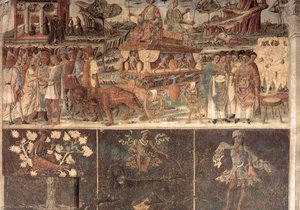
11English Allegory of June Triumph of Mercury (1484) door Cosimo TuraEnglish Allegory of June Triumph of Mercury1484 · Palazzo Schifanoia 12Portrait of a Young Man (1450) door Cosimo TuraPortrait of a Young Man1450 · Metropolitan Museum of Art 13St Anthony of Padua Reading (1475) door Cosimo TuraSt Anthony of Padua Reading1475 · Louvre 14Saint John the Baptist (1474) door Cosimo TuraSaint John the Baptist1474 · Philadelphia Museum of Art 15The Crucifixion (1450) door Cosimo TuraThe Crucifixion1450 · Fitzwilliam Museum 16Untitled (AQRDZC) (1455) door Cosimo TuraUntitled (AQRDZC)1455 · Musée Fesch 17English A Muse (Calliope ) (1460) door Cosimo TuraEnglish A Muse (Calliope )1460 18The Adoration of the Magi (1480) door Cosimo TuraThe Adoration of the Magi1480 · Fogg Museum 19Saint Lucy and Saint Eutychia at the Shrine of Saint Agatha (1484) door Cosimo TuraSaint Lucy and Saint Eutychia at the Shrine of Saint Agatha1484 · Isabella Stewart Gardner Museum 20Saint Louis of Toulouse (1484) door Cosimo TuraSaint Louis of Toulouse1484 · Metropolitan Museum of Art 21Saint Jerome (1474) door Cosimo TuraSaint Jerome1474 22Pietà (panel from the Roverella Polyptych) (1474) door Cosimo TuraPietà (panel from the Roverella Polyptych)1474 · Louvre 23View of the Salone dei Mesi (1484) door Cosimo TuraView of the Salone dei Mesi1484 · Palazzo Schifanoia 24Adoration of the Magi (from the predella of the Roverella Polyptych) (1474) door Cosimo TuraAdoration of the Magi (from the predella of the Roverella Polyptych)1474 25Untitled (D2WVMR) (1450) door Cosimo TuraUntitled (D2WVMR)1450 26Pietà (1474) door Cosimo TuraPietà1474 27Allegory of September (detail) (1476) door Cosimo TuraAllegory of September (detail)1476 · Palazzo Schifanoia 28The Muse Terpsichore (1460) door Cosimo TuraThe Muse Terpsichore1460 29Allegory of August: Triumph of Ceres (detail) (1476) door Cosimo TuraAllegory of August: Triumph of Ceres (detail)1476 · Palazzo Schifanoia 30A Muse (detail) (1455) door Cosimo TuraA Muse (detail)1455 · National Gallery 31St George (fragment van een paneel uit het Roverella Polyptych) (1474) door Cosimo TuraSt George (fragment van een paneel uit het Roverella Polyptych)1474 · Fine Arts Gallery 32Annunciation (detail) (1469) door Cosimo TuraAnnunciation (detail)1469 · Museo del Duomo 33Manuscript Illumination with All Saints in an Initial V, from an Antiphonary (1450) door Cosimo TuraManuscript Illumination with All Saints in an Initial V, from an Antiphonary1450 34Manuscript Illumination with the Presentation in the Temple in an Initial S, from a Gradual (1450) door Cosimo TuraManuscript Illumination with the Presentation in the Temple in an Initial S, from a Gradual1450 35Manuscript Illumination with the Assumption of the Virgin in an Initial A, from an Antiphonary (1450) door Cosimo TuraManuscript Illumination with the Assumption of the Virgin in an Initial A, from an Antiphonary1450 36Terpsichore (detail) (1450) door Cosimo TuraTerpsichore (detail)1450 · Museo Poldi Pezzoli 37Manuscript Illumination with the Presentation in the Templ in an Initial S, from a Gradual (1450) door Cosimo TuraManuscript Illumination with the Presentation in the Templ in an Initial S, from a Gradual1450 38Manuscript Illumination with All Saints in an Initial V, from an Antiphonary (1450) door Cosimo TuraManuscript Illumination with All Saints in an Initial V, from an Antiphonary1450 39Manuscript Illumination with the Assumption of the Virgin in an Initial G, from a Gradual (1450) door Cosimo TuraManuscript Illumination with the Assumption of the Virgin in an Initial G, from a Gradual1450 40Flight to Egypt (from the predella of the Roverella Polyptych) (1474) door Cosimo TuraFlight to Egypt (from the predella of the Roverella Polyptych)1474 · Metropolitan Museum of Art 41English Portrait of a Young Man (1452) door Cosimo TuraEnglish Portrait of a Young Man1452 42Saint George (1460) door Cosimo TuraSaint George1460 · Collezione Vittorio Cini 43Deutsch Madonna im Garten (1452) door Cosimo TuraDeutsch Madonna im Garten1452 44Madonna and Child in a Garden (1452) door Cosimo TuraMadonna and Child in a Garden1452 45Deutsch Porträt eines Mannes English Portrait of a prince from Este family (1452) door Cosimo TuraDeutsch Porträt eines Mannes English Portrait of a prince from Este family1452 46The Virgin Annunciate [middle right panel] (1480) door Cosimo TuraThe Virgin Annunciate [middle right panel]1480 · National Gallery of Art 47Untitled (AQRE3U) (1480) door Cosimo TuraUntitled (AQRE3U)1480 48Untitled (AQRE2L) (1480) door Cosimo TuraUntitled (AQRE2L)1480 49Alfonso d'Este (1477) door Cosimo TuraAlfonso d'Este1477 50Ercole I d'Este (obverse) and Eleonora of Aragon (reverse) (1477) door Cosimo TuraErcole I d'Este (obverse) and Eleonora of Aragon (reverse)1477 51Portrait of a Young Man (1470) door Cosimo TuraPortrait of a Young Man1470 · Metropolitan Museum of Art 52Deutsch Hl. Dominikus, Detail (1475) door Cosimo TuraDeutsch Hl. Dominikus, Detail1475 53English Allegory of August Triumph of Ceres (detail) (1484) door Cosimo TuraEnglish Allegory of August Triumph of Ceres (detail)1484 · Palazzo Schifanoia 54Madonna with the Child Enthroned (detail) (1474) door Cosimo TuraMadonna with the Child Enthroned (detail)1474 55Deutsch Jungfrau der Verkündigung (1475) door Cosimo TuraDeutsch Jungfrau der Verkündigung1475 56Deutsch Hl. Franz von Assisi (1475) door Cosimo TuraDeutsch Hl. Franz von Assisi1475 · National Gallery of Art 57St Dominic (1475) door Cosimo TuraSt Dominic1475 58Deutsch Hl. Maurelius von Ferrara (1475) door Cosimo TuraDeutsch Hl. Maurelius von Ferrara1475 · National Gallery of Art 59Deutsch Verkündigungsengel (1475) door Cosimo TuraDeutsch Verkündigungsengel1475 · National Gallery of Art 60English St Christopher (1484) door Cosimo TuraEnglish St Christopher1484 · Gemäldegalerie 61Deutsch Hl. Jacobus d. Ä (1475) door Cosimo TuraDeutsch Hl. Jacobus d. Ä1475 · Musée des Beaux-Arts de Caen 62Deutsch Engelpietà, Fragment (1474) door Cosimo TuraDeutsch Engelpietà, Fragment1474 · Kunsthistorisches Museum 63English St Sebastian (1484) door Cosimo TuraEnglish St Sebastian1484 · Gemäldegalerie 64English Madonna and Child in the Garden (1470) door Cosimo TuraEnglish Madonna and Child in the Garden1470 · National Gallery of Art 65Deutsch Hl. Hieronymus (1474) door Cosimo TuraDeutsch Hl. Hieronymus1474 66Allegory of August: Triumph of Ceres (detail) (1476) door Cosimo TuraAllegory of August: Triumph of Ceres (detail)1476 · Palazzo Schifanoia 67St John the Evangelist on Patmos (1470) door Cosimo TuraSt John the Evangelist on Patmos1470 · Thyssen-Bornemisza Museum 68English St James the Great (1475) door Cosimo TuraEnglish St James the Great1475 · Musée des Beaux-Arts de Caen 69Virgin Announced and St Maurelio (panels of a polyptych) (1475) door Cosimo TuraVirgin Announced and St Maurelio (panels of a polyptych)1475 70St Francis of Assisi and Announcing Angel (panels of a polyptych) (1475) door Cosimo TuraSt Francis of Assisi and Announcing Angel (panels of a polyptych)1475 71Circumcision (from the predella of the Roverella Polyptych) (1474) door Cosimo TuraCircumcision (from the predella of the Roverella Polyptych)1474 · Isabella Stewart Gardner Museum 72The Flight into Egypt (1470) door Cosimo TuraThe Flight into Egypt1470 · Metropolitan Museum of Art 73Pietà (panel from the Roverella Polyptych) (1474) door Cosimo TuraPietà (panel from the Roverella Polyptych)1474 · Louvre 74Madonna with the Child Enthroned (detail) (1474) door Cosimo TuraMadonna with the Child Enthroned (detail)1474 · National Gallery 75English Madonna with the Child (1475) door Cosimo TuraEnglish Madonna with the Child1475 · Accademia Carrara 76Allegory of September (detail) (1476) door Cosimo TuraAllegory of September (detail)1476 · Palazzo Schifanoia 77Deutsch Reitergruppe, Fragment door Cosimo TuraDeutsch Reitergruppe, Fragment 78English Allegory of July Triumph of Jupiter (detail) (1484) door Cosimo TuraEnglish Allegory of July Triumph of Jupiter (detail)1484 · Palazzo Schifanoia 79Saint Peter (1474) door Cosimo TuraSaint Peter1474 · Philadelphia Museum of Art 80Deutsch Hl. Sebastian door Cosimo TuraDeutsch Hl. Sebastian 81Madonna of the Zodiac (1459) door Cosimo TuraMadonna of the Zodiac1459 · Gallerie dell'Accademia di Venezia 82Triptych (1469) door Cosimo TuraTriptych1469 83Italiano Pietà (1460) door Cosimo TuraItaliano Pietà1460 · Museo Correr 84Deutsch Hl. Dominikus (1475) door Cosimo TuraDeutsch Hl. Dominikus1475 85Deutsch Hl. Antonius von Padua Italiano Sant'Antonio da Padova (1484) door Cosimo TuraDeutsch Hl. Antonius von Padua Italiano Sant'Antonio da Padova1484 · Galleria Estense 86Untitled (AQRE2U) door Cosimo TuraUntitled (AQRE2U)National Gallery 87English Terpsichore (1450) door Cosimo TuraEnglish Terpsichore1450 · Museo Poldi Pezzoli 88Madonna with the Child Enthroned (panel from the Roverella Polyptych) (1474) door Cosimo TuraMadonna with the Child Enthroned (panel from the Roverella Polyptych)1474 · National Gallery 89Deutsch Gekreuzigter Christus Italiano Cristo crocifisso (1474) door Cosimo TuraDeutsch Gekreuzigter Christus Italiano Cristo crocifisso1474 · Pinacoteca di Brera 90English Allegory of August Triumph of Ceres (1484) door Cosimo TuraEnglish Allegory of August Triumph of Ceres1484 · Palazzo Schifanoia 91Deutsch Altarretabel des Hl. Maurelius, Szene Martyrium des Hl. Maurelius, Tondo (1475) door Cosimo TuraDeutsch Altarretabel des Hl. Maurelius, Szene Martyrium des Hl. Maurelius, Tondo1475 · Palazzo dei Diamanti 92Deutsch Altarretabel des Hl. Maurelius, Szene Verurteilung des Hl. Maurelius, Tondo (1475) door Cosimo TuraDeutsch Altarretabel des Hl. Maurelius, Szene Verurteilung des Hl. Maurelius, Tondo1475 · Palazzo dei Diamanti 93Deutsch Der Frühling (1460) door Cosimo TuraDeutsch Der Frühling1460 · National Gallery

De beroemde schilderijen van Cosimo Tura, periode voor periode

De onderwerpen die de aandacht van Cosimo Tura troffen

De vier onderwerpen die het meest voorkomen in deze originelen, elk met zijn mooiste voorbeeld.

De musea waar de originele werken van Cosimo Tura worden bewaard

De 8 musea met de meeste schilderijen op deze pagina.

Museum Stad Werken van Cosimo Tura Schilderijen uit deze lijst
Palazzo Schifanoia, FerraraPalazzo Schifanoia Ferrara 10 Allegory of September (detail), English Allegory of June Triumph of Mercury, View of the Salone dei Mesi
National Gallery, LondenNational Gallery Londen 6 The Virgin Annunciate, A Muse (detail), Madonna with the Child Enthroned (detail)
National Gallery of Art, WashingtonNational Gallery of Art Washington 6 The Annunciation with Saint Francis and Saint Louis of Toulouse [four panels], The Virgin Annunciate [middle right panel], Deutsch Hl. Franz von Assisi
Metropolitan Museum of Art, New YorkMetropolitan Museum of Art New York 5 Portrait of a Young Man, Saint Louis of Toulouse, Flight to Egypt (from the predella of the Roverella Polyptych)
Gallerie dell'Accademia di Venezia, VenetiëGallerie dell'Accademia di Venezia Venetië 4 The Madonna of the Zodiac (detail), The Madonna of the Zodiac, The Madonna of the Zodiac
Museo del Duomo, FerraraMuseo del Duomo Ferrara 3 Annunciation, St George and the Princess, Annunciation (detail)
Louvre, ParijsLouvre Parijs 3 St Anthony of Padua Reading, Pietà (panel from the Roverella Polyptych), Pietà (panel from the Roverella Polyptych)
Museo Correr, VenetiëMuseo Correr Venetië 2 Pietà, Italiano Pietà

Cosimo Tura decennium voor decennium: het origineel dat elk tijdperk definieert

Werken per decennium

Kies een decennium om het origineel te zien dat dit tijdperk definieert.

Vragen van verzamelaars over de schilderijen van Cosimo Tura

Waar is Cosimo Tura het meest bekend om?Onthul het antwoord

Annunciation (1469), Museo del Duomo, Ferrara. The Madonna of the Zodiac (detail) (1459) en The Madonna of the Zodiac (1459) volgen.

Hoe oud was Cosimo Tura toen Annunciation werd gemaakt?Onthul het antwoord

39 jaar oud: Annunciation dateert uit 1469, en Cosimo Tura werd geboren in 1430.

Wat zijn de tien beroemdste schilderijen van Cosimo Tura?Onthul het antwoord

Annunciation, The Madonna of the Zodiac (detail), The Madonna of the Zodiac, St George and the Princess, The Madonna of the Zodiac, Pietà, Allegory of September (detail), The Virgin Annunciate, Saints Maurelius and Paul with Niccolò Roverella en The Annunciation with Saint Francis and Saint Louis of Toulouse [four panels]. De bovenstaande ranglijst vermeldt het jaar en het museum van elk werk.

Hoeveel schilderijen heeft Cosimo Tura nagelaten?Onthul het antwoord

Onze catalogus bevat 97 werken van Cosimo Tura, daterend van 1450 tot 1484.

In welke musea hangen de meesterwerken van Cosimo Tura?Onthul het antwoord

Voornamelijk in Palazzo Schifanoia (Ferrara), National Gallery (Londen) en National Gallery of Art (Washington). De bovenstaande museumtabel bevat een volledig overzicht.

In welke jaren schilderde Cosimo Tura de beroemdste werken?Onthul het antwoord

In 1470s: 44 van de 93 werken op deze pagina werden toen gemaakt, waaronder The Virgin Annunciate.

Wat zijn de eerste en de laatste beroemde originelen van Cosimo Tura?Onthul het antwoord

Op deze pagina is het vroegste Portrait of a Young Man (1450) en het laatste Allegory of September (detail) (1484).

Welke onderwerpen koos Cosimo Tura het vaakst?Onthul het antwoord

Man (19), Woman (14) en People (13), verspreid over de 93 werken op deze pagina.

Welke techniek gebruikte Cosimo Tura het meest?Onthul het antwoord

Tempera On Panel, voor 28 van de 93 werken op deze pagina.

Bij welke kunststroming behoort Cosimo Tura?Onthul het antwoord

Early renaissance, te oordelen aan de originelen op deze pagina.

Welke werken van Cosimo Tura hangen in het Palazzo Schifanoia?Onthul het antwoord

Allegory of September (detail), English Allegory of June Triumph of Mercury en View of the Salone dei Mesi: het Palazzo Schifanoia, Ferrara herbergt 10 van de werken op deze pagina.

Cosimo Tura: leven en werk

Een visionair uit Ferrara: Het leven en de kunst van Cosmè Tura

Rond 1430 geboren in de levendige hertogelijke stad Ferrara, Italië, kwam Cosmè Tura voort uit bescheiden omstandigheden – zijn vader was een schoenmaker genaamd Domenico – om uit te groeien tot een van de meest kenmerkende en invloedrijke schilders van de vroege Renaissance. Hoewel details over zijn eerste opleiding enigszins mysterieus blijven, suggereren kunsthistorici een mogelijke leertijd bij Galasso Galassi, een schimmige figuur die verbonden was met de beroemde Piero della Francesca. Deze vroege blootstelling legde waarschijnlijk de basis voor Tura's ontwikkelende artistieke gevoel, hoewel het een periode van reizen was, mogelijk omvattend Venetië en Padua tussen 1452 en 1456, die zijn creatieve vonk werkelijk deed ontbranden. In Padua zou hij het atelier van Francesco Squarcione hebben ontmoet, een cruciaal centrum voor artistieke innovatie waar de studie van de klassieke oudheid floreerde naast opkomende Renaissance-technieken zoals lineair perspectief en robuuste vormen. Deze invloeden werden niet slechts geabsorbeerd, maar gesynthetiseerd tot iets dat uniek Tura toebehoorde – een stijl die werd gekenmerkt door scherpe lijnen, decoratieve overdaad en een bijna obsessieve aandacht voor detail.

De hofschilder en zijn innovatieve stijl

Tura's carrière bloeide op aan het hof van Este, eerst onder hertog Borso d'Este en later Ercole I d’Este. Hij was niet simpelweg een schilder; hij was een veelzijdige ambachtsman die werd ingezet voor het creëren van niet alleen fresco's en paneelschilderingen, maar ook ontwerpen voor toernooien, gedecoreerd meubilair en zelfs kleding. Deze veelzijdige rol getuigt van de breedte aan artistieke vaardigheden die binnen het huis van Este werden gewaardeerd en bood Tura volop de kans om te experimenteren met materialen en technieken. Zijn innovatieve gebruik van olieverf valt bijzonder op – hij manipuleerde de eigenschappen ervan meesterlijk om een indrukwekkend scala aan texturen weer te geven, van de glinsterende glans van een metalen harnas tot de delicate plooien van luxueuze stoffen. Deze technische bekwaamheid werd gekoppenteerd aan een artistieke visie die diep geïnformeerd was door een breed scala aan invloeden: de serene spiritualiteit van Fra Angelico, de geometrische precisie van Piero della Francesca, de dramatische verkorting en klassieke verwijzingen van Andrea Mantegna, en het minutieuze realisme van Vlaamse schilders. Tura imiteerde deze meesters echter niet simpelweg; hij smeedde hen om tot een uitgesproken Ferrarese esthetiek – een stijl gedefinieerd door expressieve lijnen, ingewikkelde ornamentiek en een boeiend gevoel van dynamiek. Opmerkelijke werken uit deze periode zijn A Muse (Detail) uit 1460, die zijn delicate weergave van vorm en symboliek toont, het vroege Portret van een jonge man rond 1450, en het latere Sint Antonius van Padua lezend, voltooid in 1475. Zijn Pietà (1474) is een ander bewijs van zijn vaardigheid met temperaverf.

Een nalatenschap gesmeed in Ferrara

De impact van Cosmè Tura reikte veel verder dan de grenzen van het hof van Este. Hij wordt terecht beschouwd als een grondlegger van de School van Ferrara, een artistieke beweging die floreerde in de late 15e eeuw en aanzienlijke invloed uitoefende op latere generaties Italiaanse schilders. Zijn stijl – vaak omschreven als eigenzinnig en zelfs enigszins onrustwekkend – boeide zijn tijdgenoten en blijft kunsthistorici tot op de dag van vandaag intrigerende vragen stellen. De expressieve energie van zijn lijnen, het bijna fantastische karakter van zijn decoratieve elementen en zijn bereidheid om de grenzen van artistieke conventies te verleggen, onderscheidden hem van veel van zijn tijdgenoten. Hij beïnvloedde kunstenaars zoals Giovanni Andrea Ghirardoni, die de Ferrarese stijl voortzette na de dood van Tura in 1495. Vandaag de dag zijn voorbeelden van zijn werk te vinden in musea en collecties over de hele wereld, maar een aanzienlijke concentratie blijft in Ferrara zelf, met name in het Museo del Duomo en Palazzo Schifanoia – dat laatste pronkt met prachtige fresco's waar de hand van Tura duidelijk zichtbaar is.

Invloeden en blijvende betekenis

Om de artistieke prestaties van Cosmè Tura te begrijpen, is het essentieel om het complexe web van invloeden te herkennen dat zijn visie vormgaf. Zijn schuld aan Fra Angelico is evident in de devotionele intensiteit van zijn religieuze werken, terwijl de meesterschap van Piero della Francesca in perspectief en geometrische vorm een structurele basis bood voor zijn composities. De dramatische kracht en klassieke allusies in de kunst van Andrea Mantegna resoneerden eveneens diep met Tura, wat hem inspireerde om innovatieve benaderingen te verkennen bij het afbeelden van ruimte en anatomie. Bovendien heeft de blootstelling aan Vlaamse kunstenaars waarschijnlijk zijn adoptie van olieverf als medium aangemoedigd, wat zorgde voor meer detail en texturele nuance. Het mogelijke mentorschap van Galasso Galassi, hoewel gehuld in mysterie, kan een eerste fundament hebben gelegd voor zijn artistieke principes. De nalatenschap van Cosmè Tima ligt niet alleen in de schoonheid en originaliteit van zijn schilderijen, maar ook in zijn bijdrage aan de ontwikkeling van de Italiaanse Renaissancekunst. Hij toonde een opmerkelijk vermogen om diverse invloeden te synthetiseren tot een coherente en meeslepende stijl, waarmee hij Ferrara vestigde als een belangrijk centrum voor artistieke innovatie en een onuitwisbare stempel drukte op de geschiedenis van de schilderkunst.