Claude Joseph Vernet portretas

100 garsiausių Claude Joseph Vernet paveikių rinkinys: galerijos išboru

Atnaujinta lapkritis 2026 · pagal mūsų populiarumumo koeficientą (paieškos, lankytojai ir užsakymai kiekvienam kūriniui) · 226 Claude Joseph Vernet darbai mūsų kataloge

Trumpai tariant

Iš visų paliktų originalų kūrinių Claude Joseph Vernet garsiausias yra Sunset (1760), esantis Fitzwilliam College kolekcijoje, Cambridge. Tiesiog už jų seka A Seashore (detail) (1776) ir A Landscape at Sunset. Mūsų kataloge yra 226 darbų autoriaus Claude Joseph Vernet; galerija išsaugojo 100 labiausiai pasaulyje žyminiausių kūrinių – kiekvienas jų pateikiamas su datos, muziejaus ir istorijos aprašymu.

1714 – 1789, Avinjonas Rococo Daugiausia darbų: Uppark

Claude Joseph Vernet geriausios 10 paveikslų: galerijos pasirinkimas

1
Sunset (1760) aut. Claude Joseph Vernet

Sunset

1760 · Oil On Canvas · Fitzwilliam College, Cambridge

To gaze upon Claude Joseph Vernet's "Sunset" is to surrender to a profound sense of peace. This 1760 masterpiece does more than merely depict a coastal scene; it captures a fleeting, perfect moment where the vastness of nature meets the gentle rhythm of human life. The air itself seems thick with the warm, golden light spilling across the water as the sun dips below the horizon. One can almost hear…

2
A Seashore (detail) (1776) aut. Claude Joseph Vernet

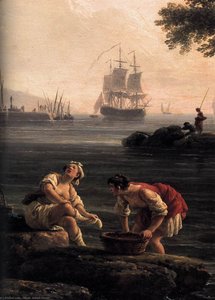
A Seashore (detail)

1776 · Oil On Copper · National Gallery, Londonas

In the delicate dance between land and sea, Claude Joseph Vernet captures a moment of profound stillness that transcends the centuries. His 1776 masterpiece, A Seashore (detail), is far more than a mere coastal observation; it is an evocative window into the Enlightenment era, where the boundaries between scientific curiosity and romantic wonder began to blur. As one gazes upon this exquisite copper print, the viewer is immediately transported to…

3
A Landscape at Sunset aut. Claude Joseph Vernet

A Landscape at Sunset

Oil On Canvas

A Landscape at Sunset is a French oil painting executed by Joseph Vernet in 1773. The work captures a specific atmospheric moment where light meets the water, establishing a serene mood through the interplay of sky and river. Vernet, a significant figure in eighteenth-century maritime art, utilizes the medium of oil on canvas to render the subtle transitions of a setting sun.

4
Seascape: Calm (1735) aut. Claude Joseph Vernet

Seascape: Calm

1735 · Oil On Canvas · Liuvro muziejus, Paryžius

In the vast annals of maritime art, few works capture the ephemeral magic of the sea with as much grace as Claude Joseph Vernet’s “Seascape: Calm.” Created in 1735, this masterpiece serves as a breathtaking window into an era where the horizon was not merely a boundary, but a stage for the divine interplay of light and water. The painting presents a serene coastal scene, likely caught in the soft,…

5
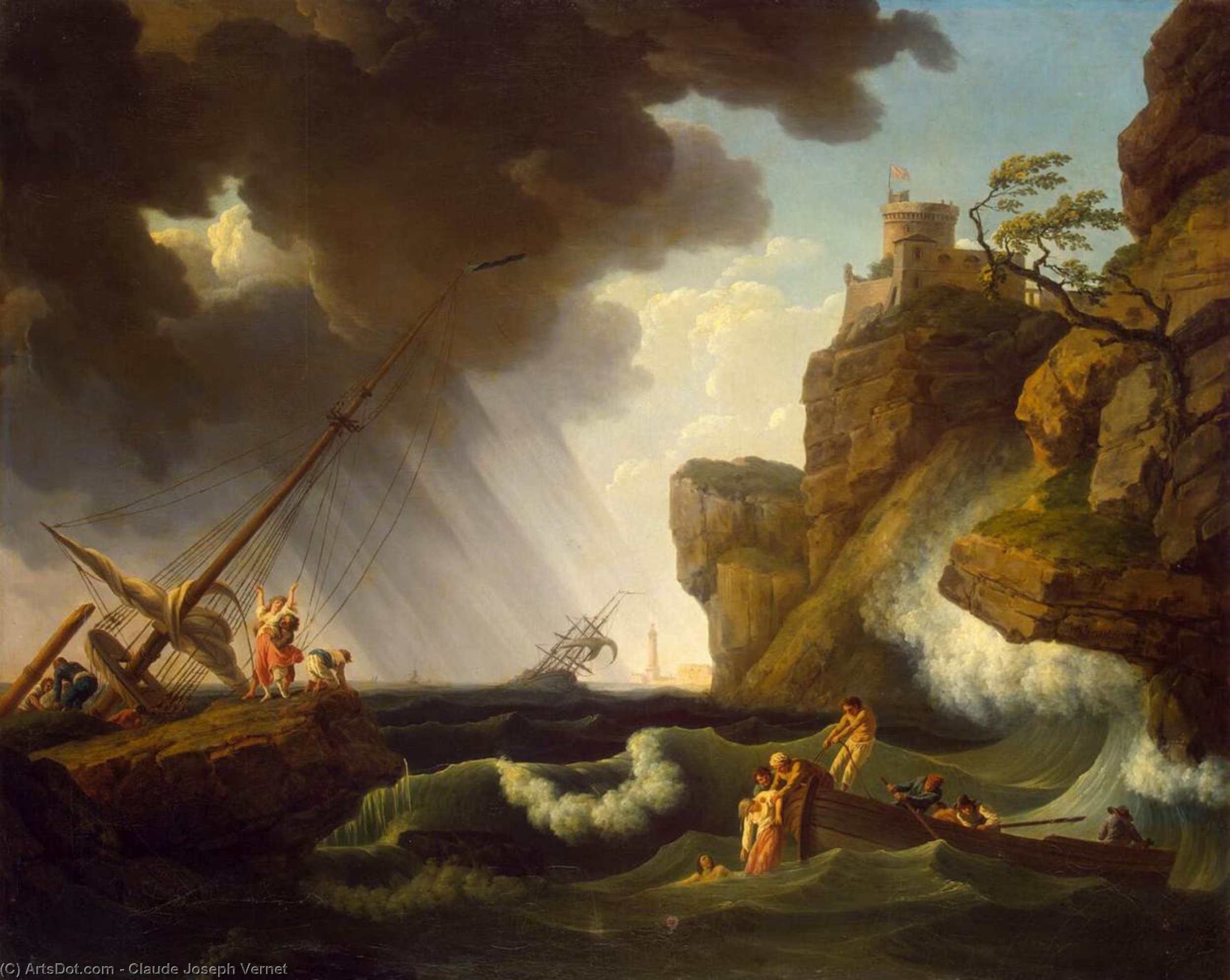
Shipwreck (1763) aut. Claude Joseph Vernet

Shipwreck

1763 · Oil On Canvas · Ermitažas, Šv. Peterburgas

Claude Joseph Vernet’s “Shipwreck” is far more than a mere depiction of maritime disaster; it is a profound cornerstone of Romantic landscape painting that captures the very essence of human vulnerability. Completed in 1763, this oil on canvas masterpiece invites viewers into a world where the boundaries between awe and terror dissolve. The scene unfolds with a panoramic intensity, dominated by turbulent, churning seas and brooding, heavy skies that seem…

6
River Scene with Bathers (1770) aut. Claude Joseph Vernet

River Scene with Bathers

1770 · Oil On Canvas · The Ashmolean Museum of Art And Archaeology, Oksfordas

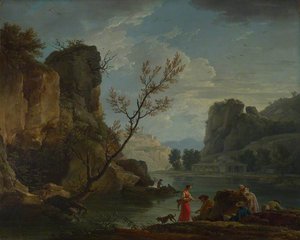
The river flows with a quiet, rhythmic pulse. In this scene, completed between 1768 and 1770, the water catches the diffused luminescence of a soft sky. Figures move through the shallows, their bodies breaking the surface in a slow dance of summer heat. A dog rests near the center, its presence grounding the pastoral dream, while sheep graze upon the hillside, their white forms scattered like fallen clouds against the…

7
Genoa Lighthouse and the Temple of Minerva Medica (1746) aut. Claude Joseph Vernet

Genoa Lighthouse and the Temple of Minerva Medica

1746 · Oil On Canvas · Bristol Museum - Art Gallery, Bristol

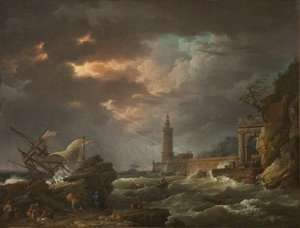
A turbulent seascape dominates the canvas, where the sea is a churning mass of white spray and dark, heavy currents. A small sailing vessel struggles against the weight of the water, its crew working to secure the hull against the pull of the tide. Above this maritime struggle, a rocky promontory rises from the foam. Upon this height, the Genoa Lighthouse pierces the gloom, its beam cutting through the salt-heavy…

9
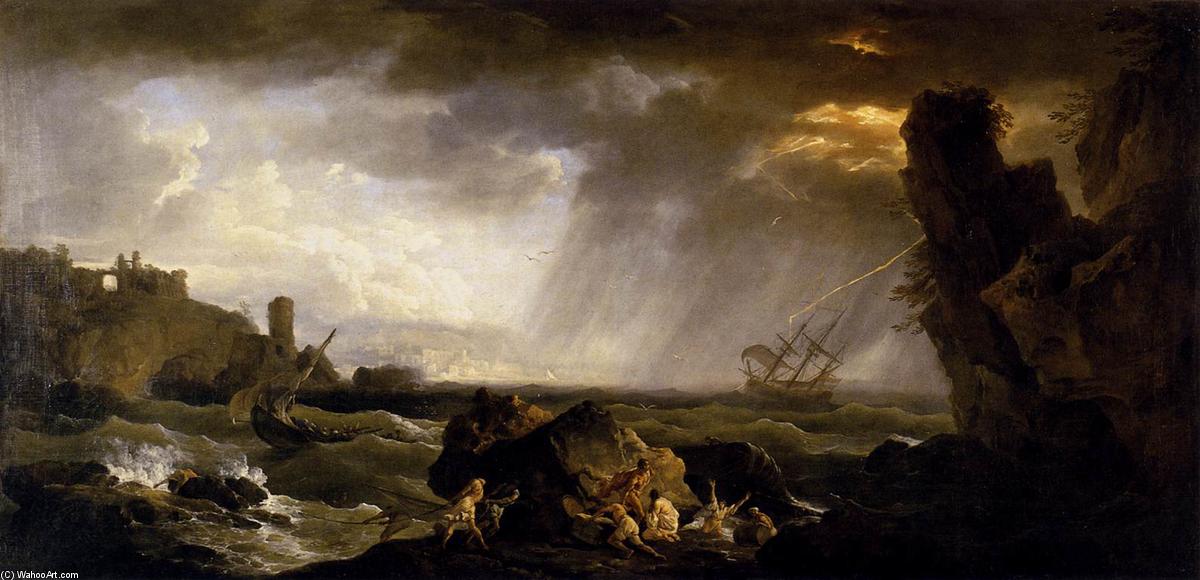
Seascape: Tempest (1735) aut. Claude Joseph Vernet

Seascape: Tempest

1735 · Oil On Canvas · Liuvro muziejus, Paryžius

Claude-Joseph Vernet's "Seascape: Tempest," painted in 1735, isn’t merely a depiction of a storm at sea; it’s a visceral embodiment of nature’s raw power and the precariousness of human existence. More than two centuries after its creation, this oil on canvas continues to resonate with viewers, drawing them into the heart of the tempestuous scene with an immediacy rarely achieved in landscape painting. Vernet, a master of maritime light and…

10
Coastal Scene (La nuit) (1750) aut. Claude Joseph Vernet

Coastal Scene (La nuit)

1750 · Acrylic On Canvas · The Ashmolean Museum of Art And Archaeology, Oksfordas

Claude-Joseph Vernet’s “Coastal Scene (La nuit),” painted circa 1750-53, stands as a cornerstone of maritime landscape painting and exemplifies the burgeoning Romantic movement's fascination with dramatic natural phenomena. Executed in oil on canvas, this artwork transcends mere depiction; it strives to capture not just what is seen but how it feels—the palpable tension between calm sea surface and turbulent sky.

Claude Joseph Vernet darba rinkinys tęsiamas, nuo 11 iki 100

11Calm (1735) aut. Claude Joseph VernetCalm1735 · Musée Comtadin-Duplessis 12Italian Landscape (1738) aut. Claude Joseph VernetItalian Landscape1738 · Dulwich Picture Gallery 13The four times of day: Evening (1757) aut. Claude Joseph VernetThe four times of day: Evening1757 · Art Gallery of South Australia 14Morning, Fishing (1750) aut. Claude Joseph VernetMorning, Fishing1750 15View of Lake Nemi (1748) aut. Claude Joseph VernetView of Lake Nemi1748 · Kanados Nacionalinė galerija 16Portrait of Simon-Mathurin Lantara (1750) aut. Claude Joseph VernetPortrait of Simon-Mathurin Lantara1750 17The Cascade at Tivoli (1750) aut. Claude Joseph VernetThe Cascade at Tivoli1750 · Birmingham art muziejus 18The Waterfalls at Tivoli, with the Villa of Maecenas (1750) aut. Claude Joseph VernetThe Waterfalls at Tivoli, with the Villa of Maecenas1750 · Mauritshuis 19An Italian Harbour in Stormy Weather (1750) aut. Claude Joseph VernetAn Italian Harbour in Stormy Weather1750 · Mauritshuis 20Port (1750) aut. Claude Joseph VernetPort1750 · Kubos nacionalinis grožio menų muziejus 21Night Rocky Inlet with Fisherfolk Setting Their Nets, Cooking and Drinking by Moonlight (1751) aut. Claude Joseph VernetNight Rocky Inlet with Fisherfolk Setting Their Nets, Cooking and Drinking by Moonlight1751 · Uppark 22A Sea Bay at Setting Sun (1760) aut. Claude Joseph VernetA Sea Bay at Setting Sun1760 · Bavarijos valstybinės paveikslų kolekcijos 23Landscape. Moonlight Effect (1759) aut. Claude Joseph VernetLandscape. Moonlight Effect1759 24Landscape with Washerwomen (1763) aut. Claude Joseph VernetLandscape with Washerwomen1763 · Petit Palais 25The Cascades of Tivoli (1760) aut. Claude Joseph VernetThe Cascades of Tivoli1760 · Dayton Art Institute 26Good Fishing (1758) aut. Claude Joseph VernetGood Fishing1758 27The Four Times of Day: Morning (1757) aut. Claude Joseph VernetThe Four Times of Day: Morning1757 · Art Gallery of South Australia 28Fishermen Under the Castle Ruin (La pêche à la ligne - copy) (1770) aut. Claude Joseph VernetFishermen Under the Castle Ruin (La pêche à la ligne - copy)1770 · Ernest Zmeták Art Gallery 29Nymphs Bathing, the Time is the Morning (1771) aut. Claude Joseph VernetNymphs Bathing, the Time is the Morning1771 · Bowes Museum 30A Shipwreck on a Rocky Coast (1775) aut. Claude Joseph VernetA Shipwreck on a Rocky Coast1775 31Seaport at Sunrise (1767) aut. Claude Joseph VernetSeaport at Sunrise1767 · Dulwich Picture Gallery 32Mediterranean Harbor at Sunset (1788) aut. Claude Joseph VernetMediterranean Harbor at Sunset1788 33Soldiers in a Mountain Gorge, with a Storm (1789) aut. Claude Joseph VernetSoldiers in a Mountain Gorge, with a Storm1789 34The four times of day: Night (1757) aut. Claude Joseph VernetThe four times of day: Night1757 · Art Gallery of South Australia 35Night: Mediterranean Coast Scene with Fishermen and Boats (1753) aut. Claude Joseph VernetNight: Mediterranean Coast Scene with Fishermen and Boats1753 · Thyssen-Bornemisza muziejus 36A Storm (1762) aut. Claude Joseph VernetA Storm1762 · Nacionalinis muziejus Varšuvoje 37Landscape with Waterfall and Figures (1768) aut. Claude Joseph VernetLandscape with Waterfall and Figures1768 · Walters Art Museum 38A River Scene (1781) aut. Claude Joseph VernetA River Scene1781 · Wallace Collection 39The Italian Gondola (1785) aut. Claude Joseph VernetThe Italian Gondola1785 · Škotijos Nacionalinė galerija 40A Storm on a Mediterranean Coast (1767) aut. Claude Joseph VernetA Storm on a Mediterranean Coast1767 · J. Paul Getty muziejus 41Oriental Seaport at Sunrise (1755) aut. Claude Joseph VernetOriental Seaport at Sunrise1755 · Alte Pinakothek 42Naples (1737) aut. Claude Joseph VernetNaples1737 · Antverpio karališkasis gražiųjų menų muziejus 43View of Posillipo near Naples (1742) aut. Claude Joseph VernetView of Posillipo near Naples1742 44Tivoli Landscape (1741) aut. Claude Joseph VernetTivoli Landscape1741 · Petit Palais 45The Waterfalls at Tivoli (1737) aut. Claude Joseph VernetThe Waterfalls at Tivoli1737 · Cleveland Museum of Art 46The Storm (1735) aut. Claude Joseph VernetThe Storm1735 · Musée Comtadin-Duplessis 47A Storm at Sea (1740) aut. Claude Joseph VernetA Storm at Sea1740 · Museum of Western and Oriental Art 48Harbour landscape (1739) aut. Claude Joseph VernetHarbour landscape1739 49The Storm (1752) aut. Claude Joseph VernetThe Storm1752 · Staatliche Kunsthalle Karlsruhe 50Shipwreck at Evening (1751) aut. Claude Joseph VernetShipwreck at Evening1751 · Bavarijos valstybinės paveikslų kolekcijos 51Evening Walk (1748) aut. Claude Joseph VernetEvening Walk1748 · Bavarijos valstybinės paveikslų kolekcijos 52Party in the Morning (1748) aut. Claude Joseph VernetParty in the Morning1748 · Bavarijos valstybinės paveikslų kolekcijos 53Morning Mist at Sunrise (1748) aut. Claude Joseph VernetMorning Mist at Sunrise1748 · Bavarijos valstybinės paveikslų kolekcijos 54Seascape, Sunset (1753) aut. Claude Joseph VernetSeascape, Sunset1753 55Seascape, Sunset; Fishermen Pushing a Boat (1750) aut. Claude Joseph VernetSeascape, Sunset; Fishermen Pushing a Boat1750 56Seascape, Landscape and Sunset (1753) aut. Claude Joseph VernetSeascape, Landscape and Sunset1753 57Marine (with three masts) (1750) aut. Claude Joseph VernetMarine (with three masts)1750 58Shipwreck (1750) aut. Claude Joseph VernetShipwreck1750 59Departure from the Port in the Morning Freshness (1749) aut. Claude Joseph VernetDeparture from the Port in the Morning Freshness1749 · Musée Calvet 60A View of Tivoli with the Anio Novus Aqueduct (1751) aut. Claude Joseph VernetA View of Tivoli with the Anio Novus Aqueduct1751 · Uppark 61The Shipwreck (1753) aut. Claude Joseph VernetThe Shipwreck1753 · Musée Calvet 62The Italian Gondola (1750) aut. Claude Joseph VernetThe Italian Gondola1750 · Musée Calvet 63Storm (1750) aut. Claude Joseph VernetStorm1750 · Musée Calvet 64Sea view (1750) aut. Claude Joseph VernetSea view1750 · Armėnijos nacionalinė galerija 65Morning in Castellammare (1750) aut. Claude Joseph VernetMorning in Castellammare1750 66Moonlight (1753) aut. Claude Joseph VernetMoonlight1753 · Musée Comtadin-Duplessis 67Marine, Calm (1745) aut. Claude Joseph VernetMarine, Calm1745 · Musée Fabre 68Marine by Calm Weather, Sunset Effect (1748) aut. Claude Joseph VernetMarine by Calm Weather, Sunset Effect1748 · Palais des Beaux-Arts de Lille 69Imaginary Landscape, Italian Harbor Scene (1746) aut. Claude Joseph VernetImaginary Landscape, Italian Harbor Scene1746 · Minneapolis Institute of Art 70A Storm (1748) aut. Claude Joseph VernetA Storm1748 · Musée Des Beaux 71View of Naples vith Mount Vesuvius (1748) aut. Claude Joseph VernetView of Naples vith Mount Vesuvius1748 72The Port of Marseille (1754) aut. Claude Joseph VernetThe Port of Marseille1754 73The Ponte Rotto, Rome (1745) aut. Claude Joseph VernetThe Ponte Rotto, Rome1745 74L'Arc en Ciel (1749) aut. Claude Joseph VernetL'Arc en Ciel1749 75Mediterranean Port at Dawn (1750) aut. Claude Joseph VernetMediterranean Port at Dawn1750 76Coastal Landscape (1747) aut. Claude Joseph VernetCoastal Landscape1747 77Nocturnal Seastorm (1752) aut. Claude Joseph VernetNocturnal Seastorm1752 78Morning A Port in the Mist – Fishermen Hauling in Their Boat (1751) aut. Claude Joseph VernetMorning A Port in the Mist – Fishermen Hauling in Their Boat1751 · Uppark 79A River Landscape with a Town above (1751) aut. Claude Joseph VernetA River Landscape with a Town above1751 · Uppark 80Evening Habour Scene with Boats Being Unloaded and Spectators (1751) aut. Claude Joseph VernetEvening Habour Scene with Boats Being Unloaded and Spectators1751 · Uppark 81Midday A Ship Offshore, Foundering in a Storm (1751) aut. Claude Joseph VernetMidday A Ship Offshore, Foundering in a Storm1751 · Uppark 82An Italianate Harbour Scene (1749) aut. Claude Joseph VernetAn Italianate Harbour Scene1749 · Dulwich Picture Gallery 83A River with Fishermen (1751) aut. Claude Joseph VernetA River with Fishermen1751 84The Tempest (Storm off the Coast) (1754) aut. Claude Joseph VernetThe Tempest (Storm off the Coast)1754 · Haworth Art Gallery 85Figures in a Landscape (1750) aut. Claude Joseph VernetFigures in a Landscape1750 86The Islands of the Archipelago (1751) aut. Claude Joseph VernetThe Islands of the Archipelago1751 · Vienos dailės akademija 87Seascape, Moonlight (1762) aut. Claude Joseph VernetSeascape, Moonlight1762 88The South, a Storm (1765) aut. Claude Joseph VernetThe South, a Storm1765 89Evening (1765) aut. Claude Joseph VernetEvening1765 90The Night, a Moonlight (1765) aut. Claude Joseph VernetThe Night, a Moonlight1765 91The Morning (1762) aut. Claude Joseph VernetThe Morning1762 · Opera House 92The Night (1762) aut. Claude Joseph VernetThe Night1762 · Opera House 93The Evening (1762) aut. Claude Joseph VernetThe Evening1762 · Opera House 94The South (1762) aut. Claude Joseph VernetThe South1762 · Opera House 95Scene on the Tiber (1760) aut. Claude Joseph VernetScene on the Tiber1760 96Castel Sant'Angelo, Rome (1760) aut. Claude Joseph VernetCastel Sant'Angelo, Rome1760 97View of Bordeaux Harbor (1759) aut. Claude Joseph VernetView of Bordeaux Harbor1759 98Rocky coast with sailors pushing a boat ashore (1764) aut. Claude Joseph VernetRocky coast with sailors pushing a boat ashore1764 99A Shipwreck (1759) aut. Claude Joseph VernetA Shipwreck1759 · Statens Museum For Kunst 100Harbour Scene (1759) aut. Claude Joseph VernetHarbour Scene1759 · Statens Museum For Kunst

Temos, kurios domino Claude Joseph Vernet

Ketverios temos, dažniausiai pasikrausto originaluose, kiekvienos su savo puikiausiu pavyzdžiu.

Muziejai, kuriuose saugomi Claude Joseph Vernet originalūs darbai

8 muziejai, kuriuose saugoma daugiausia šioje pusėje esamų paveikslų.

Muzejaus Miestas Claude Joseph Vernet darbai Šiojo sąrašo paveikslai
UpparkUppark 6 Night Rocky Inlet with Fisherfolk Setting Their Nets, Cooking and Drinking by Moonlight, A View of Tivoli with the Anio Novus Aqueduct, Morning A Port in the Mist – Fishermen Hauling in Their Boat
Bavarijos valstybinės paveikslų kolekcijos, MiunchasBavarijos valstybinės paveikslų kolekcijos Miunchas 10 A Sea Bay at Setting Sun, Shipwreck at Evening, Evening Walk
Musée Calvet, AvinjonasMusée Calvet Avinjonas 9 Departure from the Port in the Morning Freshness, The Shipwreck, The Italian Gondola
Opera House, VersalioOpera House Versalio 4 The Morning, The Night, The Evening
Dulwich Picture Gallery, LondonasDulwich Picture Gallery Londonas 6 Italian Landscape, Seaport at Sunrise, An Italianate Harbour Scene
Musée Comtadin-Duplessis, CarpentrasMusée Comtadin-Duplessis Carpentras 4 Calm, The Storm, Moonlight
Art Gallery of South Australia, AdelaidaArt Gallery of South Australia Adelaida 4 The four times of day: Evening, The Four Times of Day: Morning, The four times of day: Night
Liuvro muziejus, ParyžiusLiuvro muziejus Paryžius 6 Seascape: Calm, Seascape: Tempest

Claude Joseph Vernet dešimtmetėms po dešimtmetės: originalus kūrinys, apibūdinantis kiekvieną iš jų

Darbai pagal dešimtmečius

Pasirinkite dešimtmetį, kad pamatytėte jį apibrėžusį originalą.

Kolekcjonerų klausimai apie Claude Joseph Vernet paveikslus

Kuriu darbu Claude Joseph Vernet yra labiausiai garsus?Atsakymas

Sunset (1760), Fitzwilliam College, Cambridge. Toliau seka A Seashore (detail) (1776) ir A Landscape at Sunset.

Kokia buvo Claude Joseph Vernet amžius, kai buvo sukurtas Sunset?Atsakymas

46 metų amžiaus: Sunset sukurta 1760 m. Nr. Claude Joseph Vernet gimė 1714.

Kokie yra 10 garsiausių Claude Joseph Vernet paveikslų?Atsakymas

Sunset, A Seashore (detail), A Landscape at Sunset, Seascape: Calm, Shipwreck, River Scene with Bathers, Genoa Lighthouse and the Temple of Minerva Medica, Marine dit aussi Les pêcheurs des monts Pyrénées soirée, Seascape: Tempest ir Coastal Scene (La nuit). Viršuje esančioje reitingo sąraše nurodyta kiekvieno kūrinio metis ir muziejus.

Kiek paveikslų paliko Claude Joseph Vernet?Atsakymas

Mūsų kataloge yra 226 Claude Joseph Vernet darbų, skirtų laikotarpiui nuo 1735 iki 1789.

Kuriuose muziejuose eksponuojami Claude Joseph Vernet šedevrai?Atsakymas

Daugiausia – Uppark, Bavarijos valstybinės paveikslų kolekcijos (Miunchas) ir Musée Calvet (Avinjonas). Viršuje esančiame muziejų sąraše yra visi jie.

Kuriomis metais Claude Joseph Vernet tapo savo garsiausius kūrinius?Atsakymas

1750s laikotarpiu: 43 iš 100 šioje pusėje esančių darbų buvo sukurtos tada, iš jų Coastal Scene (La nuit).

Kokie yra pirmasis ir paskutinis garsieji Claude Joseph Vernet originalūs darbai?Atsakymas

Šioje pusėje seniausias darbas yra Seascape: Calm (1735), o naujausias – Soldiers in a Mountain Gorge, with a Storm (1789).

Kurią temą Claude Joseph Vernet rinkosi dažniausiai?Atsakymas

Sky (16), Rocks (13) ir Boats (12) iš 100 šioje pusėje esamų darbų.

Kurią techniką Claude Joseph Vernet naudojo dažniausiai?Atsakymas

Oil On Canvas, iš 100 šios puslapio darbų – 34.

Kelią meno kryptį priklauso Claude Joseph Vernet?Atsakymas

Rococo ir Romanticism, vadovaujantis šios puslapio originalais kūriniais.

Kurių Claude Joseph Vernet darbai eksponuojami Uppark?Atsakymas

Night Rocky Inlet with Fisherfolk Setting Their Nets, Cooking and Drinking by Moonlight, A View of Tivoli with the Anio Novus Aqueduct ir Morning A Port in the Mist – Fishermen Hauling in Their Boat: Uppark kolekcijoje yra 6 šioje pusėje esančių darbų.

Claude Joseph Vernet: gyvenimas ir kūryba

Ankstyvieji Metai ir Šeimos Įtaka: Klaidžiojo Jožefo Vernė kelias į Meną

Klaidžiojo Jožefo Vernė (pranc. Claude-Joseph Vernet), gimęs Bordo mieste 1714 metais, iš pradžių nebuvo lemta tapti didingų peizažų ir dramatiškų jūros vaizdų kūrėju, kurie vėliau apibrėš jo palikimą. Ankstyvieji meniniai polinkiai atskleidė aistrą arkliams – šis pomėgis buvo akivaizdus net vaikystėje, kai jis piešė kilnius gyvūnus nuo penkerių metų amžiaus. Šis ankstyvas susižavėjimas gyvūnų anatomija, ypač arklio forma, subtiliai paveikė jo vėlesnį darbą, suteikiant dinamiškos energijos ir realizmo platesnėse kompozicijose. Vernė formalus mokymas prasidėjo su tėvu Antuanu Vernė, dekoratyviniu tapytoju, ir Nikolias-Bernard Lépicié, suteikiančiu jam tvirtą akademinį pagrindą prieš patenkant į Europos meno širdį: Romą. Būtent Italijoje Vernė tikrai atrado savo pašaukimą, sužavėtas ne tik klasikiniais peizažais, bet ir jūros žalia galia bei grožiu. Banginių reginys prie Marselio pakrantės buvo lemtingas momentas, uždegęs visam gyvenimui trunkantį pomėgį jūrų temomis.

Romos Studijos ir Karališkos Užsakymai: Naujų Horizontų Paieška

Vernė laikas Romoje nebuvo tik esamų stilių kopijavimas; tai buvo gilus šviesos, atmosferos ir žmogaus bei gamtos sąveikos tyrimas. Jis įsisavino tokių meistrų kaip Klodas Lorenas (Claude Lorrain) ir Salvator Rosa įtaką, sujungdamas jų metodus į unikalų asmeninį viziją. Nors Lorenas siūlė idealizuotą ramybę, Rosa suteikė dramatišką intensyvumą – Vernė meistriškai sintetizavo šiuos elementus, kurdamas scenas, buvusius ir vizualiai įspūdingas, ir emociškai rezonuojančias. Grįžęs į Prancūziją 1753 metais, Vernė talentas greitai buvo pripažintas. Lemtinga akimirka atėjo su Liudviko XV užsakymu nutapyti prancūziškų uostamiesčių seriją. Šis ambicingas projektas – galiausiai apimantis penkiolika paveikslų – įtvirtino Vernė kaip geriausią jūros tapytoją savo laiku. Tai nebuvo tik topografiniai įrašai; tai buvo vaizdingi nacionalinio pasididžiavimo portretai, demonstruojantys Prancūzijos jūrų galią ir jos ryšį su jūra. Pavyzdžiui, Intérieur du port de Marseille (1754) nėra tik užimto uosto vaizdas – tai oda prekybai, pramonės gyvybinei energijai ir miesto klestėjimui.

Šviesos ir Audrų Palikimas: Vernė Meistriškumas

Vernė meninis įgūdis slypėjo ne tik jo tiksliame laivų ir uostų vaizdavime, bet ir meistriškame šviesos bei atmosferos valdymas. Jis suprato, kaip saulės spinduliai atspindi vandenyje, kaip susidaro debesys prieš audrą ir kaip šie elementai gali dramatiškai pakeisti scenos nuotaiką. Jo paveiksluose dažnai pasirodo dramatiškas dangus, nerami vandenys ir figūros, užfiksuotos tiek pavojaus, tiek atsparumo akimirkomis. A View of the Port of Naples with Mount Vesuvius in the Background (1774) puikiai iliustruoja šį talentą – įspūdingas Vezuvijaus buvimas stūksta virš užimto uosto, primindamas gamtos galią ir tuo pačiu pabrėžiant žmogaus veiklą. Šis gebėjimas subalansuoti didybę ir intymumą yra jo darbo bruožas. Be jūrų scenų, Vernė tyrinėjo peizažus ir medžioklės temas, visada išlaikydamas aštrų dėmesį detalėms ir supratimą apie gyvūnų anatomiją – įgūdį, ugdytą jaunystėje.

Šeima, Įtaka ir Nuolatinis Svarbumas: Vernė Paveikslų Rezonansas

Meno dinastija tęsėsi su Vernė sūnumi Antuanu Šarliu Orasu Vernė (taip pat žinomas kaip Karlas Vernė), kuris sekė tėvo pėdomis, išgarsėdamas savo dinamiškais mūšio scenomis ir medžioklės menu. Šis šeimos ryšys pabrėžia tradicijos ir mentorystės svarbą XVIII amžiaus prancūzų meno bendruomenėje. Klaidžiojo Jožefo Vernė įtaka apėjo toli už jo artimųjų ribas; jis padėjo pakelti peizažinę tapybą į reikšmingą vietą prancūzų mene. Jo darbas nutiesė kelią vėlesnės kartos menininkams, įkvėpdamas juos tyrinėti gamtos grožį ir galią. Nors jis mirė 1789 metais, revoliucijos pokyčių slenksnyje, Vernė palikimas išlieka. Jo paveikslai vis dar žavi žiūrovus savo atmosferiniu gylumu, techniniu meistriškumu ir vaizdingu pasakojimu – tai liudijimas gyvenimui, skiriamam šviesos, jūros ir žmogaus dvasios esmei.