


1


Atnaujinta lapkritis 2026 · pagal mūsų populiarumumo koeficientą (paieškos, lankytojai ir užsakymai kiekvienam kūriniui) · 35 Pieter Wouwerman darbai mūsų kataloge
Trumpai tariant
Iš visų paliktų originalų kūrinių Pieter Wouwerman garsiausias yra Forest with staffage figures (1642), esantis Villa Vauban kolekcijoje, Luxembourg. Tiesiog už jų seka Dice-Playing Soldiers in Front of an Inn (1652) ir Officer on Horseback (1660). Mūsų kataloge yra 35 darbų autoriaus Pieter Wouwerman; galerija išsaugojo 31 labiausiai pasaulyje žyminiausių kūrinių – kiekvienas jų pateikiamas su datos, muziejaus ir istorijos aprašymu.


 View of Paris seen from the Place Dauphine1660 · Statens Museum For Kunst
12
 Frederik Hendrik at the surrender of Maastricht, 22 August 16321650 · Rijksmuseum
13
 Hunting party on horseback with servants and dogs1661 · Staatliche Kunsthalle Karlsruhe
14
 Beach Scene with Fisher Woman1668 · Gemäldegalerie Alte Meister im Schloss Wilhelmshöhe
15
 View of Paris with the tower and porch of Nesle, in the backgroud the Pont Neuf and la Place Dauphine1664
16
 Landscape with a dapple grey horse1667 · Museum Boijmans Van Beuningen
17
 The storming of Coevorden, December 30, 16721672 · Rijksmuseum
18
 Horsemarket in Delft1670 · Het Prinsenhof
19
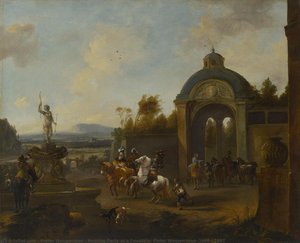 Hunting Party at a Fountain, Pieter Wouwerman, 1660 - 16821682 · Rijksmuseum
20
 Cavalry Skirmish with Foot SoldiersAntverpio karališkasis gražiųjų menų muziejus
21
 Departure for huntingNacionalinis muziejus Varšuvoje
22
 The watering place
23
 Landscape with a genre sceneNacionalinis muziejus Varšuvoje
24
 Setting Off On A Falcon Hunt
25
 The stableFitzwilliam Museum
26
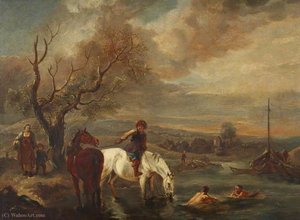 Country Scene with a Man on Horseback and Bathers
27
 Landscape with resting travellers
28
 Cavalry Men by a Suttler's Tent
29
 Dune landscape with figuresCleveland Museum of Art
30
 Encampment beside an Ale HouseFitzwilliam Museum
31
 Žindu medžioklėErmitažas
Ketverios temos, dažniausiai pasikrausto originaluose, kiekvienos su savo puikiausiu pavyzdžiu.
8 muziejai, kuriuose saugoma daugiausia šioje pusėje esamų paveikslų.
| Muzejaus | Miestas | Pieter Wouwerman darbai | Šiojo sąrašo paveikslai |
|---|---|---|---|
 Nacionalinis muziejus Varšuvoje |
Varšuva | 3 | Groom and horses, Departure for hunting, Landscape with a genre scene |
 Rijksmuseum |
Amsterdamas | 3 | Frederik Hendrik at the surrender of Maastricht, 22 August 1632, The storming of Coevorden, December 30, 1672, Hunting Party at a Fountain, Pieter Wouwerman, 1660 - 1682 |
 Staatliche Kunsthalle Karlsruhe |
Karlsruhe | 2 | The Collision, Hunting party on horseback with servants and dogs |
 Ermitažas |
Šv. Peterburgas | 2 | Horses in the Pasture, Žindu medžioklė |
 Gemäldegalerie Alte Meister im Schloss Wilhelmshöhe |
Kaselio | 2 | Landscape with horsemen at a blacksmith, Beach Scene with Fisher Woman |
 Fitzwilliam Museum |
2 | The stable, Encampment beside an Ale House | |
 Villa Vauban |
Luxembourg | 1 | Forest with staffage figures |
 Bavarijos valstybinės paveikslų kolekcijos |
Miunchas | 1 | Dice-Playing Soldiers in Front of an Inn |
Pasirinkite dešimtmetį, kad pamatytėte jį apibrėžusį originalą.

Forest with staffage figures (1642), Villa Vauban, Luxembourg. Toliau seka Dice-Playing Soldiers in Front of an Inn (1652) ir Officer on Horseback (1660).
19 metų amžiaus: Forest with staffage figures sukurta 1642 m. Nr. Pieter Wouwerman gimė 1623.
Forest with staffage figures, Dice-Playing Soldiers in Front of an Inn, Officer on Horseback, The Combat, The Collision, Groom and horses, Army Camp, Horses in the Pasture, Landscape with horsemen at a blacksmith ir Sandhills with Figure. Viršuje esančioje reitingo sąraše nurodyta kiekvieno kūrinio metis ir muziejus.
Mūsų kataloge yra 35 Pieter Wouwerman darbų, skirtų laikotarpiui nuo 1642 iki 1682.
Daugiausia – Nacionalinis muziejus Varšuvoje (Varšuva), Rijksmuseum (Amsterdamas) ir Staatliche Kunsthalle Karlsruhe (Karlsruhe). Viršuje esančiame muziejų sąraše yra visi jie.
1660s laikotarpiu: 7 iš 31 šioje pusėje esančių darbų buvo sukurtos tada, iš jų Officer on Horseback.
Šioje pusėje seniausias darbas yra Forest with staffage figures (1642), o naujausias – Hunting Party at a Fountain, Pieter Wouwerman, 1660 - 1682 (1682).
Groom and horses, Departure for hunting ir Landscape with a genre scene: Nacionalinis muziejus Varšuvoje, Varšuva kolekcijoje yra 3 šioje pusėje esančių darbų.