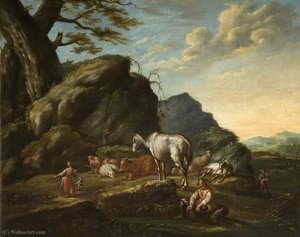
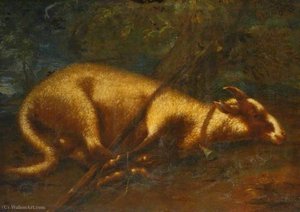
Goats and Flock of Sheep
Goats and Flock of Sheep is an oil painting by Philipp Peter Roos. The artist, who was also known by the moniker Rosa di Tivoli, produced this work about 1681. He was a German Baroque painter born in Sankt Goar, Germany.
Trumpai tariant
Iš visų paliktų originalų kūrinių Philipp Peter Roos garsiausias yra Goats and Flock of Sheep (1681), esantis Bavarijos valstybinės paveikslų kolekcijos kolekcijoje, Miunchas. Tiesiog už jų seka Piece of Livestock (1681) ir Landscape with Cattle and Shepherd (1681). Mūsų kataloge yra 93 darbų autoriaus Philipp Peter Roos; galerija išsaugojo 92 labiausiai pasaulyje žyminiausių kūrinių – kiekvienas jų pateikiamas su datos, muziejaus ir istorijos aprašymu.
Goats and Flock of Sheep is an oil painting by Philipp Peter Roos. The artist, who was also known by the moniker Rosa di Tivoli, produced this work about 1681. He was a German Baroque painter born in Sankt Goar, Germany.
Piece of Livestock is an oil painting by Philipp Peter Roos, executed in 1681. The work originates from the Baroque period, a time when the artist was establishing his presence within the Italianate landscape tradition.
Landscape with Cattle and Shepherd is a work by the German Baroque painter Philipp Peter Roos. Created about 1681, the painting reflects the artist's specialized focus on pastoral scenes and animal subjects. Roos was a significant figure in the development of Italianate landscapes, often characterized by his intimate study of livestock and the natural environment.
In Piece of Livestock, Philipp Peter Roos organizes a pastoral scene through a close-up, ground-level perspective that establishes an immediate intimacy with the subjects. The composition is dominated by a large, seated cow positioned slightly to the right of the center. To the left, a smaller lamb or calf provides a sense of scale, while a woman interacts with a dog in the space behind the primary subject. This arrangement…
Resting Flock with Shepherds is an oil painting by the German Baroque artist Philipp Peter Roos. Created about 1681, this work captures a quiet moment within a rugged landscape. The composition focuses on a group of livestock and a shepherd, rendered with a sense of immediate presence that draws the viewer into the scene.
Resting Flock with Shepherds is an oil painting by Philipp Peter Roos. The canvas captures a heavy stillness among livestock and their guardian. This work was created about 1681. It presents a scene of animals and men gathered in a quiet, layered space under a turbulent sky.
In this Baroque-style oil painting, the mythological drama of the Liberation of Io unfolds with a sudden, heavy intensity. Created by Philipp Peter Roos about 1681, the scene captures a moment of profound tension between the divine and the mortal. A massive, powerful bull dominates the foreground, its muscular form rendered with a weight that feels almost tangible. This central figure looms over the landscape, its presence commanding the space…
This oil on canvas painting, dated 1681, presents a monochromatic scene rendered in various shades of gray. In the foreground, a young woman is positioned amidst a group of livestock, including sheep or goats. The composition is a medium shot, placing the human subject and the animals in the immediate front and middle ground. The terrain is undulating, forming rolling hills that recede into a background of hazy mountains and…
Returning Flock with Shepherds is an oil painting by Philipp Peter Roos. Created about 1681, the work captures a quiet moment of pastoral movement. The artist, a German Baroque painter, was born in Sankt Goar. He would later become known by the moniker Rosa di Tivoli.
The scene unfolds in Shepherd with Cow, Sheep and Goats in Italian Mountain Landscape, a work that captures a quiet moment of pastoral life. This painting, created about 1680, brings together a shepherd and his diverse herd amidst a rugged, mountainous setting. The figures and animals exist within a landscape that feels both immediate and deeply rooted in the natural world.
Ketverios temos, dažniausiai pasikrausto originaluose, kiekvienos su savo puikiausiu pavyzdžiu.
8 muziejai, kuriuose saugoma daugiausia šioje pusėje esamų paveikslų.
| Muzejaus | Miestas | Philipp Peter Roos darbai | Šiojo sąrašo paveikslai |
|---|---|---|---|
| Miunchas | 15 | Goats and Flock of Sheep, Piece of Livestock, Landscape with Cattle and Shepherd | |
| Kopenhaga | 5 | Cattle Piece, Landscape with a Bull, Sheep and Goats, A Shepherd with his Herd | |
| Buenos Aires | 4 | Landscape with shepherd and animals, Landscape with figures and animals, Shepherd and animals in a landscape | |
| Bratislava | 3 | Goat Herd with a Goatherd, Shepherd's Idyl in a Romantic Landscape with Ruins, Herd by an Ancient Well | |
| Praha | 3 | Ravine with a Stream, a Shepherd and His Herd, Horse and Goats Grazing, Shepherd with a Herd of Sheep and Goats | |
| Viena | 3 | Herd with Sleeping Shepherds, Rider Meeting, Landscape with Flock of Sheep | |
| Šv. Peterburgas | 3 | Landscape with a Grotto, Landscape with a Waterfall, Landscape with a Herd | |
| Stokholmas | 3 | Dead Hare, Landskap med hjord, A Goat Resting |
Pasirinkite dešimtmetį, kad pamatytėte jį apibrėžusį originalą.
This large-scale oil painting, dated 1669, presents a crowded, maximalist composition of diverse animal species. The arrangement is packed, with various animals overlapping to create a sense of density and movement. The color palette relies on deep, earthy tones, including rich browns, blacks, and dark ochres. These dark shades are interrupted by specific highlights of white and cream, alongside splashes of red from a rooster and parrots. The lighting follows…
Goats and Flock of Sheep is an oil painting by Philipp Peter Roos. The artist, who was also known by the moniker Rosa di Tivoli, produced this work about 1681. He was a German Baroque painter born in Sankt Goar, Germany.
A heavy, dark-colored cow anchors the center of this scene, its presence felt in the weight of its silhouette. To the left, two goats rest upon the ground, one a pale contrast of white and light tan against the shadows. A man sits nearby, leaning back in a moment of stillness, his gaze directed toward the animals or perhaps the viewer. The air in the enclosure feels thick and dim,…
In this work, titled Shepherd's Idyl in a Romantic Landscape with Ruins, the artist Philipp Peter Roos presents a quiet moment of rural existence. Created about 1700, the painting captures a shepherd tending to his flock amidst a landscape of rolling hills and weathered stone structures. There is a sense of stillness in the way the figures and animals occupy the space, suggesting a life governed by the rhythms of…
Goats and Flock of Sheep (1681), Bavarijos valstybinės paveikslų kolekcijos, Miunchas. Toliau seka Piece of Livestock (1681) ir Landscape with Cattle and Shepherd (1681).
24 metų amžiaus: Goats and Flock of Sheep sukurta 1681 m. Nr. Philipp Peter Roos gimė 1657.
Goats and Flock of Sheep, Piece of Livestock, Landscape with Cattle and Shepherd, Piece of Livestock, Resting Flock with Shepherds, Resting Flock with Shepherds, Liberation of Io, Piece of Cattle, Returning Flock with Shepherds ir Shepherd with Cow, Sheep and Goats in Italian Mountain Landscape. Viršuje esančioje reitingo sąraše nurodyta kiekvieno kūrinio metis ir muziejus.
Mūsų kataloge yra 93 Philipp Peter Roos darbų, skirtų laikotarpiui nuo 1669 iki 1700.
Daugiausia – Bavarijos valstybinės paveikslų kolekcijos (Miunchas), Statens Museum For Kunst (Kopenhaga) ir T nacionalinis dailės muziejus (Buenos Aires). Viršuje esančiame muziejų sąraše yra visi jie.
1680s laikotarpiu: 21 iš 92 šioje pusėje esančių darbų buvo sukurtos tada, iš jų Goats and Flock of Sheep.
Šioje pusėje seniausias darbas yra Various animals gathered before Noah's Ark (1669), o naujausias – Shepherd's Idyl in a Romantic Landscape with Ruins (1700).
Landscape (33), Animals (29) ir Goats (19) iš 92 šioje pusėje esamų darbų.
Oil On Canvas, iš 92 šios puslapio darbų – 18.
Baroque, vadovaujantis šios puslapio originalais kūriniais.
Goats and Flock of Sheep, Piece of Livestock ir Landscape with Cattle and Shepherd: Bavarijos valstybinės paveikslų kolekcijos, Miunchas kolekcijoje yra 15 šioje pusėje esančių darbų.
Itiniškosios baroko auksinėje šviesoje nedarbingas vardas sukelia tokio pastoriaus ramybės pajutimą kaip Philipp Peter Roos. Istorijai žinomas savo įspūdingu pseudonimu Rosa di Tivoli, šis Voklijos gimtas meistras per gilią, beveik instinktyvią ryšį su gamtos pasauliu pervadovino kraštovės žanrą. Gimęs 1655 m. Rijnas regione – tiksliau netoli Sankt Goaro – Roos nuo ankstyvoji metų buvo paskirtas šeržui. Jis buvo Johanno Heinricho Rooso, gerbiamo kraštovės paveikslavėjo, sūnus, kuris suteikė pagrindinių mokslų apie toninę harmoniją ir kompozicinį pusmetį, kurie vėliau apibrėžė artisto brandų stilių. Ši ankstyva mokymų etapa nebuvo tik technikos mokymasis; tai buvo pasindulimas į pasaulio suvokimą per šviesos, šešėlio ir žemės tylios dignityo prizmę.
Roos gyvenimo kryptis dramatiškai pasikeitė 1677 m., kai šį poslinkį sukūrė Hesės-Kasel valdovas Charles I nuolatinė dovana. Pastebėjęs augantį talentą jauname paveikslavoje, valdovas suteikė finansinės galimybes Roos keliauti į transformatyvią Romą. Migracija iš germaniškų tradicijų į Italijos baroko širdį leido Roos’ui pasinerti į gyvybingą Romos meno energiją. Būtent čia jis ieškojo mentorystės garsiojo Giacinto Brandi šešalyje, kurio įtampa padėjo tobulinti Roos’ui gebėjimą derinti klasikinę struktūrą su laisvesniu, atmosferiniu realizmu. Šis laikotarpis Romoje buvo taip pat labai asmeniškas; būtent šiais metais Roos įsimylėjo Isabella Brandi, savo mentoro dukrą. Jų sąjunga galiausiai paskatino jį apsimesti Tivoli, žingsmas, kuris amžinai sujungė jo identitetą su kraštove, kurią jis taip mylėjo.
Tai, kas tikroju atskiria Rosa di Tivoli kūrybą, yra nepakeičiama jo gyvūnų subiectų autentiškumas. Nepalyginti su daugeliu savo samtvarių, kurie gyvūnus naudodavo tik kaip dekoratyvinius elementus kraštovėje, Roos į kiekvieną gyvūną – nuo sunkaus bulio iki lėkios kojos – žiūrėjo kaip portretistas, su didžiausia pagarba. Jo gyvenamoji vieta Tivoli buvo garsiai sukurta pagal koncepciją, panašią į gyvą studiją; jis prižiūrėjo didelę egzotiškų ir domestinių gyvūnų kolekciją, taip savo aplinką paversdamas nuolatinu judesio, anatomijos ir temperamentų tyrimu. Šis artumas leido jam užfiksuoti subtilų ausies judesį ar raumenų įtampą gyvūno stresinėje būsenoje, suteikdamas savo plėtnelėms kvapą gniaužiančio gyvybingumo.
Jo techninė meistriškumas yra akivaizdus tai, kaip jis valdė baroko estetiškumo sudėtingumą. Nors jo kompozicijos dažnai remiasi ramiomis, atmosferinėmis Olandijos Aukso amžiaus kokybėmis, jos yra prisidėjusios dramatišką intensyvumą, būdingą Italijos mokslui. Jo darbuose dažnai dominuoja:
Philipp Peter Roos istorinė svarba slypi jo gebėjime užmaiesti tiltą tarp struktūrizuotų Šiaurės Europos kraštovės tradicijų ir emocingo, šviesos kupino Italijos dramos. Jis pasirodė tokiu laiku, kai to mokslo tyrimas pradėjo reikalauti tikesnių gamtos pasaulio stebėjimų, net kai religinės ir mitologinės temos vis dar dominavo meninėje sąconsci Federali. Jo paveiksluose galima rasti tiek kruopštų naturalistų detalį, tiek romantišką poetišką sielą. Dokumentuodamas Romos šalies florą ir fauną su tokia atsidavome, jis sukūrė vizualinį įrašą, kuris yra tiek pat apie to laiko dvasią, kiek ir apie pačias temas.
Nors jis mirė 1706 m., palikdamas palikimą, įrašytą į pačią Tivolio žemę, jo įtampa išliko. Jis išlieka svarbus figūra visiems, studijantiems gyvūnų vaizduojimo (animalier) evoliuciją ir italikų kraštovės vystymą. Per jo akis mes ne tik matome galvijų kolekciją; mes liudijame gilią gyvybės šventę jos pačiose, paprastiose, neapdirštose formose. Jo darbas toliau rezonuoja kaip įrodymas stebėjimo galimai ir neblokuojamos pastoriaus idealo grožios.