Erté portretas

100 garsiausių Erté paveikių rinkinys: galerijos išboru

Atnaujinta spalis 2026 · pagal mūsų populiarumumo koeficientą (paieškos, lankytojai ir užsakymai kiekvienam kūriniui) · 360 Erté darbai mūsų kataloge

Trumpai tariant

Iš visų originalų, kuriuos paliko Erté, garsiausias yra Evening Night. Tiesiog už jų seka Little Slave ir At the Theatre, Trapeze. Mūsų kataloge yra 360 darbų autoriaus Erté; galerija išsaugojo 100 labiausiai pasaulyje žyminiausių kūrinių – kiekvienas jų pateikiamas su datos, muziejaus ir istorijos aprašymu.

1892 – 1990, Sankt Peterburgas Art deco Daugiausia darbų: Labirinto della Masone

Erté geriausios 10 paveikslų: galerijos pasirinkimas

1
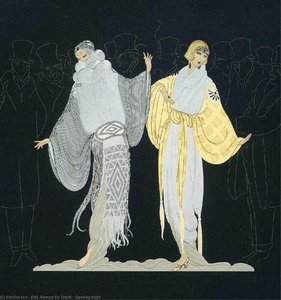
Evening Night aut. Erté

Evening Night

Painting

This work captures the essence of a period defined by glamour and the shifting tides of modern design. The influence of Persian miniatures, known for their intricate detail, whispers through the patterns on the dresses. There is a tension between the organic curves of the women's forms and the sharp, structured nature of their attire. The scene feels like a fragment of a grander theatrical production or a high-fashion illustration…

2
Little Slave aut. Erté

Little Slave

Tempera · Labirinto della Masone, Fontanellato

In the pantheon of twentieth-century visual culture, few names evoke the shimmering allure of the Jazz Age quite like Erté. His masterpiece, Little Slave, serves as a breathtaking window into an era defined by unparalleled glamour and sophisticated design. The artwork presents a stylized, ethereal depiction of a woman caught in a moment of theatrical grace, embodying the very soul of the Art Deco movement. Through elongated forms and meticulous…

3
At the Theatre, Trapeze aut. Erté

At the Theatre, Trapeze

Screenprint

The scene unfolds within the composition of At the Theatre, Trapeze, a work that captures a singular moment of suspended motion. Created by the artist Erté, this piece emerges from his celebrated At the Theatre series. It exists as a refined expression of the Art Deco movement, where the precision of line and the elegance of form define the visual language. The work is classified under the genre of design,…

4
Fantasia aut. Erté

Fantasia

Screenprint

The artwork titled Fantasia was produced by the artist Erté about 1982. This piece emerged from the hands of a man who bridged two worlds, born in Saint Petersburg, Russia, and later becoming a French artist. His life spanned from 1892 to 1990, a period that saw the rise and fall of many aesthetic movements.

5
At the Theatre, Golden Calf aut. Erté

At the Theatre, Golden Calf

Screenprint

The scene unfolds through the vision of At the Theatre, Golden Calf, a work that carries the unmistakable signature of Erté. This piece emerges from the creative mind of Romain de Tirtoff, the man who chose the name Erté to navigate his path through the artistic circles of the twentieth century. He was born in 1892 in Saint Petersburg, Russia, a place that shaped the early sensibilities of a man…

6
Oriental Tale aut. Erté

Oriental Tale

We are looking at Oriental Tale, a work by the artist known as Erté. His full name was Romain de Tirtoff, a man whose life spanned much of the twentieth century, from his birth in 1892 until his death in 1990. Born in Saint Petersburg, Russia, he eventually became a central figure in the Art Deco movement, bridging his Russian origins with the sophisticated sensibilities of France.

Erté darba rinkinys tęsiamas, nuo 11 iki 100

žymios Erté tapiojamos, pagal laikotarpį

Temos, kurios domino Erté

Ketverios temos, dažniausiai pasikrausto originaluose, kiekvienos su savo puikiausiu pavyzdžiu.

Muziejai, kuriuose saugomi Erté originalūs darbai

1 muziejai, kuriuose yra daugiausia šioje puslapyje esamų paveikslų.

Muzejaus Miestas Erté darbai Šiojo sąrašo paveikslai
Labirinto della Masone, FontanellatoLabirinto della Masone Fontanellato 1 Little Slave

Erté metai po metų: originalūs darbai, apibūdinantys kiekvieną iš jų

Nuo 1926 iki 1983, Erté kūrė 58 metų: šiame rinkinyje pristatoma ilga kūrybos kelionė, apimanti geriausius originalius darbus metus po metų.

Darbai pagal metus

Pasirinkite metus, kad pamatytumėte originalus darbus.

Kolekcjonerų klausimai apie Erté paveikslus

Kuriu darbu Erté yra labiausiai garsus?Atsakymas

Evening Night. Toliausiai eina Little Slave ir At the Theatre, Trapeze.

Kokie yra 10 garsiausių Erté paveikslų?Atsakymas

Evening Night, Little Slave, At the Theatre, Trapeze, Fantasia, At the Theatre, Golden Calf, Oriental Tale, The Seven Deadly Sins, Pride, The Seasons, Autumn, Eyes of Jealousy ir Simone. Viršuje esančioje reitingo sąraše nurodyta kiekvieno kūrinio metis ir muziejus.

Kiek paveikslų paliko Erté?Atsakymas

Mūsų kataloge yra 360 Erté darbų, skirtų laikotarpiui nuo 1926 iki 1983.

Kuriuose muziejuose eksponuojami Erté šedevrai?Atsakymas

Daugiausia – Labirinto della Masone (Fontanellato). Viršuje esančiame muziejų sąraše yra visi jie.

Kokie yra pirmasis ir paskutinis garsieji Erté originalūs darbai?Atsakymas

Šioje pusėje seniausias darbas yra Marriage Dance (1926), o naujausias – Phoenix Triumphant (1983).

Kurią temą Erté rinkosi dažniausiai?Atsakymas

Designs and sketches (56), Women (16) ir Geometric design (8) iš 100 šioje pusėje esamų darbų.

Kurią techniką Erté naudojo dažniausiai?Atsakymas

Screenprint, iš 100 šios puslapio darbų – 3.

Kelią meno kryptį priklauso Erté?Atsakymas

Art deco, judging by the originals on this page.

Erté: gyvenimas ir kūryba

Early Life and Artistic Awakening

Romain de Tirtoff, universally recognized as Erté, was born into a world of aristocratic privilege and unwavering tradition in Saint Petersburg, Russia, on November 23, 1892. His lineage traced back centuries to Tatar khans—a heritage that instilled within him a profound appreciation for history and artistic grandeur. His father, Admiral Nikolai Tirtoff, served with distinction in the Imperial Russian Navy, shaping young Romain’s understanding of discipline and ambition. Yet, amidst these expectations of naval service, a fervent passion ignited – a love affair with art that would irrevocably define his life's trajectory. This fascination wasn’t merely aesthetic; it stemmed from an innate sensitivity to beauty and form, nurtured by his mother’s unwavering affection and the mesmerizing allure of Persian miniatures housed within his father’s expansive library. These intricate designs—characterized by flowing lines and vibrant colors—would subtly permeate Erté’s artistic sensibilities throughout his career, imbuing his creations with a distinctive sense of opulent detail and stylized elegance. Legend recounts that at just five years old, Romain sketched an evening gown for his mother – a feat that astonished seamstresses and solidified his extraordinary talent for design.

Parisian Flourishing and the Birth of an Art Deco Icon

Driven by this internal conviction—a yearning to express himself creatively—Romain defied societal norms and embarked on a transformative journey toward Paris, France, in 1910 at eighteen years old. Leaving behind the familiar comforts of Russia, he embraced the exhilarating dynamism of the Parisian artistic milieu with unwavering determination. Initially securing employment as a draughtsman, Erté swiftly ascended beyond mere technical proficiency, fueled by an ambition that soared towards artistic excellence. Fate intervened decisively when he presented his portfolio to Paul Poiret—the celebrated “King of Fashion”—who immediately recognized Erté’s unparalleled gift for visual storytelling. This serendipitous encounter proved pivotal, providing him with invaluable experience in costume and accessory design and propelling him into the heart of Parisian haute couture. However, it was his association with Harper's Bazaar that cemented Erté’s reputation as an artistic visionary. From 1915 to 1936, he graced over 240 covers with breathtaking illustrations—a remarkable accomplishment reflecting his unwavering dedication and stylistic mastery. These weren’t simply fashion plates; they were exquisite works of art—celebrating the glamour and sophistication of the Art Deco era. Erté didn't merely depict fashion; he *defined* it, capturing the spirit of an epoch characterized by boldness and innovation.

Beyond Fashion: Theater, Hollywood, and Artistic Evolution

Erté’s artistic prowess transcended the boundaries of haute couture, extending into diverse creative pursuits. He demonstrated remarkable versatility as a designer for theatrical productions—creating costumes and sets that transported audiences to fantastical realms. His designs weren't merely garments; they were transformative creations imbued with symbolic meaning and designed to amplify the dramatic impact of each performance. This foray into theater allowed him to explore his artistic vision on a grand scale, experimenting with color palettes and textural contrasts—further refining his distinctive aesthetic. Simultaneously, Erté ventured westward in 1925 accepting a contract with Metro-Goldwyn-Mayer Studios in Hollywood—expanding his creative horizons and introducing his art to a wider global audience. He continued to exhibit his work, holding his first solo exhibition at the Madison Hotel in New York City that same year—a momentous occasion marking the recognition of his artistic contributions. Throughout this period Erté’s style evolved subtly yet profoundly – initially influenced by Art Nouveau's graceful curves and organic forms, he increasingly embraced the geometric precision and luxurious aesthetic emblematic of Art Deco.

Legacy and Enduring Influence

Erté’s influence reverberates throughout the annals of art history—recognized as a pioneer of Art Deco, shaping its visual language and inspiring generations of artists and designers. His designs have permeated fashion trends, interior design aesthetics, and graphic arts across decades – maintaining an undeniable resonance with contemporary creatives. Erté received numerous accolades honoring his artistic legacy—including Chevalier du Mérite Artistique et Culturel from the French government—a testament to his unwavering commitment to artistic excellence. Romain de Tirtoff passed away peacefully in Paris on April 21, 1990, at the age of 97 – leaving behind a timeless masterpiece that continues to captivate audiences worldwide. His enduring vision—characterized by elegance and stylistic innovation—remains an inspiration for artists striving to capture beauty and grandeur.