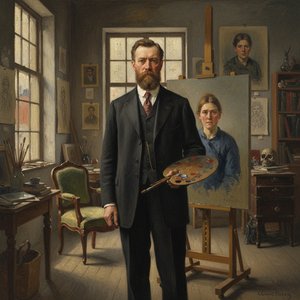
The Quiet Legacy of Carl Frederik Vogt
In the annals of Scandinavian art history, few figures embody the transition between classical training and regional identity as gracefully as Carl Frederik Vogt. Born in Copenhagen in 1781, Vogt emerged from a humble background as the son of a carriage maker, yet his destiny was carved not from wood, but from light and pigment. His journey began in the prestigious halls of the Royal Danish Academy of Fine Arts, an institution that served as the crucible for the era's most significant talents. It was here, amidst the rigorous discipline of neoclassical instruction, that Vogt first demonstrated his profound command over the medium, eventually earning the distinguished silver medal in 1802—a testament to a burgeoning mastery that would soon carry him far beyond the borders of Denmark.
While his roots were firmly planted in Danish soil, the trajectory of Vogt’s life and artistry was irrevocably altered by his move to Norway. Settling in Christiania, he became a vital presence in the Norwegian art scene during a period of profound cultural shifts. His work serves as a bridge between the formal elegance of his Copenhagen education and the rugged, evocative landscapes and intimate subjects of his adopted home. As a painter, Vogt possessed a unique ability to capture the quiet dignity of his subjects, infusing his compositions with a sense of stillness that invites deep contemplation.
Artistic Vision and Technical Mastery
The essence of Vogt’s oeuvre lies in its delicate balance of precision and atmosphere. His training at the Academy instilled in him a profound respect for anatomical accuracy and structural integrity, yet his time in Norway allowed for a softening of these rigid lines into something more organic and emotive. His technique was characterized by a subtle handling of light, which he used to breathe life into both portraiture and landscape. In his hands, the play of shadow across a face or the mist clinging to a Norwegian valley became more than mere visual phenomena; they became vessels for mood and memory.
To understand the depth of his contribution, one must consider the elements that defined his creative output:
- Classical Foundation: The rigorous academic training in Copenhagen provided him with an unbreakable foundation in composition and form.
- Regional Connection: His integration into Norwegian society allowed him to document the burgeoning national identity through a localized lens.
- Luminosity: A masterful use of light that transitioned from the structured clarity of neoclassicism toward a more atmospheric sensibility.
- Versatility: The ability to navigate between the formal requirements of portraiture and the emotive demands of landscape painting.
A Lasting Impression on Scandinavian Art
Though his life was relatively brief, ending in 1834, Carl Frederik Vogt left an indelible mark on the artistic heritage of both Denmark and Norway. He belonged to a generation of artists who were instrumental in defining the visual language of Northern Europe during the early nineteenth century. His works, now preserved in esteemed institutions such as the Oslo Museum and the Norwegian Museum of Cultural History, continue to offer scholars and art lovers alike a window into a world of refined elegance and burgeoning romanticism.
Vogt’s historical significance is found not only in the beauty of his individual canvases but in his role as a cultural conduit. He carried the sophisticated traditions of the Danish Academy into the heart of Norway, helping to nurture an artistic environment where a distinct Norwegian identity could flourish. In every brushstroke, one finds the echoes of a man who successfully harmonized the disciplined lessons of his past with the vibrant, untamed spirit of his present, ensuring that his legacy remains as luminous as the light he so expertly captured.
Klausimai ir atsakymai
Ar yra Carl Frederik Vogt kūrybos laiko linija?
Galite peržiūrėti Carl Frederik Vogt kūrybos laiko liniją: puslapyje Kūrybos chronologija kūriniai surikiuoti pagal jų sukūrimo datą.
Kur galiu pamatyti Carl Frederik Vogt kūrybą, sugrupuotą pagal atmosferą?
Carl Frederik Vogt Nuotaudų kambarys – tai puslapis, kuriame kūriniai sugrupuoti pagal nuotaiką.
Kiek Carl Frederik Vogt kūrinių galima peržiūrėti?
Visi kūriniai puslapio kataloge galite peržiūrėti 15 kūriniai kūrinius, autoriaus: Carl Frederik Vogt.
Kur galima rasti temomis suskirstytus Carl Frederik Vogt kūrybos darbus?
Carl Frederik Vogt kūrybą temomis galima tyrinėti puslapio Tematų katalogas temų kataloge.