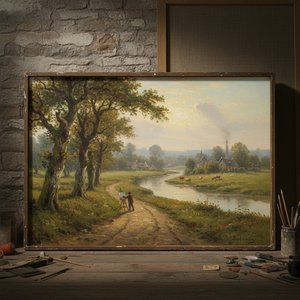
1828 - 1901

Esminiai duomenys

  • Art period: 19th Century
  • Also known as:
    • August Schenck
    • Auguste Schenck
    • Auguste Frederic Schenck
    • Schenek
    • Aug. Schenck
  • Top 3 works:
    • Skausmas
    • Flock of Sheep with Shepherdess
    • The Orphan. A Memory of Auvergne
  • Copyright status: Public domain
  • Born: 1828, Glückstadt, Germany
  • Works on this site: 6
  • Top-ranked work: Skausmas

A Life Bridging Two Worlds: August Friedrich Albrecht Schenck

August Friedrich Albrecht Schenck, a name perhaps less instantly recognizable than some of his contemporaries, nevertheless occupies a fascinating niche in 19th-century art history. Born in 1828 in Glückstadt, a town then part of the Duchy of Holstein under Danish control but deeply embedded within the German Confederation, Schenck’s life was one of geographical and cultural negotiation. This early duality – a foot in both the Germanic and French worlds – would profoundly shape his artistic sensibility and career trajectory. He wasn't destined for a quiet provincial existence; instead, he embarked on an unconventional path that led him from the bustling trade routes of Europe to the heart of Parisian art circles. Before dedicating himself fully to painting, Schenck spent five years as a “wine traveler,” traversing Germany, Russia, and Portugal, experiences which likely instilled in him a keen observational eye and a taste for the dramatic narratives inherent in human life. This period of wandering ultimately culminated in his arrival in Paris, where he formally trained under the esteemed Léon Cogniet at the École des Beaux-Arts.

The Rise of an Animalier: Landscapes and Emotive Power

Schenck’s artistic focus quickly crystallized around landscapes and animal paintings, a genre that was gaining significant traction during this period. He debuted publicly in 1855, marking the beginning of a successful career characterized by meticulous detail and a remarkable ability to imbue his subjects with profound emotion. While many artists of the time specialized in grand historical scenes or portraits of societal figures, Schenck found his voice in the quieter dramas of the natural world. He wasn’t merely depicting animals; he was exploring universal themes of grief, loss, and resilience through their portrayal. This approach resonated deeply with audiences, establishing him as a prominent figure alongside other celebrated animal painters like Rosa Bonheur. His works weren't simply realistic representations but rather carefully constructed emotional landscapes that invited viewers to connect with the vulnerability and strength inherent in the animal kingdom.

Anguish: A Masterpiece of Sentiment

Anguish, completed around 1878, remains Schenck’s most enduring legacy. This oil-on-canvas painting depicts a ewe standing protectively over the lifeless body of her lamb, encircled by a gathering of ominous black crows. The scene is stark and hauntingly beautiful, rendered in muted tones that amplify the sense of despair. It's not merely an image of death; it’s a powerful meditation on maternal love, loss, and the relentless cycle of life and death. Anguish quickly garnered critical acclaim and became an instant sensation, acquired by the National Gallery of Victoria in Melbourne just two years later, in 1880. Its enduring popularity – it was voted the gallery’s most beloved work on multiple occasions – speaks to its universal emotional resonance. The painting's composition, with the ewe’s defiant posture and the menacing presence of the crows, creates a palpable tension that draws viewers into the heart of the scene. Some scholars suggest the work may have been influenced by Charles Darwin’s research on animal emotions, reflecting a growing interest in understanding the inner lives of creatures beyond human experience.

Recognition and Legacy: A Chevalier of the Arts

Schenck's success wasn’t limited to critical acclaim; he also achieved significant recognition within artistic circles. In 1885, he was knighted into the Legion of Honour, a testament to his contributions to French art. He settled permanently in Écouen, a town north of Paris that had become a haven for artists, including Charles-François Daubigny and Jean-Baptiste-Camille Corot. The artistic community fostered there allowed Schenck to flourish, continuing to produce works that explored the emotional depths of his chosen subjects. His painting *L’Échir* now adorns the town hall of Écouen, while *Lamb of God - Agnus dei* graces its church, demonstrating the lasting impact he had on the local community. Though he passed away in 1901, Schenck left behind a body of work that continues to captivate and move audiences today. His paintings serve as poignant reminders of the power of art to evoke empathy, explore universal themes, and connect us to the natural world.

Viktorina

Kiekviename klausime yra tik vienas teisingas atsakymas.

Klausimas 1:
August Friedrich Schenck was born in which country?
Klausimas 2:
With whom did Schenck study at the École des Beaux-Arts in Paris?
Klausimas 3:
What is arguably Schenck's most famous painting?
Klausimas 4:
In what year was 'Anguish' first exhibited publicly?
Klausimas 5:
Which gallery acquired 'Anguish' in 1880?

Klausimai ir atsakymai

Kuriame istoriniame laikotarpyje kūrė August Friedrich Schenk?

August Friedrich Schenk kūrė 19th Century laikotarpiu. Šis laikotarpis leidžia įvertinti kūrybinę veiklą istoriniame kontekste.

Ar galima rasti August Friedrich Schenk kūrybos darbų pagal spalvą?

August Friedrich Schenk kūrybą pagal spalvas galite tyrinėti puslapio Spalvų indeksas svetainėje.

Kuriuose meno judelseriu dirbo August Friedrich Schenk?

Visi meno kryptys puslapio kūriniai August Friedrich Schenk yra suskirstyti pagal meno kryptis.

Kur ir kada gimė August Friedrich Schenk?

August Friedrich Schenk gimė Glückstadt, 1828 m.

Kur galima rasti sugrupuotą pagal spalvų paletę August Friedrich Schenk kūrybą?

August Friedrich Schenk kūrybą spalvų paletėms sugrupuota galite rasti puslapyje Pagrinti pagal spalvų paletę.

Kur galiu pamatyti August Friedrich Schenk kūrybos spalvų profilį?

August Friedrich Schenk darbų spalvų naudojimą, pateikiamus ši ši internetinė svetainė, galima išstudizuoti puslapyje Paletės genomas.

Iš kokios šalies yra August Friedrich Schenk?

August Friedrich Schenk gimė Germany.

Kur galiu pamatyti August Friedrich Schenk kūrybinę veiklą chronologine tvarka?

Galite peržiūrėti August Friedrich Schenk kūrybos laiko liniją: puslapyje Kūrybos chronologija kūriniai surikiuoti pagal jų sukūrimo datą.

Kur galima rasti temomis suskirstytus August Friedrich Schenk kūrybos darbus?

August Friedrich Schenk Tematų katalogas yra puslapis, kuriame kūriniai suskirstyti pagal jų tematiką.