A Greek Voice in Venetian Splendor: The Life and Art of Antonio Vassilacchi
Antonio Vassilacchi, known affectionately as L'Aliense – “the foreigner” – stands as a compelling figure within the vibrant tapestry of late
Renaissance and early
Baroque Venice. Born in 1556 on the sun-drenched island of Milos, Greece, his journey to become a celebrated painter in one of Europe’s most cosmopolitan cities is a testament to talent, adaptability, and the enduring power of artistic ambition. Leaving his homeland at a young age, Vassilacchi arrived in Venice, a republic brimming with artistic innovation and cultural exchange, ready to absorb its influences while retaining a distinct identity forged by his Greek heritage. This duality would become a defining characteristic of his work, setting him apart from many of his contemporaries. He wasn’t merely an artist *in* Venice; he was an artist *of* Venice, yet always subtly marked by the echoes of his Aegean origins.
Apprenticeship and Early Commissions: Forging a Venetian Style
Vassilacchi's artistic education began under the tutelage of
Paolo Veronese, a master renowned for his opulent color palettes, dynamic compositions, and grand-scale frescoes. This apprenticeship proved foundational, instilling in Vassilacchi a deep understanding of
Venetian painting techniques and aesthetics. He quickly absorbed
Veronese’s mastery of
light and shadow, his ability to create bustling scenes filled with richly dressed figures, and his penchant for dramatic storytelling. However, while deeply influenced by his mentor, Vassilacchi didn't simply imitate; he began to develop his own unique voice. Early commissions – frescoes in the episcopal palace at Treviso and churches in Padua and Venice – allowed him to hone his skills and experiment with different styles. These early works demonstrate a growing confidence and an emerging talent for capturing both
human emotion and architectural grandeur. A pivotal moment arrived in 1577, when a devastating fire ravaged the
Doge's Palace, offering Vassilacchi a crucial opportunity to showcase his abilities on a monumental scale as one of the artists tasked with its restoration.
The Palazzo Ducale and a Flourishing Career
The reconstruction of the
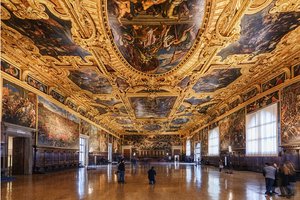
Doge’s Palace proved transformative for Vassilacchi. This commission wasn't merely about repairing damage; it was about recreating the very heart of Venetian power and prestige. He contributed extensively to numerous halls, including the Grand Council Hall, Senate Hall, and Hall of the Compass, immersing himself in the city’s political and social life while simultaneously leaving an indelible mark on its artistic landscape. His work within the
Palazzo Ducale demonstrates a remarkable versatility – he could depict historical events with dramatic flair, portray allegorical figures with elegant grace, and capture the intricate details of Venetian architecture with meticulous precision. Beyond the
Doge's Palace, Vassilacchi continued to receive commissions from churches throughout Venice and beyond. Notable examples include “
The Transfiguration” at San Marziale and a cycle of paintings depicting the life of Christ at San Pietro in Perugia, showcasing his skill in
religious iconography and narrative painting. In 1600, he became a member of ‘the brotherhood of saint nicolas of the greek nation’, one of Venice’s most vibrant communities for foreign artists, further solidifying his place within the city's cultural fabric.
Legacy and Artistic Significance: Bridging Cultures
Antonio Vassilacchi occupies a unique position in the history of Venetian art. As a Greek painter working primarily in Italy, he served as a bridge between cultures, contributing to Venice’s renowned cosmopolitan atmosphere. His ability to secure prestigious commissions – particularly his extensive work at the
Doge's Palace – underscores his reputation as a respected and sought-after artist. While often overshadowed by more celebrated contemporaries like
Veronese or Titian, Vassilacchi’s legacy lies in his significant contributions to Venetian art and his role as a representative of Greek
cultural identity within the
Italian Renaissance. His style, evolving from the
High Renaissance influences of
Veronese towards the emerging
Baroque aesthetic, is characterized by dynamic compositions,
rich colors, and
dramatic lighting – hallmarks that would come to define the artistic landscape of the 17th century. He was also a dedicated teacher, passing on his knowledge and skills to pupils like Tomasso Dollobella, ensuring that his artistic vision continued to inspire future generations.
L'Aliense, the foreigner, ultimately became an integral part of Venice’s artistic soul, leaving behind a body of work that continues to captivate and inspire today.
Major Works
- Frescoes in the Doge's Palace: Arguably his most significant achievement, showcasing versatility across numerous halls.
- Paintings for Churches: Including “The Transfiguration” at San Marziale and the cycle depicting Christ’s life at San Pietro in Perugia.
- “Triumph Of The Order Of The Benedictines”: A monumental painting located in Perugia, demonstrating skill in large-scale compositions and narrative storytelling.