


The History and Origins of the Palace
The Doge's Palace emerged from a need for defense, evolving from a 9th-century fortified stronghold built to repel Slavic raids. These early foundations reflect a period when the settlement was a vulnerable outpost on the edge of the lagoon. Over time, the structure transformed, mirroring the city's progression from a precarious maritime settlement into a global superpower. It became the sprawling seat of the Doge and the central hub of Venetian governance.
For nearly a millennium, from 810 to 1797, this building functioned as the capital of the Republic of Venice. It remains a physical chronicle of Venetian republicanism, where the architecture and the political history of the state are inseparable. The stone and marble carry the weight of a vanished empire, marking the transition from a defensive site to the heart of a maritime dominion.
Architecture and Design of the Palace
Rising from the edge of St. Mark’s Square, the structure is composed of stone and Istrian marble. The exterior façade presents a rhythmic interplay between delicate Gothic tracery and heavy masonry. This design represents a conscious departure from the traditional fortress-like structures of earlier eras, opting instead for an aesthetic of lightness and dynamism. The architecture draws profound inspiration from Byzantine precedents, most notably seen in the nearby Basilica di San Marco.
The interplay of light and shadow across the patterned stone creates a sense of movement upon the surface. While the lower levels provide a sense of solid permanence, the upper reaches achieve a weightless quality through intricate carvings. This fusion of styles reflects the historical position of Venice at the crossroads of the East and West. The structural logic prioritizes a visual openness that contrasts with the defensive architecture of the surrounding region.
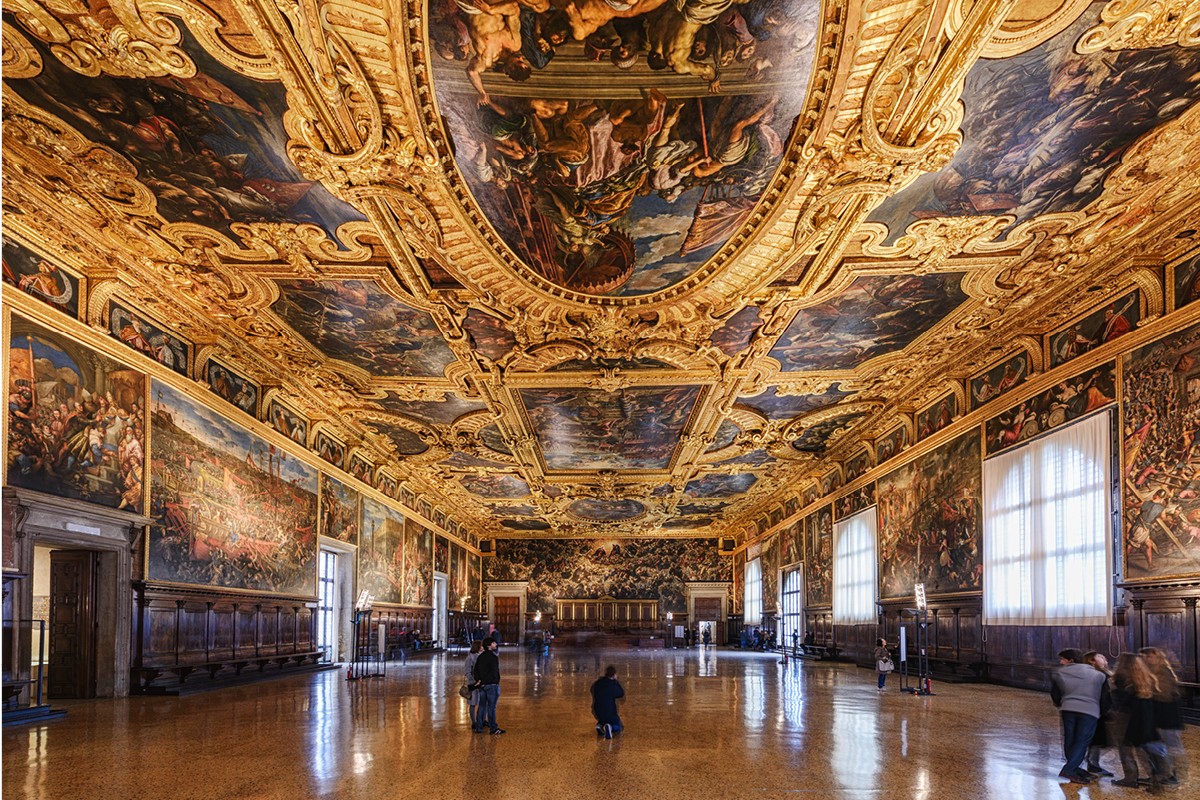
Inside, the scale of the rooms shifts to accommodate the gravity of Venetian governance. The Sala del Maggior Consiglio contains monumental works that define the spatial experience of the hall. The sheer height of the ceilings and the vastness of the interior volumes are designed to command attention through proportion rather than mere ornamentation.
Masterpieces of the Venetian Collection
Within the Sala del Maggior Consiglio, the scale of the room is defined by Tintoretto’s Paradise. This monumental canvas stretches over 120 feet in length, casting a celestial presence over the heart of Venetian governance. The sheer magnitude of the work commands the space, drawing the eye upward through its vast composition. Nearby, Veronese’s Triumph of Venice offers a feast of color and opulent detail, celebrating the maritime prowess of the Republic through a dense, layered arrangement of figures and light.
The collection reveals the delicate soul of Venetian craftsmanship through various media. Intricate tapestries depicting biblical narratives hang within the halls, while fine glasswork reflects the city's historical economic heartbeat. These objects exist alongside significant paintings that define the Venetian aesthetic, such as Vittore Carpaccio’s The Lion of St Mark from 1516.
- The Lion of St Mark, 1516 - Vittore Carpaccio
Exhibitions and Cultural Life
The palace remains a center of cultural activity through a series of rotating exhibitions. These presentations bridge the gap between ancient tradition and modern perspective, allowing the historical space to interact with contemporary thought. Recent displays have focused on the profound influence of Byzantine mosaics, tracing the visual language that shaped the region. Such exhibitions invite a closer look at the specific techniques used to create these enduring patterns.
The delicate artistry of Venetian glassmaking has also been a subject of recent focus. These exhibitions examine the technical precision and material history of the craft. By examining these specific traditions, the palace maintains its relevance in the current cultural landscape. The dialogue between the past and the present is sustained through this continuous evolution of programming.


