

 Peržiūrėti realybėje
 Pasidalinti
 Dalintis
 Išsamiau

 Atsisiųsti
 Panašūs eksponatai
 Rentgeno nuotrauka
 Automatinė diorama
LANDSCAPE
 25.0 x 438.0 cm
 Skaityti daugiau
Rankų darbo aliejinės reprodukcijos
Rankiniu būdu tapytas aliejus ant droblio jūsų pageidaujamame dydį ir rėmuose – mūsų menininkų darbas pagal užsakymą. ( Pirkti spaudinį Pirkti vaizdą)




































Pasirinkite iš mūsų nustatytų dydžių, atitinkančių originalaus meno kūrinio proporcijas.

Galite įvesti savo matmenis, kad jie atitiktų konkretų rėmą ar erdvę. Jei pasirinktas dydis neatitinka originalaus paveikslėlio proporcijų, mes arba apkropsime meno kūrinį, arba papildysime tapybą rankomis dažytい elementais. Prieš pradėdami gamybą, jūsų patvirtinimui atsiųsime skaitmeninį maketą.
Atkreipkite dėmesį, kad ekrane rodomas vaizdas neatspindi tikrojo apkarpymo ar papildymo. Tik maketas tiksliai parodys galutinę kompoziciją.
Nors galima rinktis ir individualius dydžius, rekomenduojame pasirinkti matmenis iš nustatytos sąrašo, kad būtų išlaikytos originalios proporcijos.
Gavus užsakymą, OriginalUniqueArt.com komanda susisieks su klientu el. paštu dėl instrukcijų ir pateiks maketo pavyzdį.
Pristatymas visame pasaulyje () per 3–4 savaites, o ne įprastai – per 5 savaites. (25 rugpjūtis). Kokybė lieka nepakeičiama.

Nemokamas greitasis pristatymas visame pasaulyje

Aukštos kokybės lininis drobė

Pilnas siuntimo draudimas

Muitinės mokesčių grąžinimo garantija

Tikro spalvų atitikimo garantija

60 dienų grąžinimo politika (tik esant gamyklinėms defektams)

100% pinigų grąžinimo garantija

Nuolaida už kelias reprodukcijas
 Stiklo variantas prieinamas tik pasirinkus dydį iki 110 cm

LANDSCAPE
Reprodukcijos technika
Reprodukcijos matmenys
-


Galutinė kaina
$ 300
Autoriaus biografija
Xiao Yuncong: Pioneer of Dry Brushstrokes and Ming Loyalty
Xiao Yuncong (蕭雲從), born around 1596 in Wuhu, Anhui Province, stands as a singular figure in Qing dynasty art history—a master whose stylistic independence cemented his place as the founder of the Gushu school (姑孰派) and profoundly shaped the landscape tradition. Unlike many artists of his era who diligently imitated established styles, Xiao Yuncong forged his own path, prioritizing direct observation of nature and employing a distinctive technique characterized by “gui shu pai” – dry brushstrokes—that continues to inspire admiration today.Early Life and Artistic Formation
Xiao Yuncong’s upbringing instilled in him a deep appreciation for Confucian ideals and scholarly pursuits. His family belonged to the Hanlin Academy, providing him with access to elite education and fostering an environment conducive to artistic development. Although biographical details remain scarce, records indicate he traveled extensively during his lifetime, absorbing influences from various artistic centers within China—particularly Nanjing and Yangzhou—where he engaged in dialogues with fellow luminaries of the Ming dynasty. These encounters undoubtedly broadened his understanding of artistic principles and fueled his commitment to capturing the essence of the natural world.The Gushu Style: A Revolutionary Approach
Xiao Yuncong’s contribution to Chinese painting lies primarily in his pioneering adoption of “gui shu pai,” a technique that eschewed lavish color palettes and intricate ornamentation for simplicity and directness. This method involved applying brushstrokes with minimal pigment, allowing the texture of the paper itself to contribute significantly to the visual impact of the artwork. Unlike preceding generations who meticulously blended colors to achieve idealized representations of landscapes, Xiao Yuncong sought to convey a sense of immediacy and spontaneity—a reflection of his belief that true beauty resided in capturing the subtle nuances of natural phenomena. His monumental landscape painting “Taiping Shanshui Tu Hua” (太平山水圖畫), spanning over 23 feet, exemplifies this approach perfectly, demonstrating remarkable compositional balance and masterful execution.Notable Works and Legacy
Xiao Yuncong produced a prolific body of work encompassing landscapes, calligraphy, and poetry—all united by his unwavering devotion to the Ming dynasty’s artistic heritage. His landscape paintings are celebrated for their serene compositions, evocative tonal harmonies, and unparalleled sensitivity to atmospheric conditions. Particularly noteworthy is “Pure Tones Among Hills and Waters,” which showcases Xiao Yuncong's ability to distill complex visual information into a harmonious whole—a testament to his mastery of the gui shu pai technique. Furthermore, his posthumous manuscript (“Mei Hua Tang Yu Gai”) – a collection of calligraphy pieces – stands as an enduring symbol of artistic integrity and unwavering commitment to tradition.Historical Significance and Influence
Xiao Yuncong’s legacy extends far beyond his individual achievements; he fundamentally altered the trajectory of Chinese landscape painting. By rejecting stylistic conventions and prioritizing natural observation, he established a precedent for future generations of artists—inspiring them to embrace simplicity and authenticity as guiding principles. His influence can be discerned in the works of numerous painters who followed him, solidifying his position as one of the most important figures in Qing dynasty art and ensuring that his distinctive style continues to resonate with audiences worldwide. He remains an exemplar of artistic innovation rooted in profound respect for tradition.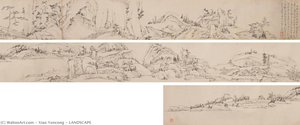
xiao yuncong
1596 - 1673
Trumpa informacija
- Artistic Movement Or Style: Gushu School
- Date Of Death: 1673
- Full Name: Xiao Yuncong
- Nationality: Chinese
- Notable Artworks: ['Taiping Shanshui Tu Hua']
- Place Of Birth: Wuhu, Anhui Province

