Peržiūrėti realaus dydžio版
 Siųsti
 Dalintis
 Išsamiau
 Vadovas

 Atsisiųsti
 Panašūs eksponatai
 Rentgeno spindulių nuotrauka
 Diaporama
 Statistika
The Marriage Contract
 Acrylic On Canvas
- WallArt
- British Classicism
 1745
1745- Renaissance
 91.0 x 70.0 cm
 Rodyti daugiau
Giclée / Meno spausdinimas
Muziejų lygio „giclée“ arba drobos spausdinimas: greita gamyba ir lankstios apdailos parinktys. ( Pirkti rankomis tapytą reprodukciją Perejti prie skaitmeninių vaizdų)




P118B €10

P118H €10

P118W €10

P438Z €10

P508JH €12

P508YH €12

P805H €10

P805Z €10

P919BZ €10

P919G €10

P919XJ €10

P959ZH €10

P968JZ €12

W106C €8

W218G €10

W218JH €8

W218Y €10

W307PJ €10

W316G €10

W316PJ €8

W316Y €10

W398PJ €8

W4111J €10

W500HY €15

W500JH €15

W692G €12

W849H €8

W940BG €15

W953PJ €8




Pasirinkite iš mūsų nustatytų dydžių, atitinkančių originalaus meno kūrinio proporcijas.

Galite nurodyti savo matmenis, kad vaizdas atitiktų konkretų rėmą ar erdvę. Jei pasirinktas dydis nesutaps su originalaus paveikslėlio proporcijomis, mes arba apkirpsime kūrinį, arba išplėsime vaizdą naudojant veideliu atspindėtą arba vientisą šoną. Skaitmeninis maketas bus išsiųstas jums patvirtinti prieš pradedant gamybą.
Atkreipkite dėmesį, kad ekrane matomas vaizdinys neatspindi tikrojo apkirpimo ar išplėtimo. Tik maketas tiksliai parodytų galutinę kompoziciją.
Nors galima rinktis ir individualius dydžius, rekomenduojame pasirinkti vieną iš išanksti nustatytų matmenų, kad būtų išlaikytos originalios proporcijos.
Pristatymas visame pasaulyje () per 2 weeks, o ne įprastas 4/5 savaičių laikotarpis. (11 spalis)

Nemokamas greitasis pristatymas visame pasaulyje

Aukštos kokybės lininis drobė

Pilnas siuntimo draudimas

Muitinės mokesčių grąžinimo garantija

Tikro spalvų atitikimo garantija

100 dienų grąžinimo politika (tik esant įtaigoms)

100% pinigų grąžinimo garantija

Nuolaida dideliems užsakymams
 Stiklo variantas prieinamas tik pasirinkus dydį iki 110 cm

The Marriage Contract
Giclée / Meno spausdinimas
Reprodukcijos dydis
-


Visų pasirinktų variantų kaina
€ 69
A Window Into Georgian Society
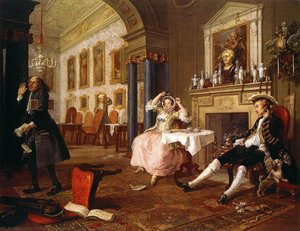
In the heart of 1745, William Hogarth captured more than a mere domestic arrangement; he froze a pivotal moment of social negotiation in "The Marriage Contract." This meticulously crafted tableau invites the viewer into a room thick with the palpable anxieties and lofty aspirations of Georgian England. As we gaze upon the central table where a man proposes to his prospective bride, we are not merely witnesses to a romantic gesture, but participants in a complex social ritual. Hogarth utilizes a masterful sense of perspective to draw us deep into the chamber, positioning figures at varying distances to create a layered, immersive experience. The scene is heavy with the weight of familial obligation and the silent negotiations of status that defined the era, making it a profound study of human connection and societal pressure.The Mastery of Hogarthian Realism
Beyond its narrative depth, the painting stands as a testament to Hogarth’s distinctive approach to realism—a style that eschewed the idealized, ethereal beauty favored by his contemporaries in favor of a more profound, often unsettling, truth. Through the expert application of chiaroscuro, Hogarth employs dramatic contrasts between light and shadow to sculpt the figures, imbuing them with a physical presence that feels almost tangible. Every fold of heavy drapery and every anatomical detail is rendered with an uncompromising dedication to accuracy. This technique does more than showcase technical prowess; it grounds the social drama in a gritty, recognizable reality. For the discerning collector or interior designer, this level of meticulous detail offers a rich, textural element that brings a sense of historical gravity and sophisticated depth to any curated space, providing a centerpiece that commands attention through its sheer authenticity.Symbolism and the Unseen Narrative
Every element within the frame serves as a silent commentator on the human condition, weaving a web of meaning beneath the surface of the domestic scene. Near the bottom left, a dog rests—a traditional emblem of fidelity and loyalty—yet its presence is subtly juxtaposed against the unsettling, watchful gaze of the woman’s maid, reminding us that even the most private contracts are subject to the scrutiny of the household. High above, a clock dominates the upper quadrant, its ticking hands serving as a poignant reminder of the relentless march of time and the fleeting nature of opportunity within the marriage market. This interplay of symbols transforms the painting from a simple genre scene into a biting critique of societal conventions. To possess a high-quality reproduction of this work is to hold a piece of history that continues to provoke thought, offering an emotional resonance that transcends the centuries and provides a captivating, intellectual focal point for modern elegance.问答 (or more naturally for a website heading): Klausimai ir atsakymai
Kokią nuotaiką ir emociją sujungia „The Marriage Contract“?
Įtvirtinta „The Marriage Contract“, autorius – Viljamas Hogartas nuotaika yra Dramatic, o emocinis tonas – Melancholic.
Kuriem metais buvo sukurta „The Marriage Contract“, autorius – Viljamas Hogartas?
„The Marriage Contract“, autorius – Viljamas Hogartas kūrybos metai – 1745.
Kuriam menininkui priskiriamas kūrinys „The Marriage Contract“?
Kūrinį „The Marriage Contract“ sukūrė Viljamas Hogartas. Darbas katalogizuojamas Viljamas Hogartas vardu.
Kokio atspalvio link tendencija yra „The Marriage Contract“?
„The Marriage Contract“ linksta į Golden Yellow Range atspalvį.
Kokia buvo Viljamas Hogartas amžius sukuriant „The Marriage Contract"]?
Viljamas Hogartas sukūrė „The Marriage Contract“ būdamas 48 metų amžiaus.ت Artistas gimė 1697, o kūrinys datuojamas 1745 metais.
Kaip galiu peržiūrėti „The Marriage Contract“, autorius – Viljamas Hogartas reprodukciją?
„The Marriage Contract“ Peržiūra puslapio funkcija leidžia peržiūrėti kūrinį prieš užsakant.
Kokią nuotaiką į erdvę atneštų „The Marriage Contract“?
Savo Dramatic nuotaika „The Marriage Contract“ siūloma Living Room erdvei.
Autoriaus biografija
William Hogarth (1697–1764)
William Hogarth, born into the bustling heart of 18th-century London in 1697, was more than just an artist; he was a visual historian, a keen observer of human nature, and a satirical commentator on the societal currents of his age. His life story is inextricably linked to the very fabric of England during a period of significant transformation – its burgeoning ambitions, underlying anxieties, and pervasive hypocrisies all finding potent expression in his remarkably detailed and often biting works. The son of a struggling Latin schoolmaster, Hogarth’s early experiences instilled within him both a love for learning and a sharp awareness of social inequalities, a foundation that would prove crucial to shaping his artistic vision. Initially apprenticed to an engraver, he quickly demonstrated a talent extending beyond mere technical skill; he possessed an innate ability to observe the nuances of human behavior and translate them into compelling visual narratives. However, he chafed against the constraints of traditional engraving, seeking a more expressive outlet for his burgeoning creativity. This led him to studies at both St Martin’s Lane Academy and under Sir James Thornhill, where he honed his skills in painting and composition, absorbing influences that would later inform his unique style.Early Life and Influences
Young Hogarth's upbringing was marked by hardship. His father, Richard Hogarth, a teacher of Latin, faced considerable difficulties securing employment and endured imprisonment for debt between 1708 and 1712 – an experience that profoundly shaped William’s worldview and fueled his gritty portrayal of London life. He developed a fascination with sketching people he encountered on the streets, mirroring the artistic sensibilities of artists like Pieter de Hooch and Rembrandt van Rijn. Hogarth's formative years instilled in him a deep appreciation for social justice and a critical eye for examining societal hypocrisy—values that would permeate his oeuvre throughout his career. Recognizing the transformative potential of observation, Hogarth embraced painting as a medium for conveying complex ideas and emotions, drawing inspiration from the monumental canvases of Sir James Thornhill, whose daughter he married in 1729. This union solidified his connection to the artistic establishment and provided him with invaluable guidance during his artistic development. He was particularly captivated by Thornhill’s masterful technique—a synthesis of realism and grandeur—which served as a cornerstone for Hogarth's own stylistic innovations.The Birth of Modern Moral Subjects
Hogarth’s true genius lay not simply *what* he painted, but *how*. He pioneered what he termed “modern moral subjects”—series of pictures designed to tell a story, often imbued with a strong satirical edge. These weren't isolated portraits or landscapes; they were visual novels unfolding before the viewer’s eyes, offering pointed commentary on contemporary society. A Harlot’s Progress, created in 1742, stands as perhaps his most iconic achievement—a meticulously crafted chronicle of Mary Burton’s descent into prostitution and its devastating consequences. Each scene is rendered with painstaking detail, populated by archetypal figures that embody the moral failings prevalent within London's social strata. The series exemplifies Hogarth’s commitment to confronting uncomfortable truths about human behavior and societal corruption—a stance reflected in his unflinching depictions of poverty, vice, and despair. Similarly, A Rake’s Progress, begun in 1733, chronicles the ruinous trajectory of Tom Rakewell—a wealthy gentleman consumed by gambling addiction and hedonistic indulgence. Like *A Harlot's Progress*, this series transcends mere narrative storytelling; it serves as a potent indictment of aristocratic excess and moral decay.Technique and Artistic Style
Hogarth’s artistic style was characterized by a masterful fusion of diverse influences—primarily Dutch genre painting and French satirical prints. He skillfully blended realism with dramatic flair, capturing the psychological complexities of his subjects with remarkable sensitivity. His technique revolved around a distinctive cross-hatching method—a meticulous layering of lines that created depth and texture—yielding results that rivaled those of Rembrandt van Rijn. This painstaking approach demanded considerable patience and precision, reflecting Hogarth’s unwavering dedication to achieving artistic excellence. Beyond visual artistry, he drew inspiration from literary works, notably Jonathan Swift's satirical prose, which honed his ability to convey moral judgments through narrative form. He believed that art should serve as a catalyst for social reform—challenging viewers to confront ethical dilemmas and fostering empathy for marginalized communities. Hogarth’s unwavering conviction in this principle underpinned his artistic endeavors and cemented his legacy as one of England's foremost satirists and visual innovators.Legacy and Enduring Influence
William Hogarth died in 1764, leaving behind a profound impact on British art history—a legacy that continues to inspire artists and scholars alike. He is universally recognized as the progenitor of political cartooning and comic strip illustration—establishing a precedent for conveying social critique through visual storytelling. Artists such as James Gillray and George Cruikshank embraced Hogarth’s stylistic precepts, perpetuating his tradition of biting satire and unwavering moral conviction. As Charles Lamb eloquently articulated, “Hogarth's images are like books to be read rather than merely looked at,” encapsulating the enduring significance of his work—a testament to its ability to provoke thought, stimulate debate, and illuminate the human condition. Hogarth’s paintings remain treasured masterpieces—celebrated for their artistic brilliance and their unflinching portrayal of Victorian society. He demonstrated that art could simultaneously entertain and enlighten—challenging audiences to grapple with ethical dilemmas and fostering a critical awareness of social injustices. His enduring influence testifies to his unwavering commitment to artistic integrity and his profound understanding of the human psyche.
Viljamas Hogartas
1697 - 1764 , Didžioji Britanija
Trumpa informacija apie kūrėją
- Artistic Movement Or Style: Satire, Realizmas
- Artists Who Influenced This Artist:
- Pieter de Hooch
- Jonathan Swift
- Date Of Birth: 1697
- Full Name: William Hogarth
- Nationality: Anglų
- Notable Artworks:
- A Harlot's Progress
- A Rake's Progress
- Place Of Birth: Londone
Susiję straipsniai

Arthur William Devis: A Provincial Eye on Georgian Life & Naval History
Explore the life & work of Arthur William Devis (1762-1822), a key figure in Georgian portraiture and naval history painting. Discover his intimate 'conversation pieces' and captivating depictions of colonial India. Learn more at OriginalUniqueArt.
The Sharpest Wit: A Historical Exploration of Satire in Visual Culture
Explore the history of satire in art! From ancient masters like Aristophanes to Goya & Grosz, discover how artists use wit and critique to reflect—and challenge—society. Expert insights at OriginalUniqueArt.
Thomas Rowlandson: Satire, Society & the Art of Caricature in Georgian England
Explore the witty world of Thomas Rowlandson, master Georgian caricaturist! Discover his satirical prints & insightful social commentary on 18th-century England. Learn about his life, techniques, and enduring influence.

William Hogarth: Satire, Social Commentary & the Birth of Modern British Art
Explore the satirical world of William Hogarth, pioneering British painter & engraver. Discover his iconic works like *A Rake's Progress* and insightful social commentary on 18th-century London life.
The Sharpest Wit: A Critical Exploration of Satire in Art History – From Hogarth to Contemporary Critique
Explore the history of satire in art! From Hogarth's London to contemporary critique, discover how artists use wit & visual power to reflect and challenge society. Expert insights at OriginalUniqueArt.