

 Peržiūrėti realaus dydžio版
 Siųsti
 Dalintis
 Išsamiau
 Vadovas

 Atsisiųsti
 Panašūs eksponatai
 Rentgeno spindulių nuotrauka
 Diaporama
 Statistika
Still-Life
 Oil On Canvas
- WallArt
- Baroque
 1653
1653- Early Modern
 105.0 x 88.0 cm
 Hermitage muziejus
 Rodyti daugiau
Giclée / Meno spausdinimas
Muziejų lygio „giclée“ arba drobos spausdinimas: greita gamyba ir lankstios apdailos parinktys. ( Pirkti rankomis tapytą reprodukciją Perejti prie skaitmeninių vaizdų)




P118B €10

P118H €10

P118W €10

P438Z €10

P508JH €12

P508YH €12

P805H €10

P805Z €10

P919BZ €10

P919G €10

P919XJ €10

P959ZH €10

P968JZ €12

W106C €8

W218G €10

W218JH €8

W218Y €10

W307PJ €10

W316G €10

W316PJ €8

W316Y €10

W398PJ €8

W4111J €10

W500HY €15

W500JH €15

W692G €12

W849H €8

W940BG €15

W953PJ €8




Pasirinkite iš mūsų nustatytų dydžių, atitinkančių originalaus meno kūrinio proporcijas.

Įveskite jums reikiamą plotį ir aukštį, kad atvaizdas derėtų prie jūsų rėmo ar sienos. Spausdiną galima tik sumažinti, bet nepadidinti virš originalaus paveikslėlio dydžio, todėl keičiant proporcijas, dalis vaizdo prarandama. Prieš spausdinimą atsiųsime jums skaitmeninį maketą patvirtinimui. Šioje puslapio nuotraukoje matomas pjūvis nėra tikslus – jį rodo tik maketas.
Pristatymas visame pasaulyje () per 2 weeks, o ne įprastas 4/5 savaičių laikotarpis. (26 spalis)

Nemokamas greitasis pristatymas visame pasaulyje

Aukštos kokybės lininis drobė

Pilnas siuntimo draudimas

Muitinės mokesčių grąžinimo garantija

Tikro spalvų atitikimo garantija

100 dienų grąžinimo politika (tik esant įtaigoms)

100% pinigų grąžinimo garantija

Nuolaida dideliems užsakymams
 Stiklo variantas prieinamas tik pasirinkus dydį iki 110 cm

Still-Life
Giclée / Meno spausdinimas
Reprodukcijos dydis
-


Visų pasirinktų variantų kaina
€ 70
A Symphony of Light and Luxury
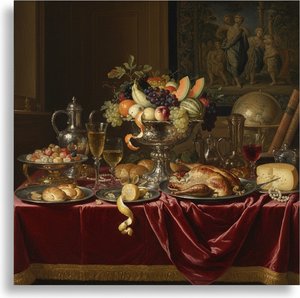
In the quiet, shadowed corners of the Dutch Golden Age, few masters could command the stage with as much dramatic flair as Willem Kalf. His 1653 masterpiece, Still Life with Lobster, Drinking Horn and Glasses, is not merely a painting of objects; it is a carefully orchestrated performance of light, texture, and prestige. As one gazes upon this canvas, they are immediately transported into an era of unprecedented maritime prosperity, where the spoils of global trade were celebrated through the meticulous brushstrokes of the pronkstilleven—the grand, opulent still life. The composition serves as a window into a world of sensory indulgence, where every glint of silver and every dewdrop on a peach tells a story of wealth, discovery, and the fleeting nature of earthly delights.
The artwork captures a moment of suspended animation, presenting an arrangement that feels both bountiful and profoundly intimate. A vibrant lobster, its shell a testament to Kalf’s ability to render organic complexity, rests amidst the soft, velvety skins of peaches and pears. These natural elements are juxtaposed against the hard, reflective surfaces of man-made treasures: a gleaming silver goblet, a sturdy drinking horn, and delicate glassware that catches the light with ethereal precision. This interplay between the perishable fruit and the enduring precious metals creates a tension that is central to the Baroque experience, inviting the viewer to linger on the exquisite details of each meticulously rendered form.
The Mastery of Chiaroscuro and Texture
Technically, Kalf’s work represents the pinnacle of seventeenth-century Dutch realism. He employs chiaroscuro—the dramatic use of intense light and deep shadow—to sculpt his subjects out of the darkness. This technique does more than provide depth; it breathes life into the inanimate. The way light spills across a silver vessel or pierces through a glass, casting long, evocative shadows across a richly patterned tablecloth, creates a palpable sense of three-dimensionality. For the discerning collector or interior designer, this mastery of contrast offers a profound visual weight that can anchor a room, providing a focal point that changes character as the ambient light of a space shifts throughout the day.
Beyond the play of light, Kalf’s true genius lies in his tactile virtuosity. He possesses an uncanny ability to translate the language of touch into oil on canvas. One can almost feel the cool, smooth surface of the bronze candlestick, the rougher texture of the drinking horn, and the soft, yielding flesh of the ripening fruit. This commitment to hyper-realistic detail ensures that a high-quality reproduction of this piece retains its soul, offering an immersive experience that celebrates the beauty of material existence. It is this level of craftsmanship that makes Kalf’s work eternally relevant for those seeking to infuse their environments with a sense of historical grandeur and sophisticated elegance.
Symbolism and the Soul of the Baroque
To look closely at Kalf’s arrangement is to read a silent poem about the human condition. In the seventeenth century, nothing was purely decorative; every element carried a weight of meaning. The lobster, often associated with luxury and abundance, serves as a symbol of the era's economic triumphs. Meanwhile, the drinking horn alludes to conviviality and social standing, reminding the viewer of the communal joys of the Dutch mercantile class. Yet, beneath this layer of opulence lies a subtle memento mori—a gentle reminder of mortality. The very ripeness of the fruit suggests an approaching decay, a poignant contrast to the enduring brilliance of the silver and gold.
This duality—the celebration of life’s richness alongside a contemplation of its transience—is what gives the painting its profound emotional resonance. It evokes a sense of quiet melancholy wrapped in a cloak of splendor. For those looking to decorate with art that possesses depth and narrative, Kalf’s work offers an unparalleled opportunity. A reproduction of this still life does not just adorn a wall; it invites conversation, stimulates the intellect, and brings a touch of timeless, scholarly prestige to any curated collection or thoughtfully designed interior.
问答 (or more naturally for a website heading): Klausimai ir atsakymai
Kokia „Still-Life“, autorius – Willem Kalf emocinė nuotaika?
„Still-Life“, autorius – Willem Kalf perteikia Dramatic emocinę nuotaiką.
Kokio meno kryžmės dalis yra „Still-Life“, autorius – Willem Kalf?
„Still-Life“, autorius – Willem Kalf priklauso Baroque stiliui. Šis dailės kryptys suteikia šiam kūriniui stilistinį kontekstą.
Kokia yra „Still-Life“, autorius – Willem Kalf technika ir kūrybos data?
„Still-Life“ sukurtas 1653 m., naudojant Oil On Canvas.
Autoriaus biografija
Gyvenimas įsivaikintas opulencijoje: Willem Kalf pasaulis
Willem Kalf, vardas, sinoniminis netiktiems Holandijos gauties laikų gyvenimo vietoms, gimė Roterdame 1619 m. patikrinėsios šeimosje. Jo tėvis, Jan Jansz Calff, užėmavo padėžves savivaldybės administracijoje, suteikiant jaunam Willem augimą, kuris atžvilgiu padėjo išsaugoti tiek saugumą, tiek pasiekimas į augančią prekybos pasaulį, kuris vėliau labai įvaizdino jo meną. Nors detales apie Kalfio ankstyvą mokymą išlieka šiek tiek neaiškios, žinoma, kad jis patogavo dirbtinio vystymosi laikotelę Paryžiuje 1630-ųjų pačių, įsivaikinus aktyvių flandrijų menininkų bendrianyje, veikiantys Saint-Germain-des-Prés. Šis formuojantis patirtis iš pradžių nukreitė jį į mažesnių matmenų kaimiškius interjerus ir gyvenimo vietoms – nuobai pradžios, kurios galiausiai išsiklaukė dideliu pronkstilleven, dėl kurio jis yra švariai žinomas šiandadienį. Abi tėvai mirtis iki 1638 m. įvykdė grįžimą į Holandiją, parengdami sceną jo paauglymo meninio laikotarpiui.Nuobai pradžios iki meistriškos parodos
Kalfio ankstyvi paryškiose veilos atskleidžia menininką, kuris ieško savo vietas. Šios kartu dažnai pavaizdindavo paprastus suskirstymus – daržovę, įprastinius virtuvės reikmenis, tokius kaip kelbės ir kaitrenės – išdėstytas prieš švilpianai apšviestintas foną, kur figūros buvo sugėdintos, o ne visiškai išgyvendintos. Šiuo stilius atspindėjo populiariai Flandrijose ankstyvo XVII amžiaus metu, ypač David Teniers jaunesnio panašiuose veilėse. Tačiau Kalfio ambicijos greitai viršija šias nuobai kompozicijas. Grįžęs į Holandiją, jis pradėjo patirtį įdomią evoliuciją, kuri vėliau tapo jo ženlinio stiliaus: pronkstilleven arba „gaudauji gyvenimo vietos“. Tai nebuvo tik objektų pavaizdavimas; tai buvo kruviškai sukurti turto ir rafinavimo parodai, rodomančios prabangias daiktus, tokius kaip sidabrinės saugynės, delikatūs porcelianas, egzotiški vaisiai ir šviesojantis stiklo dingimas.Iluzijos ir simbolinės resonanso mena
Kas išskiria Kalfio pronkstilleven buvo jo neprilygiama meistriškumas šviesoje ir tekstūroje. Jis turėjo ypatingą gebėjimą su neįtikėtina realistiškumu atvaizduoti sidabro atspindžius, stiklo skaidrumą ir vaisių veludines paviršius. Jo kompozicijos nebuvo atsitiktinis suskirstymas; jos buvo kruviškai suplanuotos orkestracijos, skirtos užfiksuoti šviesos ir šešdumo santykį, kurdamos derinio ir dramatiškumo jausmą. Nors jo pavaizdavimų pagrindinė struktūra – objektų išdėstymas – liko gana panaši, kiekvienas darbas buvo patikrinimas Kalfio gebėjimu sukurti įvairias tekstūras ir užfiksuoti subtilius šviesos efektus. Tačiau, paveržiant techninį iškilumą, buvo subtilus simbolinis matmenys. Opulencijos objektai, kuriuos jis pavaizdindavo, nebuvo tik gražūs; jie keliavo į galva apie praläufigumą, turtingumą ir žemės džiaugimų kefčianę pramonę – nuoroda į vanitas tradiciją, populirišką Holandijos pavaizdavimu.Palikta medžiaga ir įtakos
Willem Kalfio įtakos išplauko per jo pačią gausią kūrinio kiekį. Jo semi-monohromatiniai gyvenimo vietos padarė žymų įtaką prancūzių menai, ypač Le Nain narės aplinkoje, kurie buvo įkvėpti jo rafinu šviesos ir šešdumo naudojimu. Nors individualūs darbai gali būti neįkurtas garsiai kaip kai kurių jo bendraštaklaus, Kalfio įnašymas į šį žanrą yra neapribojimas. Jis padėjo apibrėžti pronkstilleven, užfiksuodamas XVII amžiaus Holandijos draivos – laikotarpį, pažymėtą beprecedentišku ekonominiu prastumiu ir augančia prekybos klasėse, norėjančiose parodyti savo turtingumą ir rafinavimą. Šiandien jo pavaizdavimai papuošę prestižinius muziejų kolekcijas visame pasaulyje, įskaitant Boijmans Van Beuningen muziejų Roterdame, Nacionalinę menų galeriją Vašingtonyje D.C., ir Getty muziejų, užtikrinanti, kad jo palikta medžiaga kaip Holandijos gyvenimo vietos meistras toliau įkvėpsdytų pobožę ir pagadırinimą. Jo kruviškas dėmesys detalėse ir meistriškas šviesos naudojimas išlieka meninio iškilumo ženklu.Toliau išsaugoti
- Wikipedia: https://en.wikipedia.org/wiki/Willem_Kalf
- National Gallery of Art: https://www.nga.gov/artists/1430-willem-kalf
- Getty Museum: https://www.getty.edu/art/collection/person/103JR3

Willem Kalf
1619 - 1693 , Netherlandija
Trumpa informacija apie kūrėją
- Artistic Movement Or Style: Holandijos gaminio eonas, Životogrybė
- Artists Or Movements Influenced By This Artist:
- Prancūzių mena
- Le Nain nařdžeriai
- Artists Who Influenced This Artist:
- Simon Luttichuys
- Pieter Claesz
- Willem Claeszoon Heda
- Date Of Birth: 1619
- Date Of Death: 1693
- Full Name: Willem Kalf
- Nationality: Holandietis
- Notable Artworks:
- Životogrybė su nautilus puodele
- Senasis šventilė
- Sidabrinis džiovis ir porceliano puodelis
- Place Of Birth: Rotterdamas, Holandija
Susiję straipsniai

Golden Light & Dutch Skies: The Timeless Magic of Dutch Golden Age Landscapes
Discover the breathtaking beauty of Dutch Golden Age landscapes. Explore the mastery of light, chiaroscuro, and 17th-century realism through an expert art history lens, celebrating the enduring legacy of the Dutch Masters for discerning collectors and art lovers.
Abraham Hendricksz van Beyeren: Pioneering Dutch Still Life & the Banquet Tradition
Explore the captivating world of Dutch Golden Age still life with Abraham van Beyeren. Discover his innovative techniques, symbolic banquet scenes & lasting influence on art history. Learn about collecting these masterpieces.

Illuminating Innovation: Exploring the Dutch Golden Age of Painting
Explore the Dutch Golden Age of painting with OriginalUniqueArt. Discover Rembrandt, Vermeer & other Masters. Learn about key characteristics, iconic artworks, and lasting influence. Expert insights for collectors & enthusiasts.

Olandijos Aukso Amžius: 10 Šedevrų, Apibrėžiančių Meną ir Stilių
Atraskite Olandijos Aukso Amži\u017us meninius šedevrus! 10 legendin\u017iŴ paveikslžiai – Rembrandto, Vermeerio ir kt. darbai. Sužnkitę j\u016ungo namus aukso amži\u017us grožiu! Āukrai, interjero dizainas – viskas OriginalUniqueArt.com. Ižirkite kolekciją internete!

Golden Age Reflections: Dutch Baroque Painting & Cultural Innovation
Explore the Dutch Golden Age of painting! Discover key artists like Vermeer & ter Borch, their innovative techniques, and the rich cultural context behind these Baroque masterpieces. Learn about collecting & appreciating this iconic art period.
