Perjungti į spausdinamus版作品
 Skaityti daugiau







































 Dėl meno kūrinių ar reprodukcijų, kurių bet kuri pusė yra didesnė nei 105 cm (apie 41 inch), rėmas bus siunčiamas kaip išskaidytas surinkimo rinkinys. Šis metodas užtikrina saugų pristatymą ir apsaugo nuo transportavimo metu galimos žalos.


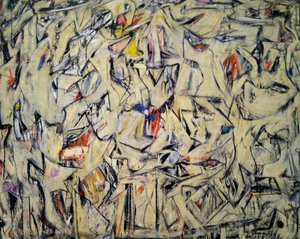
Willem de Kooning’s “Untitled (21)” – A Symphony of Emotion and Bold Gesture
“Untitled (21),” painted in 1955 by Willem de Kooning, stands as a cornerstone of Abstract Expressionism, embodying the movement's core tenets: spontaneity, emotional intensity, and a rejection of representational conventions. This monumental canvas—measuring approximately 200.7 cm x 175.3 cm—immediately commands attention with its vibrant palette dominated by fiery reds and oranges, punctuated by subtle greens that contribute to an overall sense of dynamism.
- Subject Matter: The painting depicts a woman cradling a child, capturing a tender moment of maternal care amidst turbulent artistic energy. Unlike De Kooning’s earlier depictions of women—often portrayed as fragmented and psychologically complex—here the figures are presented with a palpable warmth and intimacy.
- Style & Technique: De Kooning's signature “action painting” technique is evident in every brushstroke. Thick impasto – applying paint thickly onto the canvas – creates textured surfaces that pulsate with movement, mirroring the artist’s emotional state. The painting eschews precise lines and forms, favoring gestural marks that convey feeling rather than visual accuracy.
- Influence of Franz Kline: Notably, De Kooning cites Franz Kline as a significant inspiration, adopting Kline's bold black-and-white linear abstractions to explore the expressive potential of simplified shapes. This stylistic convergence underscores the broader artistic dialogue occurring during the period.
Historical Context – The Rise of Abstract Expressionism
“Untitled (21)” emerged against a backdrop of postwar anxieties and intellectual ferment. Following World War II, American artists sought to grapple with trauma and disillusionment through art that prioritized emotion over rational thought. De Kooning’s work aligns perfectly with this ethos, reflecting the psychological complexities inherent in navigating a world scarred by conflict.
As Nicholas Mirzoeff eloquently observes in “How to See the World,” the woman's gaze—implied but not explicitly rendered—suggests an inward focus, mirroring the broader preoccupation with subjectivity during the era. This subtle detail speaks volumes about De Kooning’s artistic ambition: to convey profound emotional resonance without resorting to conventional visual representations.
Symbolism & Emotional Resonance
The color choices – red and orange – are deliberately assertive, conveying passion and vitality. Simultaneously, the green hues introduce a counterpoint of tranquility and growth, hinting at themes of nurturing and resilience. The woman’s embrace of the child symbolizes protection and unconditional love—powerful concepts that resonate across cultures and generations.
A Legacy of Bold Expression
"Untitled (21)" continues to captivate viewers with its visceral energy and uncompromising honesty. It stands as a testament to Willem de Kooning’s mastery of abstraction, demonstrating how artistic innovation can transcend mere visual aesthetics to communicate profound emotional truths. Its enduring appeal lies in its ability to provoke contemplation and inspire awe—qualities that define the very essence of great art.
Klausimai ir atsakymai
Ar „Untitled (21)“ yra viešosios teisės kūrinys?
„Untitled (21)“ – Willem De Kooning yra vis dar saugoma autorineje teisėje. Šis statusas nustato, kaip galima reprodukcijaus šio kūrinio vaizdą.
Kaip „Untitled (21)“ spalvos dera vienas su kitu?
„Untitled (21)“ – Willem De Kooning pasižymi Strong Color Unity spalvų harmonija.
Kokiam meno stiliui priklauso „Untitled (21)“ – Willem De Kooning?
„Untitled (21)“ – Willem De Kooning priklauso Abstract Expressionism stiliui. Ši dailės kryptis suteikia kūriniui stilistinį kontekstą.
Daugiau informacijos apie šį paveikslą
 Peržiūrėti realaus dydžio版
 Pasidalinti
 Dalintis
 Išsamiau
 Vadovas

 Atsisiųsti
 Panašūs eksponatai
 Rentgeno spindulių nuotrauka
 Automatinė diorama
 问答
问答 Statistika