Ecsalių versija
 Viskas apie Molnar







































 Dėl meno kūrinių ar reprodukcijų, kurių bet kuri pusė yra didesnė nei 105 cm (apie 41 inch), rėmas bus siunčiamas kaip išskaidytas surinkimo rinkinys. Šis metodas užtikrina saugų pristatymą ir apsaugo nuo transportavimo metu galimos žalos.


A Symphony of Circles: Unveiling Victor Vasarely’s “Molnar”
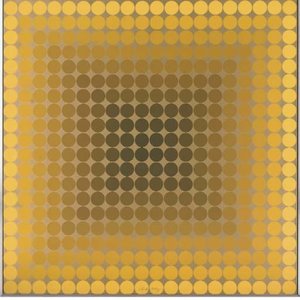
Victor Vasarely's "Molnar" is more than just a painting; it’s an invitation into the mesmerizing world of Op Art, a realm where perception itself becomes the subject. This striking composition – a dominant red circle enveloped by a constellation of smaller circles in vibrant hues – immediately captivates with its dynamic energy and illusionistic depth. The work, echoing Vasarely's pioneering explorations of optical art, demonstrates a masterful manipulation of color and form to create an experience that transcends simple visual representation.
The Genesis of Optical Illusions
Born in 1906 in Pécs, Croatia (then part of Austria-Hungary), Károly Vaszary – later known as Victor Vasarely – initially pursued a medical career before dedicating himself to the burgeoning field of visual art. His formative years were deeply influenced by the Bauhaus movement and Sándor Bortnyik’s “Műhely” workshop, where he absorbed the principles of functional design and geometric abstraction. This training provided the foundation for his revolutionary approach: to explore how the human eye perceives and interprets shapes and colors. "Molnar" exemplifies this philosophy perfectly, drawing upon techniques developed by Vasarely and other pioneers of Op Art – artists who sought to challenge traditional notions of representation by directly engaging with the viewer’s visual system.
Decoding the Composition
The painting's intricate arrangement is a deliberate exercise in controlled chaos. The large, red circle acts as an anchor, drawing the eye inward while simultaneously creating a sense of space and depth. The smaller circles, rendered in a spectrum of colors – green, yellow, pink, brown, and blue – are not randomly scattered; they’re meticulously positioned to create a dynamic interplay of light and shadow, further enhancing the illusion of three-dimensional form. This technique, characteristic of Vasarely's work, relies on the principles of optical mixing, where adjacent colors appear to blend together due to the way our eyes perceive them. The overall effect is one of constant movement and shifting perspective, a testament to the artist’s understanding of visual perception.
Symbolism and Emotional Resonance
"Molnar" transcends mere aesthetic appeal; it speaks to fundamental questions about reality and perception. Vasarely's work often explored themes of order and chaos, suggesting that these two forces are inextricably linked within the human experience. The circles themselves can be interpreted as representing wholeness, unity, or even the infinite – concepts frequently explored in geometric abstraction. Beyond its intellectual depth, "Molnar" evokes a powerful emotional response, inviting viewers to lose themselves in its mesmerizing patterns and contemplate the nature of visual reality. It’s a piece that demands attention, stimulating the senses and challenging our assumptions about how we see the world.
Klausimai ir atsakymai
Ar šis kūrinys Molnar yra sukeitintas rankiniu būdu ar atspausdintas?
Ranko darbas: profesionalus pavežėjas rankiniu būdu nukopijuoja Molnar aliejuje ant lino drobės.
Kokią dydį turėčiau pasirinkti darbui Molnar?
Dydviai svyra nuo 31.6 x 31.7 cm (€178) iki 239.2 x 240.1 cm (€1843); šioje pusėje pateiktoje lentelėje nurodyti pagrindiniai etapai ir jų kainos.
Kiek trunka pristatymas?
Pristatymas užtruks nuo 4 iki 5 savaičių, naudojant nemokamą ekspresinį siuntimą visame pasaulyje; šioje pusėje taip pat galite rinktis skubios gamybos variantą. Jūs galite grąžinti prekę per 100 dienų ir gauti visą sumokėtą sumą atgal, nepriklausomai nuo bet kokių sąlygų.
Kokia technika buvo naudojama kūriniui Molnar autoriu Victor Vasarely?
Acrylic On Canvas
 Peržiūrėti realaus dydžio版

 Pasidalinti
 Dalintis
 Išsamiau
 Informacinė l lapelė


 Atsisiųsti
 Panašūs eksponatai
 Rentgeno spindulių nuotrauka
 Automatinė diorama
 问答

 Statistika