

 Peržiūrėti realaus dydžio版
 Siųsti
 Dalintis
 Išsamiau
 Vadovas

 Atsisiųsti
 Panašūs eksponatai
 Rentgeno spindulių nuotrauka
 Diaporama
 Statistika
Still Rose


 Rodyti daugiau
Šiame puslapyje rodomas meno kūrinys yra saugomas autorių teisių įstatymais, todėl neturime teisės legaliai kurti ar parduoti jo identiškos reprodukcijos. Ši apsauga užtikrinama remiantis tokiais tarptautiniais susitarimais kaip Bernės konvencija ir pagal nacionalines įstatymų nuostatas, įskaitant tas, kurias nurodo JAV autoriškos teisės įstatymas – 17-asis skyrius.
Šis metodas visiškai atitinka autorių teises, nes jame nėra kūrinio kopijavimo ar dubliavimo. Tai yra kūrybinė reinterpretacija – naujas paveikslas, kurį įkvėpė originalas, tačiau kuris nėra jo identiškas.
Giclée / Meno spausdinimas
Muziejų lygio „giclée“ arba drobos spausdinimas: greita gamyba ir lankstios apdailos parinktys. ( Pirkti rankomis tapytą reprodukciją Perejti prie skaitmeninių vaizdų)

White €1

Blurside €1

Extended €1

































Pasirinkite iš mūsų nustatytų dydžių, atitinkančių originalaus meno kūrinio proporcijas.

Įveskite jums reikiamą plotį ir aukštį, kad atvaizdas derėtų prie jūsų rėmo ar sienos. Spausdiną galima tik sumažinti, bet nepadidinti virš originalaus paveikslėlio dydžio, todėl keičiant proporcijas, dalis vaizdo prarandama. Prieš spausdinimą atsiųsime jums skaitmeninį maketą patvirtinimui. Šioje puslapio nuotraukoje matomas pjūvis nėra tikslus – jį rodo tik maketas.
Pristatymas visame pasaulyje () per 2 weeks, o ne įprastas 4/5 savaičių laikotarpis. (24 spalis)

Nemokamas greitasis pristatymas visame pasaulyje

Aukštos kokybės lininis drobė

Pilnas siuntimo draudimas

Muitinės mokesčių grąžinimo garantija

Tikro spalvų atitikimo garantija

100 dienų grąžinimo politika (tik esant įtaigoms)

100% pinigų grąžinimo garantija

Nuolaida dideliems užsakymams
 Stiklo variantas prieinamas tik pasirinkus dydį iki 110 cm

Still Rose
Giclée / Meno spausdinimas
Reprodukcijos dydis
-


Visų pasirinktų variantų kaina
€ 70
A Symphony of Crimson: The Immersive Power of Still Rose
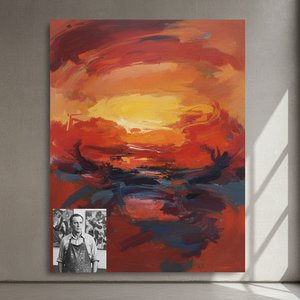
In the realm of abstract expressionism, few works command the immediate attention of a room quite like Still Rose. This large-scale masterpiece by the esteemed British artist Trevor Bell is not merely a painting, but an atmospheric experience that envelops the viewer in a warm, pulsating glow. At first glance, the eye is met with a breathtaking gradient of fire and earth; a vibrant, sun-drenched orange at the upper reaches of the canvas gradually descends into a deep, saturated crimson at its base. There is no subject to distract the mind, no figure to anchor the gaze—only the pure, unadulter than raw emotion of color itself. The composition operates on a flat plane, yet through the masterful manipulation of hue, it creates an illusion of receding space, pulling the observer into a meditative, infinite horizon.
The technical brilliance of Still Rose lies in its seamless transitions and the subtle, tactile quality of its surface. Utilizing what appears to be a sophisticated wet-on-wet blending technique, Bell achieved a smoothness that feels almost liquid. Upon closer inspection, one can discern the delicate traces of layering and brushwork that prevent the piece from feeling static. These minute textural variations catch the light, lending a sense of movement to the color field as if the painting were breathing. This mastery of medium ensures that the work remains dynamic, shifting its character depending on the ambient lighting of the room, making it an extraordinary centerpiece for any sophisticated interior.
Beyond its aesthetic splendor, the painting carries a profound symbolic weight. The choice of red and orange—colors intrinsically linked to passion, energy, and the primal warmth of a setting sun—evokes a dual sense of intensity and comfort. While the deep reds can suggest the heat of danger or the depth of human emotion, the soft transitions provide a sanctuary for contemplation. For the collector or interior designer, this piece offers a unique opportunity to introduce a focal point that is both bold and tranquil. It serves as an anchor in modern decor, providing a sophisticated backdrop that complements minimalist aesthetics while injecting a much-needed pulse of vitality into a living space or gallery.
As a significant figure associated with the influential St Ives School, Trevor Bell’s legacy is one of boundary-pushing abstraction. In Still Rose, we see the culmination of his lifelong devotion to color and form. Owning a high-quality reproduction of this work allows one to bring a piece of British art history into the home—a fragment of a movement that redefined how we perceive light and space. It is an invitation to pause, to breathe, and to lose oneself in the eternal glow of a single, perfect moment captured in pigment.
问答 (or more naturally for a website heading): Klausimai ir atsakymai
Ar „Still Rose“, autorius – Trevor Bell autorinės teisės leidžia daryti kopijas?
Kūrinys „Still Rose“, autorius – Trevor Bell, saugomas Museum of Fine Arts kolekcijoje, yra vis dar saugoma autorinės teisės. Šis statusas nulemia, ar galima rengti vaizdo reprodukcijas.
Kokią temą ir atmosferą sujungia „Still Rose“, autorius – Trevor Bell?
„Still Rose“, autorius – Trevor Bell sujungia abstract expressionism, color field painting, red orange palette, meditative art, emotional color, modern abstraction, bold color artwork ir Bold atmosferą.
Kokios spalvų paletės naudojama darbe „Still Rose“, autorius – Trevor Bell?
„Still Rose“, autorius – Trevor Bell spalvų paletė apibūdinama kaip Dark. Tai glausta kūrinio spalvų aprašoma.
Autoriaus biografija
A Visionary of Form: The Life and Legacy of Trevor Bell
In the vibrant tapestry of twentieth-century British abstraction, few threads are as strikingly colored or structurally daring as those woven by Trevor Bell. Born in Leeds in 1930, Bell emerged from the industrial heart of England to become a transformative force within the prestigious St Ives School. His journey was one of profound metamorphosis, moving from the structured academic training of his youth toward a radical reimagining of what a painting could be. To encounter a Bell original is to step into a world where the boundaries of the frame dissolve, replaced by a rhythmic dance of geometry and light that continues to captivate the modern eye.
The trajectory of Bell’s career was irrevocably altered in 1955 when, drawn by the magnetic pull of the Cornish coast and encouraged by his contemporary Terry Frost, he relocated to Cornwall. This move was far more than a change in geography; it was an immersion into a crucible of creative innovation. Surrounded by the rugged landscapes and the pioneering spirits of artists like Peter Lanyon and Barbara Hepworth, Bell began to move away from representational echoes toward a pure exploration of Abstract Expressionism. The salt-sprayed light and undulating topography of St Ives provided the essential catalyst for his fascination with how color and shape could evoke the essence of nature without mimicking its literal form.
The Revolution of the Shaped Canvas
As Bell’s artistic consciousness deepened, he began to challenge the very architecture of the medium. He grew dissatisfied with the traditional rectangular window of the canvas, viewing it as a restrictive container that imposed an artificial limit on the energy of his compositions. This dissatisfaction birthed one of his most significant contributions to modern art: the shaped canvas. By manipulating the physical edges of his work, Bell allowed the painted forms to bleed into the surrounding space, creating an organic continuity between the artwork and its environment.
These experimental formats were not merely aesthetic whims but profound structural statements. Through these non-traditional boundaries, he achieved several artistic breakthroughs:
- Dynamic Interconnectivity: The edges of the canvas became active participants in the composition, guiding the viewer's eye through interlocking geometric segments.
- Spatial Expansion: His work broke the "fourth wall" of traditional painting, suggesting that the energy of the colors extended far beyond the physical fabric.
- Structural Harmony: The interplay between bold, saturated hues and meticulously calculated shapes created a sense of balanced tension, mirroring the natural rhythms of the Cornish landscape.
A Lasting Impression on British Abstraction
The historical significance of Trevor Bell lies in his ability to marry the visceral emotion of abstraction with a rigorous, almost architectural precision. While many of his contemporaries focused on the gestural spontaneity of action painting, Bell sought a more structured equilibrium. His work stands as a testament to a period when British art was bravely redefining itself on the global stage, moving away from pastoral traditions toward a sophisticated, international language of form.
Throughout his decades of experimentation, Bell remained a steadfast explorer of the relationship between color and perception. His legacy is preserved not just in museum collections, but in the very way we perceive the limits of the frame. He taught us that art need not be contained by borders, but can instead exist as an expansive, breathing entity. Today, his influence persists in the works of contemporary abstract artists who continue to push the boundaries of shape and space, forever indebted to the bold, geometric courage of this Leeds-born pioneer.

Trevor Bell
1930 - 2017 , United Kingdom
Trumpa informacija apie kūrėją
- Full Name: Trevor Bell
- Nationality: British
- Date Of Birth: 1930
- Date Of Death: 2017
- Place Of Birth: Leeds, United Kingdom
- Notable Artworks:
- Studio with florida queen on the rear wall
- Still Rose
- Untitled
- Artistic Movement Or Style: Abstract Expressionism
- Artists Who Influenced This Artist: ['Terry Frost']
- Artists Or Movements Influenced By This Artist: ['Abstract Expressionism']
Susiję straipsniai

Mark Rothko: 25 Šedevrai, Apibūdinantys Spalvų Ir Jaustmo Gylį | OriginalUniqueArt
Atraskite 25 įspūdingiausius Mark Rothko kūrinius! Gilinkitės į abstraktaus meno spalvų laukus, ekspresionizmą ir jaustmingas tapybas. Meno reprodukcijos aukščiausia kokybe – OriginalUniqueArt.com

Geometrinės Abstrakcijos Šedevrai: 10 Kūrinių, Pakeitusių Meną | OriginalUniqueArt.com
Atraskite 10 geometrinės abstrakcijos šedevrų – nuo Mondriano iki Malevičiaus! Sužinokite apie Piet Mondrian, Kazimir Malevič ir kitus menininkus. Meno kūriniai jūsų interjerui | OriginalUniqueArt.com
Jacob Kainen: A Pioneer of American Color Field Painting & Abstract Expressionism
Explore the life & work of Jacob Kainen, a pivotal figure in American Abstract Expressionism and Color Field painting. Discover his journey from Social Realism to vibrant abstraction and lasting influence on 20th-century art.

Kandinsky's Masterpieces: 25 Paintings That Define Abstract Art | OriginalUniqueArt
Journey through Wassily Kandinsky's 25 most iconic abstract paintings. Explore his revolutionary use of color, form & spiritual expressionism. Find museum-quality Kandinsky reproductions and elevate your home decor with OriginalUniqueArt.com. Discover all masterpieces on OriginalUniqueArt.com!

Top 10 Abstraktus Ekspresionizmas: Simboliai ir Grožio Paslaptys
Atraskite 10 legendinių abstraktus ekspresionizmo kūrinių! Pažinkite Pollocko, Rothko ir kitų genijų istorijas bei jų spalvingas meno interpretacijas. Puikios meninės reprodukcijos jūsų namams – OriginalUniqueArt.com