American Realism · 1891
Weda Cook (Thomas Eakins, 1891)
Thomas Eakins (1844–1916) sukūrė Weda Cook. Šis kūrinys datuojamas 1891 m. Šis kūrinys priklaulo American Realism kieruliui. Pagaminta naudojant Oil On Canvas.
- 1891
- Oil On Canvas

 Peržiūrėti realaus dydžio版

 Rankinio darbo aliejinės imitacijos paveikslas
 Pasidalinti
 Dalintis
 Informacinė l lapelė


 Atsisiųsti
 Panašūs eksponatai
 Rentgeno spindulių nuotrauka
 Automatinė diorama
 问答

 Statistika
Weda Cook, trumpai
- Pavadinimas
- Weda Cook
- Autorius
- Thomas Eakins (1844–1916)
- Dizainere/is gimęs
- Filadelfija, Jungtinės Amerikos Valstijos
- Data
- 1891
- Mediumas
- Oil On Canvas
- Judėjimas
- American Realism
- Laikotarpis
- 19th Century
- Tema
- portrait, woman, pink dress, eakins style, 19th century, american art
Ką vaizduoja Weda Cook?
The Unflinching Gaze: Capturing Modernity in Thomas Eakins' Weda Cook
To stand before Thomas Eakins’ Weda Cook is not merely to observe a portrait; it is to confront a moment of profound, unvarnished reality. Painted in 1891, this oil on canvas transcends the simple act of likeness, offering instead a deep psychological study wrapped in the elegance of late Victorian fashion. Eakins, the master of American realism, possessed an almost scientific dedication to capturing the human form and spirit with breathtaking accuracy. The subject herself, Weda Cook, is rendered with a poise that seems both natural and meticulously composed. Her long hair cascades around her shoulders, framing a face that meets the viewer’s gaze with an intensity that refuses easy interpretation. It is this directness—this refusal to simply smile for posterity—that makes the painting such a compelling piece of art history.
Technique and The Art of Realism
Eakins' technical mastery in Weda Cook is evident in every visible brushstroke. He was a proponent of realism, eschewing the romantic flourishes that sometimes characterized his contemporaries for something far more grounded: truth. Observe the texture of the pink dress; Eakins has managed to convey the weight and drape of the fabric while simultaneously suggesting its delicate nature. The handling of light across her skin is masterful, giving her complexion a luminous quality that seems almost alive. This attention to detail—the subtle shading around the eyes, the precise rendering of the hair strands—speaks to an artist who studied anatomy as rigorously as he studied composition. For those interested in acquiring a reproduction, understanding this commitment to visible technique allows one to appreciate the painstaking effort required to translate such depth onto canvas.
Historical Echoes and Social Portraiture
The late 19th century was a period of immense social flux in America, and Eakins chronicled that change through his subjects. Weda Cook serves as a beautiful artifact from this era, capturing the societal expectations placed upon women while simultaneously celebrating their individual presence. The seriousness etched into her expression suggests a woman of substance, perhaps navigating the complex currents of turn-of-the-century society. Unlike idealized portraits meant solely for vanity, Eakins’ work feels engaged with the world around him—a testament to the dignity found in everyday American life. It invites us to consider not just who she was, but what it meant to be a woman of her standing during that transformative time.
Emotional Resonance and Interior Placement
Emotionally, the painting resonates with a quiet power. There is an undeniable gravity emanating from Weda Cook that draws the viewer in, compelling them to look closer, to decipher the meaning behind that steady gaze. For collectors or interior designers seeking art that anchors a space with intellectual weight, Weda Cook offers more than mere decoration; it offers conversation. Imagine this piece gracing a formal drawing-room or a sophisticated study—its presence would lend an air of cultivated history and thoughtful depth to the surroundings. It is a work that demands contemplation, rewarding the viewer with layers of observation upon every viewing.
Weda Cook dididraudžios kokybės vaizdai

Viešoji domenė: suregalis mirė 1916 m.
Kiti dydžiai, iškarai ir citavimo informacija →Thomas Eakins, Weda Cook (1891). Viešoji domenė.
Spalvos suderintos su originalu skaitmeninio eksperto, failas kruopščiai retušuotas ir tiksliai atitinkantis autoriaus brushwork stilių.
Atsisiųskite aukštos iš}|$resolution iš høj-resolution failoAtsakimai į klausimus apie Weda Cook
Kuriem metais buvo sukurta „Weda Cook“ – Thomas Eakins?
„Weda Cook“ – Thomas Eakins sukurtas 1891 m.
Kokia technika sukurta „Weda Cook“ – Thomas Eakins?
„Weda Cook“ – Thomas Eakins technika – Oil On Canvas. Kopijos siekia atkartoti šios technikos vaizdą.
Kas yra „Weda Cook“?
„Weda Cook“ – Thomas Eakins vaizdeletas: portrait, woman, pink dress, eakins style, 19th century, american art.
Ar „Weda Cook“ – Thomas Eakins priklauso viešosios teisės domenui?
Kalbant apie autorišką teisę, „Weda Cook“ yra yra viešosios erdvės dalis – jo autorinė teisė pasibaigusi.
Kas sukūrė „Weda Cook“?
Kūrinį „Weda Cook“ sukūrė Thomas Eakins. Darbas katalogizuojamas Thomas Eakins vardu.
Kokio meno kryžmės dalis yra „Weda Cook“ – Thomas Eakins?
Kūrinio „Weda Cook“ – Thomas Eakins stilius – American Realism. Ši klasifikacija leidžia šį darbą įtraukti į bendrą susijusių menininkų ir kūrinių kontekstą.
Kokio Thomas Eakins kūrybos laikotarpio priklauso „Weda Cook“?
Thomas Eakins kūrybos enceklopedijoje kūrinys „Weda Cook“ priskiriamas Mature Period laikotarpiui. Šis etapas leidžia palyginti jį su kitais šio autoriaus kūriniais.
Kiek metų buvo Thomas Eakins, kai sukūrė „Weda Cook“ 1891 m.?
Kai 1891 m. buvo sukurta „Weda Cook“, Thomas Eakins – gimęs 1844 m. – buvo 47 metų amžiaus.
Kodėl „Weda Cook“ autoriškos teisės statusas yra toks, koks yra?
„Weda Cook“ – Thomas Eakins yra yra viešosios erdvės dalis – jo autorinė teisė pasibaigusi. Autorinės teisės galioja nuo mirties metų, kai šis kūrėjas mirė 1916 m.
Apie šį menininką, Thomas Eakins

1844–1916, Jungtinės Amerikos Valstijos
Thomas Eakins
Thomaso Eakinso gyvenimas Gimęs Pensilvanijos Filadelfijoje 1844 m. liepos 25 d., Thomasas Eakinsas gyvenimą, glaudžiai įsišakinusį jo gimimo mieste, skvėrė į daugybę meninių ir mokslinių disciplinų. Jis buvo universalus kūrybos žmogus – dailininkas, fotografas, skulptorius ir aukštomasmeninis meno pedagogas. Nors studijų metu jo domėjimas dažnai vedė jį už Danės seas, jo egzistencijos geografija iš esmės išliko Filadelfijos rėmuose.
Taip pat Thomas Eakins darbai
 „The Gross Clinic“1875
 Plaukiot1885
 Maxas Šmitsas vienoje taikės1871
 Portrait of Samuel Murray1889
Esdai apie Weda Cook
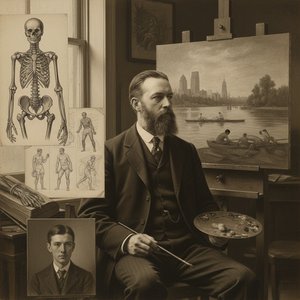 Thomas Eakins: Realism, Anatomy & the American Spirit – A Comprehensive Exploration of Life and LegacyExplore the life & legacy of Thomas Eakins, a pivotal American Realist painter. Discover his groundbreaking techniques, anatomical precisio…
 Mastering Reality: A Definitive Guide to the Timeless Elegance of Academic RealismExplore the profound beauty of Academic Realism. Discover the technical mastery, historical significance, and timeless techniques that defi…
 The Emotional Resonance of Wall Art: Elevating Interior Design from Aesthetic to Experiential LuxuryDiscover how curated wall art transforms interiors into emotionally resonant experiences. Explore the psychology of color, bespoke commissi…