

 Peržiūrėti realybėje
 Pasidalinti
 Dalintis
 Išsamiau

 Atsisiųsti
 Panašūs eksponatai
 Rentgeno nuotrauka
 Automatinė diorama
Building
 2009
2009 21.0 x 62.0 cm
 Skaityti daugiau
Rankų darbo aliejinės reprodukcijos
Rankiniu būdu tapytas aliejus ant droblio jūsų pageidaujamame dydį ir rėmuose – mūsų menininkų darbas pagal užsakymą. ( Pirkti spaudinį Pirkti vaizdą)




































Pasirinkite iš mūsų nustatytų dydžių, atitinkančių originalaus meno kūrinio proporcijas.

Galite įvesti savo matmenis, kad jie atitiktų konkretų rėmą ar erdvę. Jei pasirinktas dydis neatitinka originalaus paveikslėlio proporcijų, mes arba apkropsime meno kūrinį, arba papildysime tapybą rankomis dažytい elementais. Prieš pradėdami gamybą, jūsų patvirtinimui atsiųsime skaitmeninį maketą.
Atkreipkite dėmesį, kad ekrane rodomas vaizdas neatspindi tikrojo apkarpymo ar papildymo. Tik maketas tiksliai parodys galutinę kompoziciją.
Nors galima rinktis ir individualius dydžius, rekomenduojame pasirinkti matmenis iš nustatytos sąrašo, kad būtų išlaikytos originalios proporcijos.
Gavus užsakymą, OriginalUniqueArt.com komanda susisieks su klientu el. paštu dėl instrukcijų ir pateiks maketo pavyzdį.
Pristatymas visame pasaulyje () per 3–4 savaites, o ne įprastai – per 5 savaites. (22 rugpjūtis). Kokybė lieka nepakeičiama.

Nemokamas greitasis pristatymas visame pasaulyje

Aukštos kokybės lininis drobė

Pilnas siuntimo draudimas

Muitinės mokesčių grąžinimo garantija

Tikro spalvų atitikimo garantija

60 dienų grąžinimo politika (tik esant gamyklinėms defektams)

100% pinigų grąžinimo garantija

Nuolaida už kelias reprodukcijas
 Stiklo variantas prieinamas tik pasirinkus dydį iki 110 cm

Building
Reprodukcijos technika
Reprodukcijos matmenys
-


Galutinė kaina
$ 300
Kūrinio aprašymas
Autoriaus biografija
A Tapestry of Two Worlds: The Artistic Journey of Susan Hefnou
Born in 1962, the life and work of Susan Hefnou (often referred to as Susan Hafouz) serve as a profound meditation on the intersections of identity, geography, and memory. Her very existence is a bridge between cultures; born to an Egyptian father and a German mother, her early years were spent amidst the vibrant, sun-drenched landscapes of Egypt before moving through Austria and eventually settling into the rigorous artistic circles of Germany. This dual heritage does not merely exist as a biographical fact but acts as the primary engine of her creativity. Hefnou’s oeuvre is a restless, beautiful exploration of what it means to belong to multiple places at once, weaving together the visual languages of the East and the West into a singular, cohesive aesthetic experience.
The foundations of her practice were laid in the rich cultural soil of Cairo, where exposure to Egyptian art history and the intricate elegance of Islamic calligraphy first ignited her fascination with symbolic representation. However, it was her formal training in Germany—culminating in a postgraduate degree from the prestigious Städelschule in Frankfurt under the mentorship of Peter Weibel—that provided her with the multidisciplinary toolkit necessary to express such complex themes. This fusion of Eastern spiritual symbolism and Western contemporary experimentation allowed her to transcend the boundaries of a single medium, moving fluidly between drawing, sculpture, installation, video, and performance.
The Language of Pattern and Presence
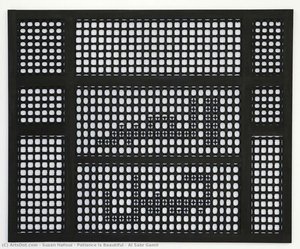
To encounter a work by Hefnou is to enter a space of meticulous contemplation. Her artistic style is defined by an extraordinary attention to detail and a deliberate, almost rhythmic exploration of texture. In her drawings, one often finds intricate patterns that pay homage to Islamic geometric designs, yet these are never purely decorative. Instead, she utilizes abstraction to challenge the viewer’s perception, creating a dialogue between the seen and the unseen. A notable example is her Buildings and Cityscapes series, where she employs layers of tracing paper and Indian ink to create network-like designs. These works evoke the grid-like precision of New York City’s streets while simultaneously echoing the complex, functional beauty of the Mashrabiya—the traditional carved wooden latticework screens found in Islamic architecture.
This use of the Mashrabiya motif is perhaps her most poignant symbolic tool. Through her photography and sculpture, she uses these screens to investigate the concept of the "exchanged gaze." By depicting subjects through screen-covered windows, she makes the viewer a participant in an act of looking that borders on an invasion of privacy, thereby questioning the strength and permeability of cultural boundaries. Her sculptures, often rendered in wood or bronze, incorporate both English and Arabic texts, further cementing her role as a translator of cultures. In these works, the physical material becomes a vessel for exploring notions of resilience, transformation, and the enduring nature of tradition in a modern, globalized world.
Legacy of Patience and Perseverance
Beyond the technical mastery of her media, Hefnou’s work is deeply rooted in a philosophical pursuit of patience. This theme is explicitly captured in projects such as "Patience Is Beautiful - Al Sabr Gamil," where repetitive patterns are used to mirror the meditative process of perseverance. Her art suggests that identity is not a static destination but a continuous, patient construction—a layering of experiences, much like the layers of tracing paper in her drawings.
Throughout her career, Hefnou has achieved significant recognition within both the Egyptian and international art communities, with her works finding homes in prestigious institutions such as the Guggenheim Museum. Her ability to illuminate pressing sociopolitical issues through a lens of spiritual and timeless beauty ensures her historical significance. She remains a vital voice in contemporary art, reminding us that even in an era of rapid fragmentation, there is profound meaning to be found in the slow, deliberate act of connecting our disparate histories.
susan hafouz
1962 - , Egypt
Trumpa informacija
- Artistic Movement Or Style: Contemporary Art
- Date Of Birth: 1962
- Full Name: Susan Hefnou Hafouz
- Nationality: Egyptian
- Notable Artworks: ['Building']
- Place Of Birth: Cairo, Egypt

