Perjungti į spausdinamus版作品
 Skaityti daugiau







































 Dėl meno kūrinių ar reprodukcijų, kurių bet kuri pusė yra didesnė nei 105 cm (apie 41 inch), rėmas bus siunčiamas kaip išskaidytas surinkimo rinkinys. Šis metodas užtikrina saugų pristatymą ir apsaugo nuo transportavimo metu galimos žalos.


Identification of The Mountain Stream
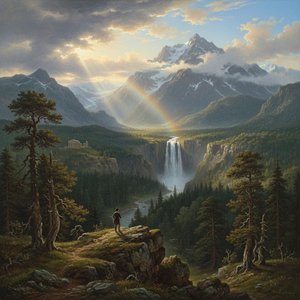
In this work, The Mountain Stream, Paul Weber presents a secluded woodland interior. Painted about 1850, the scene captures a dense, shadowy forest where a stream winds through the landscape. The composition focuses on the quietude of the natural world, drawing the eye into the depths of the shaded greenery.
Within this landscape, Weber includes a subtle vignette of a solitary hunter. The figure is at rest, accompanied by his dog and his gun, tucked away in the quietude of the trees. This small detail adds a sense of scale and human presence to the expansive, primeval setting of the forest.
Composition and Visual Elements
The composition is defined by a strong sense of verticality, with large trees dominating the frame and establishing a rhythmic structure throughout the woodland interior. These towering elements create a sense of enclosure, framing a secluded space that feels both intimate and vast. A stream winds through the center of the scene, acting as a leading line that draws the eye steadily into the depths of the forest. This movement is grounded by a foreground composed of heavy rocks and moss, which provides a tactile sense of depth and stability to the viewer.
The lighting is notably dramatic, utilizing a chiaroscuro effect to manipulate the atmosphere. Pools of light break through the canopy to illuminate specific patches of foliage and stone, while much of the surrounding landscape remains held in deep shadow. This interplay of light and dark creates a quiet, mysterious mood. The color palette is predominantly earthy and muted, relying on subtle tones to maintain the somber, tranquil atmosphere of the forest interior.
Technique and Artistic Style
Executed in oil on canvas, this work leans toward the principles of Romanticism. The artist moves away from strict realism to prioritize a subjective, emotional experience of the natural world. There is a palpable sense of the sublime here, where the scale and atmosphere of the forest suggest a quiet, introspective power. The lighting is handled with a dramatic chiaroscuro effect, utilizing deep shadows and sudden pools of light to define the terrain.
The surface of the painting is characterized by a physical presence. Texture is achieved through deliberate, visible brushstrokes that create a rough, impasto-like quality, particularly across the foliage and the rugged bark of the trees. This tactile approach gives the organic elements a sense of weight and immediacy. Rather than smooth transitions, the paint is applied to emphasize the varied textures of moss, stone, and flowing water.
Klausimai ir atsakymai
Ar „The Mountain Stream“ – Paul Weber yra šviesaus ar tamsaus tono kūrinys?
„The Mountain Stream“ bendroji ryškumas yra deep_shadow, o švytėjimas – Dark.
Kas sukūrė „The Mountain Stream“ ir kokiu stiliumi tai atlikta?
„The Mountain Stream“ kūrybinį darbu pasižymi Paul Weber, taikantis Hudson River School stilių. Autorius ir stilius nurodo šio kūrinio tradiciją.
Ar studentams skirtas informacinis lapelis apie „The Mountain Stream“ – Paul Weber yra prieinamas?
„The Mountain Stream“ – Paul Weber Informacinė medžiaga puslapioje galima rasti spausdinamą dviejų lapų informacinę lentelę: kūrinį su jo tapatybės lentele, laikotarpį nurodantį juostą, atitinkantį gyvenimo metus, kitus šio autoriaus darbus, išmatuotą spalvų paletę bei keturiomis stiliais paruoštus citavimo pavyzdžius.
Daugiau informacijos apie šį paveikslą
 Peržiūrėti realaus dydžio版

 Pasidalinti
 Dalintis
 Išsamiau
 Vadovas


 Atsisiųsti
 Panašūs eksponatai
 Rentgeno spindulių nuotrauka
 Automatinė diorama
 问答
 Statistika