Perjungti į spausdinamus版作品
 Skaityti daugiau







































 Dėl meno kūrinių ar reprodukcijų, kurių bet kuri pusė yra didesnė nei 105 cm (apie 41 inch), rėmas bus siunčiamas kaip išskaidytas surinkimo rinkinys. Šis metodas užtikrina saugų pristatymą ir apsaugo nuo transportavimo metu galimos žalos.


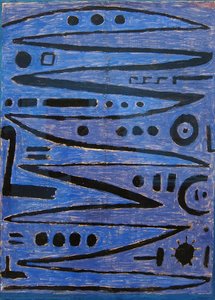
Woman Knitting – A Fragment of Geometric Harmony
Paul Klee’s “Woman Knitting” stands as a deceptively simple yet profoundly resonant exploration of domesticity and abstraction, born from the crucible of 1915 Switzerland during the burgeoning Expressionist movement. This watercolor and charcoal drawing isn't merely a depiction of an everyday activity; it’s a carefully constructed visual puzzle designed to convey complex ideas about form, color, and emotional resonance—a hallmark of Klee’s distinctive artistic vision.- Composition & Perspective: The artwork prioritizes clarity over realism. A central figure – a woman seated at a table – dominates the frame, positioned in a three-quarter view facing right. Minimal perspective is employed; overlapping geometric shapes subtly suggest spatial relationships without adhering to traditional conventions. This deliberate flattening of space reinforces Klee’s rejection of representational illusionism and invites viewers to focus on the interplay of forms themselves.
- Color Palette & Texture: Dominated by shades of gray, black, and white, the color palette is strikingly restrained. However, subtle tonal variations create a sense of depth and texture—likely achieved through layering charcoal and watercolor—adding tactile qualities to the image. These muted hues contribute to an atmosphere of quiet contemplation and underscore Klee’s fascination with monochrome as a vehicle for conveying emotion.
- Geometric Forms & Stylistic Influences: Angular lines are paramount, defining the contours of the woman, table, and surrounding space. Triangular shapes—particularly prominent in the woman's torso—are interwoven with rectangles and trapezoids, reflecting Klee’s engagement with Cubist principles while simultaneously retaining elements of folk art aesthetics. This blending of influences speaks to his desire to synthesize disparate artistic traditions into a unified expressive language.
- Symbolism & Emotional Impact: The act of knitting itself carries symbolic weight—representing labor, caregiving, and the creation of something tangible from raw materials. Klee’s masterful simplification elevates this commonplace gesture into an emblem of human connection and resilience. The artwork's overall effect is one of serene contemplation, inviting viewers to consider themes of solitude, creativity, and the beauty found in understated forms.
Technique & Medium – Watercolor Meets Charcoal’s Grain
Klee’s technique exemplifies his commitment to spontaneity and gestural expression. Watercolor was skillfully applied with loose brushstrokes, allowing for subtle blending and tonal gradations—a characteristic approach that distinguishes it from more polished academic styles. Charcoal was incorporated to establish foundational contours and add textural richness, particularly evident in the woman's figure and the table surface. The grainy texture of the paper further enhances this tactile dimension, grounding the artwork in a physicality that contrasts with its abstract composition.Historical Context – Expressionism’s Quiet Revolution
“Woman Knitting” emerged during a pivotal moment in European art history—the rise of Expressionism—a movement characterized by an intense focus on subjective emotion and psychological insight. Rejecting Impressionistic objectivity, Expressionist artists sought to convey inner feelings through distorted forms and vibrant colors. Klee's work aligns with this broader artistic ethos while simultaneously forging his own unique path, demonstrating the power of abstraction to communicate profound emotional truths.Further Exploration – Zentrum Paul Klee & Beyond
To delve deeper into Paul Klee’s artistic legacy, we encourage visitors to explore Zentrum Paul Klee in Bern, Switzerland—the world's largest collection dedicated to his oeuvre. Alternatively, reproductions of “Woman Knitting” can be found at Kunstmuseum Bern and numerous online art galleries, offering a captivating glimpse into the enduring beauty and intellectual depth of this iconic artwork.Klausimai ir atsakymai
Kokia yra autorinės teisės situacijos priežastis kūriniam darbui „Moteris mezgianti“ – Polis Klė?
Autorinės teisės statusas kūriniui „Moteris mezgianti“ – yra viešosios erdvės dalis – jo autorinė teisė pasibaigusi – nustatomas remiantis to, kad menininkas mirė 1940 m.
Kokia technika buvo panaudota kūriniui „Moteris mezgianti“ ir kada jis buvo sukurtas?
„Moteris mezgianti“ sukurtas 1915 m. naudojant Akvarelė techniką. Medžiaga ir data nurodo, kaip ir kada buvo sukurtas originalas.
Kokia buvo Polis Klė amžius sukuriant „Moteris mezgianti“?
Kai 1915 m. buvo sukurta „Moteris mezgianti“, Polis Klė – gimęs 1879 m. – buvo 36 metų amžiaus.
Daugiau informacijos apie šį paveikslą
 Peržiūrėti realaus dydžio版
 Pasidalinti
 Dalintis
 Išsamiau
 Vadovas

 Atsisiųsti
 Panašūs eksponatai
 Rentgeno spindulių nuotrauka
 Automatinė diorama
 问答
问答 Statistika