Perjungti į spausdinamus版作品
 Skaityti daugiau







































 Dėl meno kūrinių ar reprodukcijų, kurių bet kuri pusė yra didesnė nei 105 cm (apie 41 inch), rėmas bus siunčiamas kaip išskaidytas surinkimo rinkinys. Šis metodas užtikrina saugų pristatymą ir apsaugo nuo transportavimo metu galimos žalos.


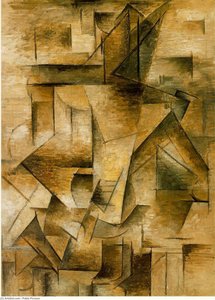
A Glimpse into Genesis: Picasso’s Early Cubist Exploration
This pastel drawing offers a captivating window into Pablo Picasso's formative years, revealing his initial steps toward revolutionizing 20th-century art. It depicts two nude figures – one reclining, the other seated – engaged in an ambiguous and powerfully suggestive interaction. The work is not merely a depiction of bodies; it’s a study in form, emotion, and the very act of perception, brimming with the energy that would come to define his groundbreaking Cubist style.Deconstructing Reality: Style & Technique
The artwork embodies an early stage of Cubism, characterized by *fragmentation* rather than complete dissolution of form. Bodies are broken down into simplified geometric shapes and presented from multiple viewpoints simultaneously. This isn’t about replicating visual reality; it's about conveying a more holistic understanding of structure and spatial presence. Picasso masterfully employs pastel sticks or chalk, building up texture through distinct, expressive strokes. The application is rough and deliberate, contributing to the dynamism and immediacy of the piece. Lines are bold, defining contours with an energetic force that suggests movement and internal tension. A flattened perspective – where forms overlap and intersect without traditional depth cues – further emphasizes this deconstruction of visual reality.A Palette of Psychological Resonance: Color & Composition
The color palette is deliberately non-naturalistic, creating a jarring yet compelling effect. An earthy orange dominates the background, providing a warm but unsettling contrast to the cooler pinks and blues used for the figures. This isn’t harmonious blending; it's a deliberate clash intended to amplify emotional impact. Color serves not to describe realistically, but rather to heighten the feeling of tension and psychological complexity within the composition. The arrangement of forms is chaotic yet carefully considered, lacking a clear focal point. This ambiguity invites viewers to actively participate in constructing meaning, piecing together a narrative that remains tantalizingly incomplete.The Crucible of Innovation: Historical Context
Created during Picasso’s period of intense experimentation (likely pre-1907), this work reflects his growing dissatisfaction with traditional artistic conventions. Inspired by Paul Cézanne's emphasis on underlying geometric forms and the powerful simplification of the human figure found in African sculpture, he began to question the foundations of representation. This period was a crucial stepping stone toward the full-blown Cubism that emerged in 1907 with *Les Demoiselles d'Avignon*. While lacking the radical angularity of his later work, this piece demonstrates the foundational principles – fragmentation, multiple perspectives, and an emphasis on form – that would define the movement.Beyond the Visible: Symbolism & Emotional Impact
The ambiguous interaction between the figures invites a multitude of interpretations. Are they embracing? Struggling? The lack of clear narrative allows for personal resonance. The fragmented forms themselves can be seen as symbolic of the complexities and contradictions inherent in human relationships, or even the fractured nature of modern experience. Ultimately, this artwork transcends mere representation. It’s an exploration of emotion, perception, and the very act of seeing. The energy radiating from the composition is palpable, conveying a sense of both vulnerability and power. This piece isn't simply *about* two figures; it *embodies* a feeling – a raw, visceral expression of human connection and internal conflict.Key Features at a Glance
- Artist: Pablo Picasso (1881-1973)
- Style: Early Cubism, Proto-Cubism
- Medium: Pastel on paper
- Emotional Impact: Tension, vulnerability, psychological complexity.
Klausimai ir atsakymai
Iš kokios šalies kilęs Cubism kūrinys „The dawn 1“?
„The dawn 1“ sujungia Cubism stilių su Ispanija, atspindėdama kūrėjo gimimo vietą.
Kokia yra „The dawn 1“ – Pablo Pikaso dominuojanti spalva?
Dominuojanti „The dawn 1“ – Pablo Pikaso spalva yra Warm Sunset Tones. Šis tonas yra pagrindinė paletės spalva.
Kokį Pablo Pikaso kūrybos etapą atspindi „The dawn 1“?
„The dawn 1“ atspindi Pablo Pikaso kūrybinį laikotarpį Mature Period.
Daugiau informacijos apie šį paveikslą
 Peržiūrėti realaus dydžio版
 Pasidalinti
 Dalintis
 Išsamiau
 Vadovas

 Atsisiųsti
 Panašūs eksponatai
 Rentgeno spindulių nuotrauka
 Automatinė diorama
 问答
问答 Statistika