Surrealist Expressionism · 1927
The Forest (Maksas Ernstas, 1927)
Maksas Ernstas (1891–1976) sukūrė The Forest. Šis kūrinys datuojamas 1927 m. Šis kūrinys priklauso Surrealist Expressionism kieruliui. Pagaminta naudojant Acrylic On Canvas. Eksponatas saugomas Tel Aviv Museum of Art Tel Aviv, Izrael. Matmenys – 25 × 36 cm.
- 1927
- Acrylic On Canvas
- 25 × 36 cm
- Tel Aviv Museum of Art

 Peržiūrėti

 Rankinio darbo aliejinės imitacijos paveikslas
 Pasidalinti
 Dalintis
 Informacinė lLapelė


 Atsisiųsti
 Panašūs eksponatai
 Rentgeno spindulių nuotrauka
 Automatinė diorama
 Klausimai ir atsakymai

 Statistika
The Forest, trumpai
- Pavadinimas
- The Forest
- Autorius
- Maksas Ernstas (1891–1976)
- Autorius gimęs
- Briūlis, Vokietija
- Data
- 1927
- Technika
- Acrylic On Canvas
- Dalių matmenys
- 25 × 36 cm
- Kur galima pamatyti
- Tel Aviv Museum of Art, Tel Aviv, Izrael
- Judėjimas
- Surrealist Expressionism
- Laikotarpis
- Early Modern
- Tema
- moonlit cityscape, surreal forest, urban night, max ernst, german art, 1927 painting
Ką vaizduoja The Forest?
A Nocturne of Dreams: Max Ernst’s “The Forest”
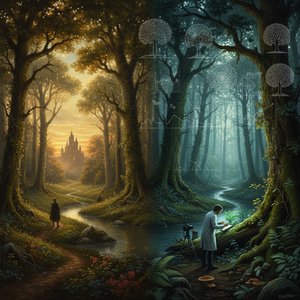
Max Ernst's "The Forest," painted in 1927, isn’t merely a depiction of a landscape; it’s an immersion into the subconscious, a carefully constructed dreamscape rendered with the unsettling beauty characteristic of the artist’s early Surrealist explorations. This intimate canvas – measuring just 25 x 36 cm – holds within its borders a potent collision of natural and urban elements, inviting viewers to contemplate the anxieties and aspirations simmering beneath the surface of modern life. The painting immediately draws the eye upward to a luminous moon dominating the sky, casting an ethereal glow upon the sprawling cityscape below. Buildings rise from the darkness, not as symbols of progress or order, but as strangely distorted monoliths, hinting at a world both familiar and profoundly alien.
Ernst’s technique is deliberately evocative, employing a layered approach that anticipates techniques he would later refine in his collage work. He utilizes loose, expressive brushstrokes, building up the forms of trees and buildings with a sense of urgency and movement. The color palette leans heavily into cool blues and greens, punctuated by the stark white of the moon and the muted tones of the city lights – colors that contribute to the painting’s nocturnal atmosphere and imbue it with a feeling of quiet mystery. Notice how he doesn't meticulously render detail; instead, he favors suggestion and mood, allowing the viewer’s imagination to fill in the gaps.
The Seeds of Surrealism: Ernst’s Intellectual Landscape
Understanding “The Forest” requires acknowledging Max Ernst’s unique artistic trajectory. Born in Brühl, Germany, in 1891, Ernst wasn't a traditional painter; his path was forged through rigorous academic study – philosophy, art history, literature, psychology, and psychiatry at the University of Bonn. This intellectual grounding profoundly shaped his approach to art, moving him beyond mere representation towards exploring the realm of dreams, memory, and the irrational. His father, a teacher of the deaf, instilled in him a sensitivity to the world and a rebellious spirit – qualities that would become central to Ernst’s artistic vision. He was deeply influenced by thinkers like Freud and Jung, particularly their theories on the unconscious mind, which he sought to translate into visual form.
The year 1927 is crucial within this context. It represents a pivotal moment in Ernst's development as a Surrealist, a period marked by experimentation with automatism – a technique of spontaneous creation designed to bypass conscious control and tap directly into the subconscious. "The Forest," therefore, can be seen as a product of this process, a visual manifestation of his inner world.
Symbolic Echoes: Nature Versus Urbanity
The juxtaposition of the forest and the city is laden with symbolic weight. The forest, traditionally associated with nature, instinct, and the primal, stands in stark contrast to the rigid geometry and artificial light of the urban landscape. This isn’t a harmonious blend; rather, it's a tension – a suggestion that the encroachment of modernity threatens to overwhelm the natural world. The moon itself is a potent symbol, often linked to cycles, intuition, and the hidden realms of the unconscious. Its presence elevates the scene beyond a simple cityscape, transforming it into a dreamlike tableau.
Furthermore, consider the distorted forms of the buildings. They aren’t simply architectural structures; they seem to lean inward, almost collapsing under their own weight, mirroring perhaps a sense of unease or anxiety about the future. The trees, though present, are somewhat obscured by the city's glow, hinting at a diminishing connection with nature.
A Timeless Resonance: Reproduction and Artistic Legacy
"The Forest" continues to resonate with viewers today because it taps into fundamental human experiences – the longing for escape, the anxieties of urban life, and the enduring power of the subconscious. OriginalUniqueArt’s meticulously crafted hand-painted reproductions capture not only the visual details of Ernst's original but also its emotional depth and atmospheric quality. Each reproduction is created with the same attention to texture and color as the original, ensuring a faithful representation of this iconic Surrealist masterpiece. Whether you are an art collector seeking to expand your collection or an interior designer searching for a unique piece to elevate a space, a OriginalUniqueArt reproduction of “The Forest” offers a captivating glimpse into the mind of one of 20th-century’s most visionary artists.
Kuriame muziejuje eksponuojama karya The Forest?
Tel Aviv Museum of Art
Tel Aviv, Izrael
Kūrybiškumo švyturys Vidžemio krante Įsikūręs vibruojančiame Tel Avivo širdyje – mieste, pulsuojančiame menine energija ir istorine reikšme – Tel Avivo menų muziejus stovi kaip tikras Izraelio klestinčios kultūros peisnis. Tai ne tik šedevrų saugykla; TAMA, kaip jį meiliai vadina, įkvepia menui gyvybę, skatina dialogą, įkvepia kartas ir tarnauja kaip gyvybiškai svarus ryšys tarp šalies praeities ir jos dinamiškos dabarties. Jo istorija prasideda ne prancangiuose salēs, o skromiose Tel Avivo pirmojo mero namų sienose – erdvėje, prisigėlusioje tautos identybės kūrimo aidais.


The Forest dididraudžios kokybės vaizdai

Apsaugotas autoriškomis teisėmis: šie failai skirti asmeniniam peržiūrėjimui, o ne perraštiniam naudojimui.
Maksas Ernstas, The Forest (1927), Tel Aviv Museum of Art.
Atsakimai į klausimus apie The Forest
Kur šiandien galima pamatyti kūrinį „The Forest“ – Maksas Ernstas?
Originalų kūrinį „The Forest“ galite pamatyti Tel Aviv Museum of Art, Tel Aviv, Izrael.
Kokia yra „The Forest“ – Maksas Ernstas kūrybos data?
„The Forest“ – Maksas Ernstas kūrybos metai – 1927.
Kokia technika panaudota kūriniui „The Forest"]?
Maksas Ernstas kūriniui „The Forest“ panaudojo Acrylic On Canvas techniką. Ši technika apibrėžė originalaus kūrinio medžiaginę prigimtį.
Kokie yra originalaus „The Forest“ – Maksas Ernstas matmenys?
Įrašyti kūrinio „The Forest“ – Maksas Ernstas matmenys yra 25 x 36 cm. Kopijas galima užsisakyti kitais dydžiais, išlaikant tą pačius proporcijas.
Kas yra „The Forest“?
„The Forest“ – Maksas Ernstas temos apima moonlit cityscape, surreal forest, urban night, max ernst, german art, 1927 painting, dreamlike scene. Kartu jie apibendrina šio kūrinio tematiką.
Ar „The Forest“ – Maksas Ernstas vaizdą galima laisvai reprodukcijaoti?
Kalbant apie autorišką teisę, „The Forest“ yra vis dar saugoma autorineje teisėje.
Kas yra „The Forest“ kūrybos autorius?
„The Forest“ priskiriamas Maksas Ernstas.
Kokiam stiliui priklauso „The Forest“?
Kūrinio „The Forest“ – Maksas Ernstas stilius – Surrealist Expressionism. Ši klasifikacija leidžia šį darbą įtraukti į bendrą susijusių menininkų ir kūrinių kontekstą.
Kokį Maksas Ernstas kūrybos etapą atspindi „The Forest“?
Maksas Ernstas kūrybos enceklopedijoje kūrinys „The Forest“ priskiriamas Early Surrealism laikotarpiui. Šis etapas leidžia palyginti jį su kitais šio autoriaus kūriniais.
Apie menininką Maksas Ernstas

1891–1976, Vokietija
Maksas Ernstas
Maksas Ernstas: Sapnų ir Inovacijų Virtuvė Maksas Ernstas, gimęs 1891 m. balandžio 2 d. Briūlyje, Vokietijoje, buvo neeilinis menininkas – tarsi sapnių architektas, kurio kūriniai vis dar kviečia pasitelkti į keistą ir nuostabią pasaulį. Jo kelionė nebuvo tiesiog tapybos mokyklų sekimas; tai buvo savarankiškas tyrimas, skatintas filosofiniais užmojais, psichologiniu susidomėjimu ir giliu nusivylimu visuomenės normomis.
Taip pat Maksas Ernstas darbai
 Célèbes arba Elėfantas Célèbes1921
 Elefantas Celebes1921
 Europa po Liūčių II1942
 Apie Tai Vyrai Nieko Nemanys1923
Esdai apie The Forest
 Symphony of Sunlight: The Luminous Legacy of Pine Tree Landscapes in Art HistoryExplore the luminous history of pine landscapes through Sorolla and Shishkin. Discover the magic of forest art today.
 Unlocking the Unconscious: The Top 25 Surrealist Masterpieces by Max ErnstStep into the dreamscapes of Max Ernst. Explore 25 iconic Surrealist masterpieces, from pioneering collages to haunting landscapes. Find in…
 The Enchanted Canopy: Exploring Forests in Art History – From Romantic Idealization to Ecological ConsciousnessExplore the rich history of forests in art! Discover Romantic masterpieces by Friedrich & Monet, Symbolist depths, and contemporary visions…