

 Peržiūrėti realaus dydžio版
 Siųsti
 Dalintis
 Išsamiau
 Vadovas

 Atsisiųsti
 Panašūs eksponatai
 Rentgeno spindulių nuotrauka
 Diaporama
 Statistika
Boy with Skull
 Oil
Oil- WallArt
- Symbolism
 1893
1893- 19th Century
 95.0 x 66.0 cm
 Ateneum meno muziejus
 Rodyti daugiau
Giclée / Meno spausdinimas
Muziejų lygio „giclée“ arba drobos spausdinimas: greita gamyba ir lankstios apdailos parinktys. ( Pirkti rankomis tapytą reprodukciją Perejti prie skaitmeninių vaizdų)




P118B €10

P118H €10

P118W €10

P438Z €10

P508JH €12

P508YH €12

P805H €10

P805Z €10

P919BZ €10

P919G €10

P919XJ €10

P959ZH €10

P968JZ €12

W106C €8

W218G €10

W218JH €8

W218Y €10

W307PJ €10

W316G €10

W316PJ €8

W316Y €10

W398PJ €8

W4111J €10

W500HY €15

W500JH €15

W692G €12

W849H €8

W940BG €15

W953PJ €8




Pasirinkite iš mūsų nustatytų dydžių, atitinkančių originalaus meno kūrinio proporcijas.

Įveskite jums reikiamą plotį ir aukštį, kad atvaizdas derėtų prie jūsų rėmo ar sienos. Spausdiną galima tik sumažinti, bet nepadidinti virš originalaus paveikslėlio dydžio, todėl keičiant proporcijas, dalis vaizdo prarandama. Prieš spausdinimą atsiųsime jums skaitmeninį maketą patvirtinimui. Šioje puslapio nuotraukoje matomas pjūvis nėra tikslus – jį rodo tik maketas.
Pristatymas visame pasaulyje () per 2 weeks, o ne įprastas 4/5 savaičių laikotarpis. (24 spalis)

Nemokamas greitasis pristatymas visame pasaulyje

Aukštos kokybės lininis drobė

Pilnas siuntimo draudimas

Muitinės mokesčių grąžinimo garantija

Tikro spalvų atitikimo garantija

100 dienų grąžinimo politika (tik esant įtaigoms)

100% pinigų grąžinimo garantija

Nuolaida dideliems užsakymams
 Stiklo variantas prieinamas tik pasirinkus dydį iki 110 cm

Boy with Skull
Giclée / Meno spausdinimas
Reprodukcijos dydis
-


Visų pasirinktų variantų kaina
€ 70
A Haunting Encounter with Mortality
In the quiet, somber depths of Magnus Enckell’s 1893 masterpiece, Boy with Skull, we are invited into a moment of profound and unsettling stillness. The painting presents a scene that feels pulled from the periphery of a dream or a dark folk tale, where the innocence of childhood meets the stark reality of death. A young boy sits grounded, his small frame positioned toward the edge of the composition, yet his focus is entirely consumed by the object in his hands: a human skull. There is no fear in his gaze, only a quiet, contemplative curiosity that bridges the gap between the living and the departed. This juxtaposition creates an eerie atmosphere, one that lingers in the mind long after the viewer has looked away, making it a piece that demands emotional engagement.
As a leading figure of the Finnish Symbolist movement, Enckell was a master at navigating the complexities of the human psyche. During this period of his career, his palette remained subdued and melancholic, eschewing the bright colorism he would later adopt with the Septem group. This restraint is vital to the impact of Boy with Skull; the muted tones and soft transitions allow the shadows to breathe, wrapping the subject in a shroud of mystery. The technique emphasizes texture and light in a way that feels almost tactile, as if one could feel the coldness of the bone and the weight of the boy's heavy thoughts. For the collector, this subtlety offers a sophisticated depth, providing a focal point that is both intellectually stimulating and visually serene.
Symbolism and the Weight of Existence
Beyond its surface-level strangeness, the painting serves as a powerful memento mori—a meditation on the inevitability of death. The skull, a universal symbol of mortality, acts as a mirror to the boy's burgeoning consciousness. In the hands of a child, the object loses its terror and becomes an instrument of inquiry, representing the moment when the human spirit begins to grapple with the concept of finitude. Enckell utilizes this symbolism to explore themes of transition and the cyclical nature of life. The composition, which places the boy slightly off-center, creates a sense of imbalance that mirrors the psychological tension inherent in contemplating one's own end.
For interior designers and curators of fine art, this piece offers an unparalleled opportunity to introduce narrative depth into a space. It is not merely a decoration but a conversation starter, a work that brings a sense of historical gravity and philosophical inquiry to a room. Whether placed in a dimly lit study or as a striking centerpiece in a contemporary gallery setting, the painting’s ability to evoke both unease and wonder makes it an extraordinary acquisition for those who appreciate art that challenges the boundaries of the seen and the unseen.
问答 (or more naturally for a website heading): Klausimai ir atsakymai
Kokia paletė ir pagrindinė spalva apibrėžė „Boy with Skull“?
Kūrybos darbe „Boy with Skull“, autorius – Magnus Enckell naudojama Earthy paletė, kurioje dominuoja Rosy Brown (#d5b87b) spalva.
Kuriam muziejui priklauso originalus kūrinys „Boy with Skull“?
Kūrinys „Boy with Skull“, autorius – Magnus Enckell rodomas Ateneum meno muziejus, Helsinkis, Finlandija. Nuoroda į muziejų nurodo originalą, o ne reprodukciją.
Kuriame namų kambaryje gerai tiktų „Boy with Skull“ reprodukcija?
Rekomenduojama erdvė kūriniui „Boy with Skull“, autorius – Magnus Enckell yra Living Room. Šią rekomendaciją, žinoma, galima pritaikyti prie jūsų interjero.
Autoriaus biografija
The Emergence of a Symbolist Vision
Born in the coastal town of Hamina in 1870, Knut Magnus Enckell was destined to become a cornerstone of the Finnish Golden Age. His early journey was one of profound transition, moving from the quiet landscapes of his youth toward the vibrant, intellectual currents of Paris. After initial studies in Helsinki under the guidance of Gunnar Berndtson, Enckell sought the rigorous training of the Académie Julian, where the influence of masters like Jules-Joseph Lefebvre and Jean-Joseph Benjamin-Constant began to shape his artistic eye. While his early education was rooted in the prevailing Naturalism of the era, a deeper, more introspective impulse soon began to stir within his work, pulling him away from mere representation toward the enigmatic and evocative realms of Symbolism.A Transformation of Light and Color
The trajectory of Enckell’s career is marked by a remarkable aesthetic metamorphosis that mirrored the shifting tides of European modernism. In his formative years, his canvases were characterized by a subdued, almost somber palette that captured the melancholic depths of the human psyche. However, from 1902 onwards, a dramatic shift occurred; the shadows retreated to make way for an increasingly bright and luminous colorism. As a leading figure in the Septem group, Enckell embraced a new language of light, pushing the boundaries of Finnish art through bold, vibrant hues. This evolution was not merely technical but spiritual, as his use of radiant colors allowed him to explore themes that were previously shrouded in muted tones, bringing a newfound vitality to the Symbolist movement.The Tapestry of Myth and Psyche
Enckell’s oeuvre is a captivating exploration of the unseen, where mythology, theatre, and the human soul converge upon the canvas. His works often feel like fever dreams or whispered legends, capturing moments of profound psychological tension and ethereal beauty. He possessed a unique ability to blend the tangible world with the subconscious, creating scenes that resonate with both mystery and grace. Among his most evocative contributions are:- Fantasia (1895): A hauntingly beautiful watercolor that utilizes impressionistic brushwork to depict a mythological figure submerged in water, evoking themes of nature and deep melancholy.
- Midsummer Day Service in Lohja Church (1899): An atmospheric oil painting that captures the solemnity of Finnish religious ceremony through warm tones and intricate Gothic details.
- Boy with Skull: A poignant exploration of mortality and the darker, more existential facets of his Symbolist explorations.
A Lasting Legacy in Finnish Art
Beyond his technical mastery, Magnus Enckell remains a figure of immense historical significance. He was more than just a painter; he was a cultural influencer who helped redefine the identity of Finnish art on an international stage. His ability to oscillate between being a traditionalist and a radical reformer allowed him to leave an indelible mark on the landscape of early 20th-century European art. Today, his legacy is preserved in the great institutions of Finland, standing as a testament to a life spent chasing the light through the shadows of the human spirit.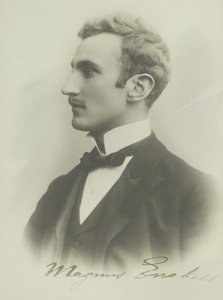
Magnus Enckell
1870 - 1925 , Finland
Trumpa informacija apie kūrėją
- Full Name: Knut Magnus Enckell
- Nationality: Finnish
- Date Of Birth: 1870
- Date Of Death: 1925
- Place Of Birth: Hämeenlinna, Finland
- Notable Artworks:
- Fantasia
- Midsummer Day Service in Lohja Church
- Boy with Skull
- Artistic Movement Or Style: Symbolism
Susiję straipsniai
The Subdued Palette: Emotional Resonance & Aesthetic Impact of Muted Tones in Art
Explore the captivating world of muted tones in art! Discover Tonalism's history, Whistler’s influence & how subtle color palettes evoke emotion. Find serene landscapes and expert advice for integrating these timeless pieces into your home with OriginalUniqueArt.

Akseli Gallen-Kallela: Shaping Finnish Identity Through National Romanticism & Symbolism
Explore the captivating world of Akseli Gallen-Kallela, Finland's iconic National Romantic painter. Discover his symbolic landscapes, Kalevala illustrations & lasting impact on Finnish identity. Expert analysis & high-quality reproductions at OriginalUniqueArt.
Albert Edelfelt: A Pioneer of Finnish Realism & International Impressionist Circles
Explore the life & work of Albert Edelfelt, a pioneering Finnish Realist painter who bridged Impressionism & national identity. Discover his masterpieces and lasting influence on art history.

The Subdued Palette: Exploring Emotional Resonance & Aesthetic Impact in Muted Artworks
Explore the power of muted colors in art! Discover the history, psychology & techniques behind serene palettes. Find inspiration & expert advice for creating emotionally resonant spaces with OriginalUniqueArt.
The Subdued Resonance: Exploring Emotional Depth & Artistic Nuance within Muted Color Palettes
Explore the captivating world of muted colors in art & design! Discover historical context, psychological effects, techniques, and inspiration for creating serene spaces. Elevate your aesthetic with OriginalUniqueArt.