
() ·
A painting made for you, by hand
Rankų darbo aliejinės reprodukcijos
Rankiniu būdu tapytas aliejus ant droblio jūsų pageidaujamame dydį ir rėmuose – tai mūsų menininkų pagal užsakymą sukurtas darbas. ( Perjungti į spausdinamus版作品 Perejti prie skaitmeninių vaizdų)
Kolekcinio objekto aprašas
Admire Josef Hoffmann’s ‘Chair - Nr. 511,’ a stunning Art Nouveau masterpiece! Hand-carved wood & woven cane create elegant comfort. Explore this unique 1901 design.
Autoriaus biografija
Josef Hoffmann (1870-1956) was a pioneering Austrian architect & designer of the Vienna Secession and Wiener Werkstätte. Known for Art Nouveau, geometric forms, functionalism, and his masterpiece, the Stoclet Palace. Explore his iconic furniture, gla
 Skaityti daugiau
from ·
Chapter 1
How large should it be?
Slide to change the size; the picture on the left shows the frame at its real width. The proportions of the original are kept.
Pasirinkite iš mūsų nustatytų dydžių, atitinkančių originalaus meno kūrinio proporcijas.

Įveskite jums reikiamą plotį ir aukštį, kad paveikslas atitiktų jūsų rėmą ar sieną. Kadangi šis darbas yra rankinio darbo, siekiant išgauti kitokios formos dydį, paveikslas gali būti šiek tiek didesnis (nuo kraštų bus palikta daugiau erdvės) arba mažesnis – pasirinkite jums patogiausią variantą. Prieš pradedant tapyti, atsiųsime jums skaitmeninį maketą patvirtinimui. Šioje puslapio nuotraukoje matomas vaizdas nėra galutinis rezultatas – jį parodys tik sukurtas maketas.
Chapter 2
How should it arrive?
Choose the edges of the stretched canvas
Choose your frame

White €1

Blurside €1

Extended €1

P118B €10

P118H €10

P118W €10

P438Z €10

P508JH €12

P508YH €12

P805H €10

P805Z €10

P919BZ €10

P919G €10

P919XJ €10

P959ZH €10

P968JZ €12

W106C €8

W218G €10

W218JH €8

W218Y €10

W307PJ €10

W316G €10

W316PJ €8

W316Y €10

W398PJ €8

W4111J €10

W500HY €15

W500JH €15

W692G €12

W849H €8

W940BG €15

W953PJ €8

H24-GOLD €30

H24-SILVER €30

H36-GOLD €45

H36-SILVER €45
Įrėmintas
Moulding: . Overall size with the frame: .
Chapter 3
Who paints it, and should anything change?
After order, OriginalUniqueArt.com team will email client for instructions and provide a mockup preview
Pristatymas visame pasaulyje () per 3–4 savaites, o ne įprastai – per 5 savaites. (31 spalis). Kokybė lieka nepakeičiama.
Chapter 4
The finishing touches
A nameplate, as in a museum?
Išgraviruotos bronzinės plokštelės detalės
This elegant plaque features the artist's name and the title of the artwork, finely engraved for a timeless presentation.
It is made from bronze with a refined, elegant finish. The text is precisely laser-engraved for a sharp and permanent result. Measuring 9x2 cm, the plaque is compact yet easy to read. It's built to be durable and scratch-resistant, offering a professional, museum-quality look. Mounting is simple thanks to the included adhesive backing.
Skaidrios akrilo plokštelės informacija
The plaque includes essential engraved details such as the artist's name, the title of the artwork, the date it was created, the type of media used-like oil on canvas or watercolor-a brief description of the piece, and a QR code that links to the complete artwork information.
It is crafted from clear acrylic, offering a sleek, modern appearance. The text is UV-engraved in black to ensure strong visual contrast. With a size of 10x15 cm, it ensures optimal readability. It comes equipped with two metal hooks for secure wall mounting. The plaque is designed to be weather-resistant, making it suitable for various environments, and it includes interactive features that work seamlessly with smartphone scanning.
Juodos akrilo plokštelės informacija
This elegant plaque includes engraved information such as the artist's name, the title of the artwork, the date it was created, the type of media used (like oil on canvas or watercolor), a short description of the artwork, and a QR code for quick access to more information.
The plaque itself is made from refined black acrylic with a premium finish. The text is laser-engraved in white for high contrast and readability. Its size is 10x15 cm, designed to be easy to read. It comes with two metal hooks for professional mounting. The design is sleek and fits any interior style. It is also weather-resistant and durable, with built-in digital integration for mobile compatibility.
A protective varnish?
When do you need it?
Chapter 5
Your painting, as you ordered it

Chair - Nr. 511
Reprodukcijos technika
Reprodukcijos matmenys
-

Aukščiausios klasės meistras
Daugiau detalių, meistriškumo ir papildomo gamybos laiko
-

Reprodukcijos rėmėjimo parinktys
-
-
Dėl meno kūrinių ar reprodukcijų, kurių bet kuri pusė yra didesnė nei 105 cm (apie 41 inch), rėmas bus siunčiamas kaip išskaidytas surinkimo rinkinys. Šis metodas užtikrina saugų pristatymą ir apsaugo nuo transportavimo metu galimos žalos.
Reikalingas profesionalus surinkimas – tai nėra „pasidaryk pats“ (DIY) produktas.
Rinkinys turi būti surinktas, o drobė išplėsta naudojant patyrį profesionalų rėmininką, medžio klijus (nėra įtraukti į rinkinį), drobės plėšimo kleslę bei presas, kad rėmo rėžiai išliktų tiesūs, kol klijai išdžiūvus. Netinkamas surinkimas arba netolydus drobės įtampa gali negrįžtamai sugadinti meno kūrinį, todėl šie atvejai nėra užtraukiami mūsų garantijos.
 Dėl meno kūrinių ar reprodukcijų, kurių bet kuri pusė yra didesnė nei 105 cm (apie 41 inch), rėmas bus siunčiamas kaip išskaidytas surinkimo rinkinys. Šis metodas užtikrina saugų pristatymą ir apsaugo nuo transportavimo metu galimos žalos.
Į komplektą įeina visi vientisos medienos elementai, tiksliai išpjauti pagal dydį.
Surmontinama naudojant pridėtus varžtus bei papildomai reikalingą medžio kliją kampų jungtims, kuris nėra pridėtas ir turi būti parinktas rėmininkui.
Reikalingi profesionalūs įrankiai, kurie nėra įtraukti į rinkinį: drobės kėlimo plytelės (stiprintuvai) ir klemiai, laikantys rėmo strygius tiesiu kampu, kol džiūsta lipas.
Svarbu:
Kampų jungtims reikalingi medžio klijai, barams reikia laikyti naudojant presas, kol klijai visiškai išdžiūvės, o surinktam rėmui įtempiamai privilgti būtinos drobės įtempimo plytযুক্ত. Šios priemonės į rinkinį neįtrauktos. Prieš užsakydami šio dydžio rinkinį, rekomenduojame pasimalkoti patyrusiu rėmų meistru.

Pavadinimo lentelė
-
-

Apsauginis lakas
Blizgus lakas (ryškina spalvas, saugo nuo šviesos ir drėgmės)
-

Personalizuoti kūrinį
Ką galima pakeisti (pavyzdžiui): pakeisti veidą klientui skirta nuotrauka; pridėti augintinį (pvz., katę pakeisti šuniu); įtraukti paslėptą žinutę fone; pakeisti fono kraštovaizdį ar elementus.
-

Skubiai
Pristatymas visame pasaulyje () per 3–4 savaites, o ne įprastai – per 5 savaites. (31 spalis). Kokybė lieka nepakeičiama.
-
Skubus pristatymas
Pristatymas visame pasaulyje () per 5 weeks. (7 lapkritis).
Įskaičiuota
Bendroji kaina
€ 267
Stiklo variantas prieinamas tik pasirinkus dydį iki 110 cm
Included with every order
- Nemokamas greitasis pristatymas visame pasaulyje
- Aukštos kokybės lininis drobė
- Pilnas siuntimo draudimas
- Muitinės mokesčių grąžinimo garantija
- Tikro spalvų atitikimo garantija
- 100 dienų grąžinimo politika (tik esant įtaigoms)
- 100% pinigų grąžinimo garantija
- Nuolaida dideliems užsakymams


 Peržiūrėti realaus dydžio版
 Pasidalinti
 Dalintis
 Išsamiau
 Vadovas

 Atsisiųsti
 Panašūs eksponatai
 Rentgeno spindulių nuotrauka
 Automatinė diorama
 Q&A
Q&A Statistika
In numbers
- 1901the year it was painted
- 29frames to choose from
- standard sizes, in its own proportions
- 5weeks to paint and deliver it
About the original

- 40.0 x 42.0 cm


Josef Maria Gustav Hoffmann
1870 - 1956, Croatia
Quick facts about Josef Maria Gustav Hoffmann
- Artistic Movement Or Style: Vienna Secession, Art Deco, Modernism
- Artists Or Movements Influenced By This Artist: ['Wiener Werkstätte']
- Date Of Birth: 1870
- Date Of Death: 1956
- Full Name: Josef Maria Gustav Hoffmann
- Nationality: Austrian-Moravian
- Notable Artworks: ['Stoclet Palace']
- Place Of Birth: Příbor, Croatia
Autoriaus biografija
The lines of a life in Moravia and Vienna
Born in Příbor, Croatia, in 1870, Josef Maria Gustav Hoffmann moved through a world shaped by the heavy textures of his father's textile factory. His early years in Brtnice/Pirnitz were far from the studios he would later inhabit. He sat in classrooms that felt like prisons, eventually finding a different kind of discipline at the Higher School of Arts and Crafts in Brno. By 1892, the focus had shifted to the Academy of Fine Arts Vienna. Under the guidance of Otto Wagner, his hands learned the weight of stone and the precision of a draft. He studied alongside Joseph Maria Olbrich, two figures who would soon look at the old ways of ornament and see something that needed to be stripped away.
The years following his return from Italy were marked by a search for a new language. In 1895, he joined a group known as the Siebener Club, a small gathering that would grow into the Vienna Secession. He did not seek to cover buildings in unnecessary layers of cement or molded shapes. Instead, he looked toward the idea of a harmonious ensemble. His work began to favor the square, the cube, and the stark contrast of black and white surfaces. These were forms he believed were intelligible to everyone.
The workshop and the object
In 1903, alongside Koloman Moser and Fritz Wärndorfer, Hoffmann helped establish the Wiener Werkstätte. This was a place where the boundaries between architecture and daily life blurred. He worked on everything from silver and furniture to bookbindings and textiles. His approach to a tea service, for instance, relied on the geometry of cubes and squares. Often, the only decoration present was the mark left by a hammer blow during the crafting process. In some pieces, small, colorful stones were set into these block-like shapes to break the austerity.
His touch extended to much smaller, more delicate surfaces as well. He designed vases for the glass manufactory Loetz that utilized the Biedermeier technique of Cameo glass. These objects featured layers of multi-colored glass, etched and engraved to reveal patterns of green leaves or vertical ribbons. In 1914, his designs for glass continued to reflect a sober taste, using polished geometric shapes that applied an architectural perspective to a handheld object. Even a chair from 1901, made of carved wood and woven cane, showed this same commitment to a unified aesthetic.
A legacy in stone and structure
Architecture remained the foundation of his practice. The Stoclet Palace in Brussels, built between 1905 and 1911, remains his most recognized structural achievement. It stands as a point where modern architecture and Art Deco meet, characterized by its lack of useless ornament. He also shaped the urban fabric of Vienna through projects like the Karlsplatz station and the design of exhibition spaces that housed the works of Gustav Klimt. His vision was often centered on the concept of the Gesamtkunstwerk, a total work of art where every element of an environment is designed by a single mind to create a unified living space.
Throughout his long career, which lasted until his death in 1956, Hoffmann remained a teacher and a practitioner. He taught at the Kunstgewerbeschule from 1899, passing on the importance of authenticity in materials and the unity of decor to new generations. His work was never about grand pronouncements but about the careful integration of architecture, furniture, and the objects of daily life.
Susiję straipsniai

Art Nouveau: The Elegant Fusion of Nature and Design – A Journey Through Organic Sophistication
Discover the exquisite world of Art Nouveau. Explore the elegant fusion of nature and design through architectural masterpieces, organic forms, and the legendary masters of the Belle Époque. Immerse yourself in a journey of timeless sophistication and ornamental beauty.
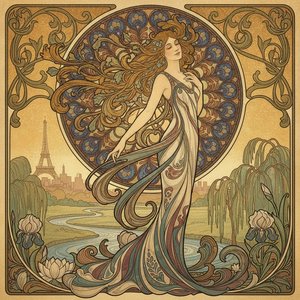
The Elegance of Art Nouveau: Embracing Nature's Fluid Beauty and the Belle Époque Spirit
Discover the enchanting world of Art Nouveau. Explore the organic beauty, flowing lines, and Belle Époque elegance that defined an era of unparalleled craftsmanship and natural inspiration.
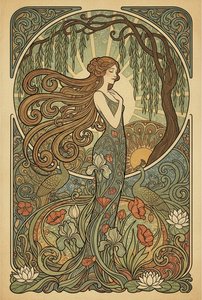
The Flowing Line & Flourishing Form: Exploring Art Nouveau's Aesthetic Legacy
Explore the captivating world of Art Nouveau! Discover its origins, key artists like Horta & Mucha, regional styles, innovative techniques, and lasting influence on architecture & design. A comprehensive guide for art enthusiasts.
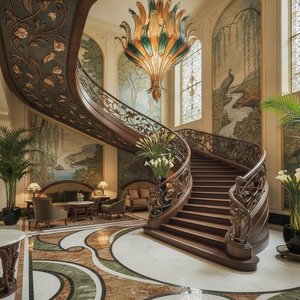
Art Nouveau Guide: Integrating Elegant Curves and Organic Design into Luxury Hotel Interiors
Master Art Nouveau integration for luxury hotel interiors. Discover expert strategies for utilizing organic curves, whiplash lines, and botanical motifs to create sophisticated, high-end hospitality spaces with scalable, professional art procurement solutions.