

 Peržiūrėti realybėje
 Pasidalinti
 Dalintis
 Išsamiau

 Atsisiųsti
 Panašūs eksponatai
 Rentgeno nuotrauka
 Automatinė diorama
Fruit

 Skaityti daugiau
Įsigykite aukštos skiriamosios raiškos, patobulintą skaitmeninį vaizdą, gerokai pranašesnį už internetinę peržiūrą.
Kiekvieną failą mūsų specialistai kruopščiai paruošia naudojant pažangias technologijas ir profesionalų rankinį retušavimą. Užtikriname, kad kiekvienas vaizdas pasižymėtų išskirtiniu aiškumu, tikslia spalvų atspalviu ir smulkiomis detalėmis.
Baigiamas failas el. paštu pristatomas per 72 valandas; jis optimizuotas nedelsiant naudojimui profesionalioje, redakcinėje ir spausdinimo aplinkoje. Tai ta pati kokybė, kuria pasitiki aukščiausios klasės dizaino studijos, leidyklos ir galerijos.
Skaitmeninis vaizdas
Atsisiųskite didelės raiškos failą asmeniniam naudojimui, spausdinimui ir kūrybiniams projektams. ( Pirkti spaudinį Pirkti rankomis tapytą paveikslą)
Kiekvieną skaitinio vaizdo užsakymą papildė
Profesionalus skaitmeninis pristatymas, garantuotas
Pasirinkę OriginalUniqueArt.com, jūs ne tik gaunate paveikslėlį – jūs gaunate profesionaliai patobudintą skaitmeninį kūrinį, sukurtą itin tikniai ir užtikrinantį pasitenkinimą. Štai viską, kas automatiškai pritékia jūsų užsakymui:

Greitas siuntimas el. paštu
Jūsų aukštos raiškos skaitmeninis vaizdo failas bus išsiųstas jums el. paštu per 72 valaudas nuo užsakymo – paruoštas naudojimui be jokių papildomų veiksmų.

Skaitmeninis failas su dirbtiniu intelektu
Jūsų meno kūrinys profesionaliai optimizuojamas naudojant pažangius dirbtinio intelekto įrankius ir rankinį redagavimą, užtikrinant maksimalią detalę, aiškumą ir spalvų tikslumą.

Nemokamas visam laikui pakartotinis siuntimas
Atsitiktinai ištrytikote ar praradote savo failą? Nebijokite – bet kuriuo metu atsiųsime jį jums vėl nemokamai.

Jokio importo mokesčio – niekada
Mėgaukitės savo meno kūriniu akimirka – skaitiniai failai visada yra neapmokestinami, todėl nereikės mokėti muitinės, mokesčių ar pristatymo mokesčių.

Spalvų tikslumo garantija
Naudodami profesionalią įrangą ir spalvų valdymo sistemas, užtikriname, kad jūsų skaitmeninis vaizdas kuo tiksliau atspindėtų originalias spalvas.

60 dienų pasitenkinimo garantija
Jei nebuvate patenkinti savo skaitinio vaizdo, per 60 dienų jį pertaisysime arba grąkinsime 100% sumą – be jokių klausimų.

100% pinigų grąžinimo garantija
Nepat 만족inti? Gaukite visą sumokėtą sumą per 60 dienų nuo skaitmeninio failo gavimo – be jokių papildomų klausimų.

Nuolaidos dideliems užsakymams
Pirkti 3 nuotraukas – pasiūla 10% - Pirkti 5 – pasiūla 15% - Pirkti 10 ir daugiau – pasiūla 20%. Puikiai tinka kūrybiniams projektams, galerijoms bei agentūroms.
Autoriaus biografija
Johann Wilhelm Preyer: Life and Legacy
Early Life and Education
- Born in Düsseldorf, Germany, in 1803, Johann Wilhelm Preyer emerged from a family with artistic inclinations. His father was a merchant, and his brother, Gustav, also pursued a career as a painter.
- Growing up in the old town of Eschweiler, Preyer displayed an early aptitude for art. A playful anecdote recounts how he and his brother, both small in stature, would occasionally disguise themselves as children to play pranks.
- Formal training began at the Düsseldorf Art Academy in 1822, where he studied under Peter von Cornelius. He later became a master student of Wilhelm von Schadow, solidifying his foundation in classical artistic principles.
Artistic Development and Influences
- Preyer’s education extended beyond Düsseldorf; he embarked on extensive travels throughout Europe between 1835 and 1843. These journeys took him to the Netherlands, Munich, Northern Italy, and Switzerland, exposing him to diverse artistic styles and traditions.
- Influences from Dutch still life masters are evident in his meticulous attention to detail and realistic depiction of textures. The Düsseldorf School’s emphasis on precise observation also shaped his approach.
- Upon returning to Düsseldorf in 1844, Preyer dedicated himself primarily to still life painting, establishing a reputation for exceptional skill within the genre.
Major Works and Artistic Style
- Specialization: Preyer became renowned for his exquisitely detailed paintings of flowers and fruit. His works are characterized by their vibrant colors, realistic textures, and careful compositions.
- Notable examples include “Fruit and a Goblet,” “Fruit Still Life with Sculpted Ceramic Bowl,” and numerous depictions of grapes and floral arrangements.
- His style is often associated with the Biedermeier period, reflecting a focus on domesticity, simplicity, and meticulous craftsmanship.
Achievements and Recognition
- Preyer quickly gained recognition as one of the leading still life painters of his time. His works were highly sought after by collectors, with a significant portion eventually finding their way into American collections.
- Founding Member: He was among the founding members of the Association of Düsseldorf Artists in 1844, demonstrating his commitment to fostering artistic community and collaboration.
- Preyer also took on private students, including Helen Searle, an American still life painter who further disseminated his techniques and influence.
Personal Life and Legacy
- Around 1844, Preyer married Emilie Lachenwitz, the sister of painter Siegmund Lachenwitz. They had two children, Emilie and Paul, both of whom also became painters, continuing the family’s artistic legacy.
- Historical Significance: Johann Wilhelm Preyer is considered one of the earliest masters of the Düsseldorf School of Painting and a pivotal figure in 19th-century German still life art.
- In recognition of his contributions, a road in Eschweiler, where he grew up, was renamed Preyerstrasse in 1974.
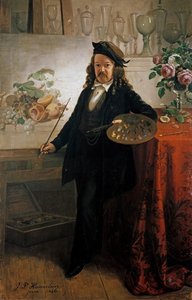
Johann Wilhelm Preyer
1803 - 1889 , Germany
Trumpai apie šį kūrėją
- Birth Date: 1803
- Birth Place: Düsseldorf, Germany
- Death Date: 1889
- Influenced By:
- Peter von Cornelius
- Wilhelm von Schadow
- Movement: Düsseldorf School of Painting
- Name: Johann Wilhelm Preyer
- Nationality: German
- Notable Works:
- Fruit and a Goblet
- Fruit Still life
- Flowers in a Jug

