Perjungti į spausdinamus版作品
 Skaityti daugiau







































 Dėl meno kūrinių ar reprodukcijų, kurių bet kuri pusė yra didesnė nei 105 cm (apie 41 inch), rėmas bus siunčiamas kaip išskaidytas surinkimo rinkinys. Šis metodas užtikrina saugų pristatymą ir apsaugo nuo transportavimo metu galimos žalos.


Introduction to Joan Miró and Abstract Art
Joan Miró (1893–1983) stands as a monumental figure in the annals of 20th-century art, an artist whose singular vision irrevocably altered the landscape of modern expression. Born in Barcelona during a period of profound artistic ferment—marked by the burgeoning Surrealist movement and the echoes of Cubism—Miró embarked on a journey characterized not merely by stylistic evolution but by an unwavering pursuit of inner realms, translating dreams, memories, and Catalan identity onto canvas with a visual language imbued with poetic nuance.
The Surrealist impulse, championed by André Breton and fellow artists, sought to liberate creativity from the constraints of rational thought, tapping into the subconscious mind as a source of inspiration. Miró embraced this ethos wholeheartedly, employing techniques like automatism—chance operations designed to bypass conscious control—to generate imagery rooted in spontaneous association. This approach yielded works that defy easy categorization, blending organic forms with geometric abstractions and conveying emotions that transcend literal representation.
His distinctive style is instantly recognizable: bold colors juxtaposed against simplified shapes, reminiscent of Matisse’s Fauvist paintings, yet infused with a uniquely Miróesque spirit. Recurring motifs—birds, insects, fantastical creatures—appear throughout his oeuvre, symbolizing freedom, metamorphosis, and the primal forces of nature. These images are not merely decorative; they embody complex psychological states and convey profound philosophical ideas.
Exploring the Artistic Style of Joan Miró
Miró’s artistic vocabulary is remarkably consistent across his prolific output. He favored a palette dominated by vibrant hues—yellows, reds, blues—creating canvases that pulsate with energy and luminosity. His brushstrokes are loose and expressive, conveying movement and texture without striving for photorealistic detail. This deliberate rejection of conventional realism reflects Miró’s belief in the primacy of feeling over observation.
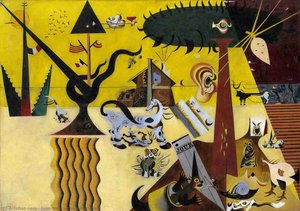
Consider Tirador in the Arc—a captivating piece that exemplifies Miró’s signature style. The central horse figure dominates the composition, its mane rendered in swirling brushstrokes of brilliant yellow and orange, capturing a sense of restless dynamism. Around its neck encircles a ribbon of crimson, adding a touch of theatrical color and hinting at themes of confinement and liberation.
The overall effect is one of dreamlike beauty—a visual meditation on the interplay between order and chaos, rationality and imagination. Miró’s art invites contemplation, prompting viewers to confront their own subconscious desires and anxieties while simultaneously appreciating the sublime grandeur of nature.
Historical Context and Significance
Miró's work emerged during a period of intense artistic experimentation—the aftermath of World War I and the rise of Surrealism—a time when artists sought to challenge established conventions and explore new frontiers of creative expression. Influenced by Cubist fragmentation and Dada nihilism, Miró nevertheless forged his own path, developing a distinctive visual language that resonated with audiences worldwide.
His paintings are housed in prestigious institutions such as the Fundació Joan Miró in Barcelona—a testament to his enduring legacy and a beacon for contemporary art—and the Rugby Art Gallery and Museum in the United Kingdom. These venues offer visitors the opportunity to immerse themselves in Miró’s artistic universe and appreciate the profound impact of his work on subsequent generations of artists.
To delve deeper into Miró's life and oeuvre, visit OriginalUniqueArt.com for comprehensive information and stunning reproductions of his celebrated paintings.
Klausimai ir atsakymai
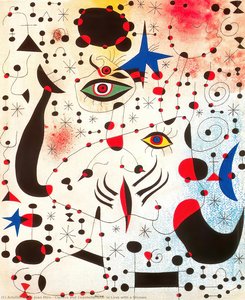
Kaip „Del libre Ruban de Michel Leiris“ spalvos dera vienas su kitu?
„Del libre Ruban de Michel Leiris“ – Žoanas Miro pasižymi Discordant Palette spalvų harmonija.
Kur turėtų būti pakabinta „Del libre Ruban de Michel Leiris“ – Žoanas Miro reprodukcija?
Savo Tall forma „Del libre Ruban de Michel Leiris“ reprodukcija siūloma Living Room kambariui.
Kaip atsisiųsti „Del libre Ruban de Michel Leiris“ – Žoanas Miro vaizdą?
„Del libre Ruban de Michel Leiris“ – Žoanas Miro galite atsisiųsti iš kūrinio Atsisiųsti skaitmeninį vaizdą puslapio kaip aukštos raiškos skaitmeninio vaizdo atsisiuntimas.
Daugiau informacijos apie šį paveikslą
 Peržiūrėti realaus dydžio版
 Pasidalinti
 Dalintis
 Išsamiau
 Vadovas

 Atsisiųsti
 Panašūs eksponatai
 Rentgeno spindulių nuotrauka
 Automatinė diorama
 问答
问答 Statistika